
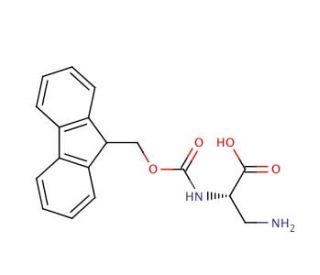

Structure moléculaire de Fmoc-Dap-OH, Numéro CAS: 181954-34-7
Fmoc-Dap-OH (CAS 181954-34-7)
Noms alternatifs:
Nα-Fmoc-L-2,3-diaminopropionic acid
Application(s):
Fmoc-Dap-OH est un composé protégé par Fmoc pour la recherche en protéomique
Numéro CAS:
181954-34-7
Masse Moléculaire:
326.35
Formule Moléculaire:
C18H18N2O4
Pour la Recherche Uniquement. Non conforme pour le Diagnostic ou pour une Utilisation Thérapeutique.
* Consulter le Certificat d'Analyses pour les données spécifiques à un lot (incluant la teneur en eau).
ACCÈS RAPIDE AUX LIENS
Informations pour la commande
Description
Information Technique
Données de Sécurité
SDS & Certificat d’Analyses
Le Fmoc-Dap-OH est un composé protégé par le Fmoc pour la recherche protéomique. Le Fmoc-Dap-OH est un dérivé d'acide aminé utilisé dans la synthèse des peptides et des protéines. Sa polyvalence en tant que réactif dans la synthèse organique en fait un composant clé dans les méthodes de synthèse peptidique, y compris la synthèse en phase solide, la synthèse en phase de solution et la ligature chimique native.
Fmoc-Dap-OH (CAS 181954-34-7) Références
- Synthèse et étude de peptides liés à des lactames à chaîne latérale. | Taylor, JW. 2002. Biopolymers. 66: 49-75. PMID: 12228920
- Analogues CCK8 conformationnellement contraints obtenus à partir d'une bibliothèque de peptides rationnellement conçus comme ligands du récepteur de la cholécystokinine de type B. | De Luca, S., et al. 2006. ChemMedChem. 1: 997-1006. PMID: 16915602
- Évaluation d'analogues structurellement diversifiés de la philanthotoxine pour leur activité inhibitrice sur les sous-types de récepteurs ionotropiques du glutamate: découverte d'antagonistes nanomolaires, non sélectifs et dépendants de l'utilisation. | Frølund, S., et al. 2010. J Med Chem. 53: 7441-51. PMID: 20873775
- Stratégie synthétique pour la mono-N-alkylation de la chaîne latérale des acides aminés Fmoc promue par des tamis moléculaires. | Monfregola, L. and De Luca, S. 2011. Amino Acids. 41: 981-90. PMID: 21069398
- Modulateurs TRPV1: relations structure-activité utilisant une approche combinatoire rationnelle. | Zaccaro, L., et al. 2011. Bioorg Med Chem Lett. 21: 3541-5. PMID: 21612926
- Élucidation de la contribution des interactions du site actif et de l'exosite à l'affinité et à la spécificité des inhibiteurs de protéases à sérine peptidique à l'aide d'analogues non naturels de l'arginine. | Hosseini, M., et al. 2011. Mol Pharmacol. 80: 585-97. PMID: 21719463
- Conception basée sur la structure d'inhibiteurs covalents de la Siah. | Stebbins, JL., et al. 2013. Chem Biol. 20: 973-82. PMID: 23891150
- Synthèse d'un précurseur azido de la (2S,5R)-5-hydroxylysine à l'aide d'une séquence organocatalytique asymétrique de chloration/réduction. | Johannes, M. and Brimble, MA. 2013. J Org Chem. 78: 12809-13. PMID: 24175670
- Détection sélective du pyrophosphate dans les milieux physiologiques à l'aide de peptides à fonction dipicolylamino de zinc(II). | Zwicker, VE., et al. 2015. Org Biomol Chem. 13: 7822-9. PMID: 26107804
- Conjugués médicamenteux stables et puissants à base de sélénomab. | Li, X., et al. 2017. Cell Chem Biol. 24: 433-442.e6. PMID: 28330604
- Synthèses diversifiées par combinaison de réactions CuAAC et INCIC stéréosélectives avec des peptides. | Wang, Y., et al. 2017. Chemistry. 23: 13869-13874. PMID: 28833706
- Inhibiteurs peptidiques modifiés de l'interaction protéine-protéine Keap1-Nrf2 incorporant des acides aminés non naturels. | Georgakopoulos, ND., et al. 2018. Chembiochem. 19: 1810-1816. PMID: 29927029
- Synthèse, activité antiproliférative et études de liaison à l'ADN de complexes Pt(II) contenant des acides nucléoamino. | Riccardi, C., et al. 2020. Pharmaceuticals (Basel). 13: PMID: 33007911
- Construction de diverses architectures structurelles peptidiques par ligature chimiosélective de peptides. | Cheung, CHP., et al. 2021. Chem Sci. 12: 7091-7097. PMID: 34123337
- Synthèse d'un dérivé peptidique MAGE-1 radio-iodé et photoréactif et marquage par photo-affinité de molécules d'antigènes de leucocytes humains-A1 associées à des cellules. | Anjuère, F., et al. 1995. Anal Biochem. 229: 61-7. PMID: 8533896
Informations pour la commande
| Nom du produit | Ref. Catalogue | COND. | Prix HT | QTÉ | Favoris | |
Fmoc-Dap-OH, 1 g | sc-228181 | 1 g | $103.00 |