
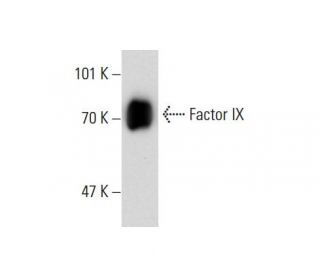

Factor IX Antibody (GMA-124): sc-65951
- Factor IX Antibody (GMA-124) is a mouse monoclonal IgG1 provided at 100 µg/ml
- raised against Factor IX of human origin, with epitope mapping to Factor IX light chain (residues 1-145)
- recommended for detection of Factor IX of human origin by WB and IP
- At present, we have not yet completed the identification of the preferred secondary detection reagent(s) for Factor IX Antibody (GMA-124). This work is in progress.

QUICK LINKS
SEE ALSO...
Factor IX Antibody (GMA-124) is a mouse monoclonal IgG1 antibody that detects coagulation factor IX in human samples through western blotting (WB) and immunoprecipitation (IP) applications. Factor IX, also known as plasma thromboplastic component, plays a crucial role in the blood coagulation cascade, which is essential for hemostasis following tissue injury. This vitamin K-dependent serine protease is synthesized in the liver and circulates as an inactive precursor until activated by factor XIa-mediated proteolytic cleavage, resulting in factor IXa. The active form consists of a 145 amino acid light chain and a 236 amino acid catalytic heavy chain, which are linked by disulfide bonds. Proper functioning of factor IX is vital, as deficiencies or genetic alterations at the Factor IX locus can lead to hemophilia B, a bleeding disorder characterized by an inability to form stable blood clots. Understanding the structure and activation mechanism of factor IX is important for developing therapeutic strategies for hemophilia and other coagulation disorders, making Factor IX (GMA-124) antibody an invaluable tool for researchers studying coagulation pathways and related diseases.
Alexa Fluor® is a trademark of Molecular Probes Inc., OR., USA
LI-COR® and Odyssey® are registered trademarks of LI-COR Biosciences
Factor IX Antibody (GMA-124) References:
- High levels of factor IX increase the risk of venous thrombosis. | van Hylckama Vlieg, A., et al. 2000. Blood. 95: 3678-82. PMID: 10845896
- Discontinuous residues of factor IX constitute a surface for binding the anti-factor IX monoclonal antibody A-5. | Chang, YJ., et al. 2003. Thromb Res. 111: 293-9. PMID: 14693178
- Factor XIa dimer in the activation of factor IX. | Sinha, D., et al. 2005. Biochemistry. 44: 10416-22. PMID: 16042419
- Factor IX oligomerization underlies reduced activity upon disruption of physiological conditions. | Simhadri, VL., et al. 2014. Haemophilia. 20: e157-63. PMID: 24417758
- Comparative interactions of factor IX and factor IXa with human platelets. | Ahmad, SS., et al. 1989. J Biol Chem. 264: 3244-51. PMID: 2492533
- Factor VIII influences binding of factor IX and factor X to intact human platelets. | Muntean, W. and Leschnik, B. 1989. Thromb Res. 55: 537-48. PMID: 2510357
- Population pharmacokinetics of plasma-derived factor IX: procedures for dose individualization. | Brekkan, A., et al. 2016. J Thromb Haemost. 14: 724-32. PMID: 26806557
- Ultrasound-targeted hepatic delivery of factor IX in hemophiliac mice. | Anderson, CD., et al. 2016. Gene Ther. 23: 510-9. PMID: 26960037
- Fusion of Factor IX to Factor XIII-B Sub-Unit Improves the Pharmacokinetic Profile of Factor IX. | Le Quellec, S., et al. 2018. Thromb Haemost. 118: 2053-2063. PMID: 30453348
- Characterization of recombinant factor IX fusion proteins enabling subcutaneous administration. | Schön, K., et al. 2024. J Thromb Haemost. 22: 2713-2723. PMID: 39019440
Ordering Information
| Product Name | Catalog # | UNIT | Price | Qty | FAVORITES | |
Factor IX Antibody (GMA-124) | sc-65951 | 100 µg/ml | $322.00 |