
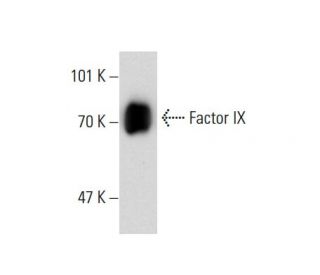

第IX因子抗体 (F9-1): sc-52800. ヒト遺伝子組換え第IX因子のウエスタンブロット解析.
Factor IX抗体(F9-1): sc-52800
- Factor IX抗体 (F9-1)はマウスモノクローナルIgG1 (kappa light chain)です。100 µg/mlで提供
- human由来のFactor IXに対応します
- human由来のFactor IX WB, IP と ELISAでの検出にはお勧めします
- 現在、Factor IX Antibody (F9-1)に適した二次検出試薬の同定はまだ完了していません。この研究は進めています。

クイックリンク
サポート品
説明
Gene情報
データシートとプロトコル
研究情報
関連項目
組織傷害後の止血には、必須血漿凝固促進因子(プロトロンビン、第X因子、第IX因子、第V因子、第VIII因子)が関与し、不溶性フィブリン凝血塊の形成と血小板凝集の促進をもたらす血液凝固カスケードに関与する。凝固第IX因子(血漿血栓形成成分、F9、F.IX、HEMB)はビタミンK依存性の一本鎖セリンプロテアーゼで、肝臓で合成され、不活性前駆体として循環している。第IX因子が第XIa因子を介してタンパク質分解切断されると、第IXa因子が生成される。第IXa因子は、ジスルフィド結合を介して結合した145アミノ酸の軽鎖と236アミノ酸の触媒性重鎖からなる活性型セリンプロテアーゼである。点突然変異、挿入、欠失などの第IX因子遺伝子座における遺伝的変化は、クリスマス病としても知られる血友病Bを引き起こす可能性がある。
試験・研究用以外には使用しないでください。 臨床及び体外診断には使用できません。
Alexa Fluor® はMolecular Probes Inc., OR., USAの商標です。
LI-COR® and Odyssey® はLI-COR Biosciencesの登録商標です。
Factor IX抗体(F9-1) 参考文献:
- 第IX因子γ-カルボキシグルタミン酸(Gla)ドメインは第IX因子と第XIa因子との相互作用に関与している。 | Aktimur, A., et al. 2003. J Biol Chem. 278: 7981-7. PMID: 12496253
- 第IX因子変異体が血友病Bに対する遺伝子治療の有効性を改善した。 | Schuettrumpf, J., et al. 2005. Blood. 105: 2316-23. PMID: 15550487
- 外傷性凝固障害に対する第IX因子複合体製剤。 | Joseph, B., et al. 2012. J Trauma Acute Care Surg. 72: 828-34. PMID: 22491593
- 自動プロトコールによる発色第IX因子測定法の評価。 | Kershaw, GW., et al. 2018. Haemophilia. 24: 492-501. PMID: 29488668
- 手術を受ける血友病B患者における第IX因子の母集団薬物動態。 | Preijers, T., et al. 2018. J Thromb Haemost. 16: 2196-2207. PMID: 30394056
- ヒト血清由来第IX因子における新規糖鎖付加事象の同定 | Pegg, CL., et al. 2020. Glycoconj J. 37: 471-483. PMID: 32378017
- 第IX因子p.A37V変異がフェンプロクーモン治療患者に重篤な出血を引き起こした。 | Mülling, N., et al. 2021. Eur J Med Res. 26: 63. PMID: 34187575
- 第IX因子の活性化を阻害するF9ミスセンス変異は、多面的な血漿表現型と関連している。 | Branchini, A., et al. 2022. J Thromb Haemost. 20: 69-81. PMID: 34626083
- ラジオイムノアッセイによる第IX因子抗原。ワルファリン治療中および血友病B患者における第IX因子蛋白の異常。 | Thompson, AR. 1977. J Clin Invest. 59: 900-10. PMID: 856873
- 第XIa因子による第IX因子の活性化は遊離中間体を放出することなく進行する。 | Wolberg, AS., et al. 1997. Biochemistry. 36: 4074-9. PMID: 9100000
注文情報
| 製品名 | カタログ # | 単位 | 価格 | 数量 | お気に入り | |
Factor IX 抗体 (F9-1) | sc-52800 | 100 µg/ml | $322.00 |