
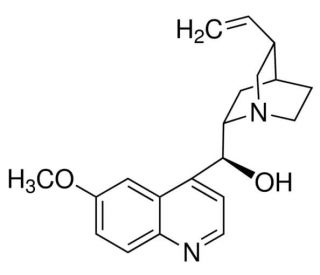

Epiquinine (CAS 572-60-1)
QUICK LINKS
Epiquinine is a stereoisomer of quinine, distinguished by its unique spatial arrangement of atoms, which imparts different chemical and physical properties compared to its more famous counterpart. In scientific research, epiquinine has been primarily explored for its potential as a chiral catalyst and its utility in stereoselective synthesis. Its role in these contexts is vital for the development of asymmetric synthesis methods, which are crucial in the creation of enantiomerically pure substances used in various biochemical applications. The study of epiquinine′s mechanisms of action has highlighted its ability to influence stereochemical outcomes in organic reactions. For example, researchers have investigated its use in the catalysis of Michael additions, where its stereochemical configuration significantly affects the enantioselectivity of the reaction. This provides valuable insights into the relationship between molecular structure and catalytic activity, which is fundamental in the field of organic chemistry. Additionally, epiquinine has served as a tool in probing the stereoselective interactions of molecules, which is important for understanding the fundamental principles of chirality and its implications in molecular recognition processes. These studies contribute to a broader understanding of chemical interactions at the molecular level, paving the way for advanced research in chemical synthesis and catalysis.
Epiquinine (CAS 572-60-1) References
- Inhibition of the peroxidative degradation of haem as the basis of action of chloroquine and other quinoline antimalarials. | Loria, P., et al. 1999. Biochem J. 339 (Pt 2): 363-70. PMID: 10191268
- Enantioselective anion exchangers based on cinchona alkaloid-derived carbamates: influence of C8/C9 stereochemistry on chiral recognition. | Maier, NM., et al. 1999. Chirality. 11: 522-8. PMID: 10423277
- Conformational spaces of Cinchona alkaloids. | Caner, H., et al. 2003. Chirality. 15: 637-45. PMID: 12840830
- Rabe rest in peace: confirmation of the rabe-kindler conversion of D-quinotoxine into quinine: experimental affirmation of the Woodward-Doering formal total synthesis of quinine. | Smith, AC. and Williams, RM. 2008. Angew Chem Int Ed Engl. 47: 1736-40. PMID: 18236503
- Examination of quinidine and quinine and their pharmaceutical preparations. | Smith, E., et al. 1973. J Pharm Sci. 62: 1151-5. PMID: 4714123
- A facile synthesis of quinine and related cinchona alkaloids. | Taylor, EC. and Martin, SF. 1972. J Am Chem Soc. 94: 6218-20. PMID: 5054415
- Analysis of Cinchona alkaloids by high-performance liquid chromatography. Application to the analysis of quinidine gluconate and quinidine sulfate and their dosage forms. | Smith, E. 1984. J Chromatogr. 299: 233-44. PMID: 6490780
- Conformational analysis of epiquinine and epiquinidine | Silva, T. H., Oliveira, A. B., Dos Santos, H. F., & De Almeida, W. B. 2001. Structural Chemistry. 12: 431-437.
Ordering Information
| Product Name | Catalog # | UNIT | Price | Qty | FAVORITES | |
Epiquinine, 50 mg | sc-460772 | 50 mg | $286.00 |