
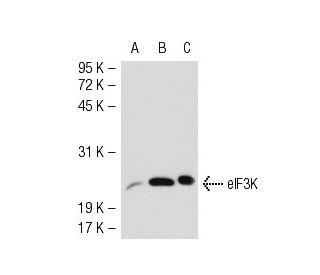


eIF3K Antibody (2313C2a): sc-81262
- eIF3K Antibody (2313C2a) is a mouse monoclonal IgG2b, cited in 1 publications, provided at 100 µg/ml
- raised against a recombinant protein corresponding to an internal region of eIF3K of human origin
- recommended for detection of eIF3K of mouse, rat and human origin by WB and IP
- At present, we have not yet completed the identification of the preferred secondary detection reagent(s) for eIF3K Antibody (2313C2a). This work is in progress.

eIF3K Antibody (2313C2a) is a mouse monoclonal IgG2b antibody that detects eIF3K in mouse, rat, and human samples through western blotting (WB) and immunoprecipitation (IP) applications. eIF3K, or Eukaryotic translation initiation factor 3 subunit K, plays a crucial role in the initiation of protein synthesis, which is essential for cellular function and growth. As the smallest subunit of the eIF3 complex, eIF3K is integral to the formation of the 40S initiation complex, facilitating the binding of methionyl-tRNAi and mRNA to the ribosome. This process is vital for the accurate translation of mRNA into proteins, impacting various cellular processes, including cell proliferation and differentiation. eIF3K is highly conserved across high eukaryotes, indicating its fundamental importance in cellular biology, and is ubiquitously expressed in human tissues, with notable localization in both the nucleus and cytoplasm. eIF3K′s interaction with other eIF3 subunits and colocalization with cyclin D3, a key regulator of the cell cycle, further underscore eIF3K′s significance in coordinating translation and cell cycle progression. anti-eIF3K antibody (2313C2a) is an invaluable tool for researchers studying translation initiation and its implications in various biological processes and diseases.
Alexa Fluor® is a trademark of Molecular Probes Inc., OR., USA
LI-COR® and Odyssey® are registered trademarks of LI-COR Biosciences
eIF3K Antibody (2313C2a) References:
- Characterization of eIF3k: a newly discovered subunit of mammalian translation initiation factor elF3. | Mayeur, GL., et al. 2003. Eur J Biochem. 270: 4133-9. PMID: 14519125
- Crystal structure of human eIF3k, the first structure of eIF3 subunits. | Wei, Z., et al. 2004. J Biol Chem. 279: 34983-90. PMID: 15180986
- Identification of the p28 subunit of eukaryotic initiation factor 3(eIF3k) as a new interaction partner of cyclin D3. | Shen, X., et al. 2004. FEBS Lett. 573: 139-46. PMID: 15327989
- Novel interaction between the human 5-HT7 receptor isoforms and PLAC-24/eIF3k. | De Martelaere, K., et al. 2007. Cell Signal. 19: 278-88. PMID: 16935469
- eIF3k regulates apoptosis in epithelial cells by releasing caspase 3 from keratin-containing inclusions. | Lin, YM., et al. 2008. J Cell Sci. 121: 2382-93. PMID: 18577580
- The translation initiation factor 3 subunit eIF3K interacts with PML and associates with PML nuclear bodies. | Salsman, J., et al. 2013. Exp Cell Res. 319: 2554-65. PMID: 24036361
- Neisseria gonorrhoeae-induced salpingitis is targeted by circular RNA EIF3K via miR-139-5p and regulating MAPK/NF-κB signaling pathway to promotes apoptosis and autophagy bacterial cells. | Yao, L., et al. 2020. Microb Pathog. 142: 104051. PMID: 32045642
- New Proteins Contributing to Immune Cell Infiltration and Pannus Formation of Synovial Membrane from Arthritis Diseases. | de Seny, D., et al. 2021. Int J Mol Sci. 23: PMID: 35008858
- Comparative systeomics to elucidate physiological differences between CHO and SP2/0 cell lines. | Demirhan, D., et al. 2022. Sci Rep. 12: 3280. PMID: 35228567
- eIF3 mRNA selectivity profiling reveals eIF3k as a cancer-relevant regulator of ribosome content. | Duan, H., et al. 2023. EMBO J. 42: e112362. PMID: 37155573
Ordering Information
| Product Name | Catalog # | UNIT | Price | Qty | FAVORITES | |
eIF3K Antibody (2313C2a) | sc-81262 | 100 µg/ml | $339.00 |