
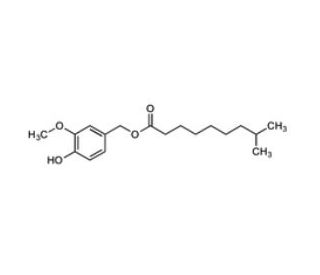

Dihydrocapsiate (CAS 205687-03-2)
ACCÈS RAPIDE AUX LIENS
Le dihydrocapsiate est un composé présent dans les piments qui est couramment utilisé dans les recherches sur le métabolisme et la dépense énergétique. Il est structurellement apparenté à la capsaïcine mais n'est pas piquant, ce qui en fait un sujet d'intérêt dans les études portant sur les effets des capsinoïdes sur l'oxydation des graisses et la thermogenèse. Dans la recherche nutritionnelle, le dihydrocapsiate est examiné pour son potentiel à affecter le taux métabolique. En outre, il est utilisé dans des études explorant la régulation du métabolisme des lipides et les mécanismes par lesquels les composés alimentaires peuvent influencer les voies métaboliques. La recherche sur le dihydrocapsiate porte également sur son rôle dans l'activation des canaux TRP (transient receptor potential), qui sont impliqués dans la détection de la température et de la saveur.
Dihydrocapsiate (CAS 205687-03-2) Références
- Synthèse enzymatique d'un capsinoïde par acylation de l'alcool vanillylique avec des dérivés d'acides gras catalysés par des lipases. | Kobata, K., et al. 2002. Biosci Biotechnol Biochem. 66: 319-27. PMID: 11999404
- Études du potentiel toxicologique des capsinoïdes: V. Études de génotoxicité du dihydrocapsiate. | Bernard, BK., et al. 2008. Int J Toxicol. 27 Suppl 3: 59-72. PMID: 19037799
- Études du potentiel toxicologique des capsinoïdes: VI. Étude de toxicité à dose unique et test du micronoyau du dihydrocapsiate de qualité commerciale. | Watanabe, E., et al. 2008. Int J Toxicol. 27 Suppl 3: 73-7. PMID: 19037800
- Études du potentiel toxicologique des capsinoïdes: VIII. Étude de toxicité de 13 semaines du dihydrocapsiate de qualité commerciale chez le rat. | Watanabe, E., et al. 2008. Int J Toxicol. 27 Suppl 3: 101-18. PMID: 19037802
- Études du potentiel toxicologique des capsinoïdes: IX. Études tératologiques du dihydrocapsiate chez le rat et le lapin. | Bernard, BK., et al. 2008. Int J Toxicol. 27 Suppl 3: 119-36. PMID: 19037803
- Détermination des capsinoïdes par HPLC-DAD dans les espèces de capsicum. | Singh, S., et al. 2009. J Agric Food Chem. 57: 3452-7. PMID: 19415923
- Évaluation de la similarité biologique de trois analogues de la capsaïcine (Capsinoïdes) trouvés dans les fruits du piment non piquant (CH-19 Sweet). | Sasahara, I., et al. 2010. Biosci Biotechnol Biochem. 74: 274-8. PMID: 20139632
- Études du potentiel toxicologique des capsinoïdes XIV: une étude de toxicité par gavage de 26 semaines du dihydrocapsiate chez le rat. | Kodama, T., et al. 2010. Int J Toxicol. 29: 27S-54S. PMID: 20388822
- Effets du dihydrocapsiate sur la thermogenèse adaptative et induite par un régime alimentaire riche en protéines et très pauvre en calories: un essai de contrôle randomisé. | Lee, TA., et al. 2010. Nutr Metab (Lond). 7: 78. PMID: 20925950
- Relation entre la longueur de la chaîne acyle des analogues du paradol et leur activité anti-obésité après ingestion orale. | Haratake, A., et al. 2014. J Agric Food Chem. 62: 6166-74. PMID: 24909840
- Production pratique à grande échelle de dihydrocapsiate, une substance non piquante de type capsaïcinoïde. | Kurosawa, W., et al. 2017. Biosci Biotechnol Biochem. 81: 211-221. PMID: 27838955
- Le dihydrocapsiate améliore les déficiences associées à l'âge chez les souris en augmentant la dépense énergétique. | Ohyama, K. and Suzuki, K. 2017. Am J Physiol Endocrinol Metab. 313: E586-E597. PMID: 28811294
- Un mélange thermogénique, seul ou en combinaison avec un supplément de protéines de lactosérum, stimule le métabolisme des graisses et améliore la composition corporelle chez la souris. | Vieira-Brock, PL., et al. 2018. Pharmacognosy Res. 10: 37-43. PMID: 29568185
- La supplémentation en dihydrocapsiate prévient l'adiposité, la stéatose hépatique, l'intolérance au glucose et les altérations morphologiques de l'intestin induites par un régime riche en graisses chez les souris. | Baboota, RK., et al. 2018. Nutr Res. 51: 40-56. PMID: 29673543
- Quantification du capsiate et du dihydrocapsiate et identification provisoire de capsinoïdes mineurs dans les fruits du poivron (Capsicum spp.) par HPLC-ESI-MS/MS (QTOF). | Fayos, O., et al. 2019. Food Chem. 270: 264-272. PMID: 30174045
Informations pour la commande
| Nom du produit | Ref. Catalogue | COND. | Prix HT | QTÉ | Favoris | |
Dihydrocapsiate, 10 mg | sc-500977 | 10 mg | $306.00 |