
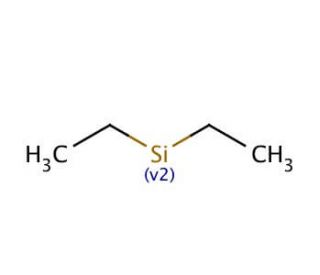

Diethylsilane (CAS 542-91-6)
QUICK LINKS
Diethylsilane is a reducing agent in various chemical reactions. It acts as a source of silicon in the synthesis of organosilicon compounds, participating in hydrosilylation reactions to form carbon-silicon bonds. Diethylsilane′s mechanism of action involves the transfer of a hydride ion to a substrate, facilitating the reduction of functional groups such as carbonyls and olefins. Diethylsilane plays a role in the production of silicon-containing materials and serves as a precursor in the preparation of silicon-based polymers and coatings. Diethylsilane interacts at the molecular level, participating in hydrosilylation reactions to modify the structure of organic compounds. Its function as a reducing agent allows for the manipulation of chemical structures and the synthesis of diverse silicon-containing compounds for development purposes.
Diethylsilane (CAS 542-91-6) References
- Solid-phase, Pd-catalyzed silicon-aryl carbon bond formation. Synthesis of sansalvamide A peptide. | Gu, W., et al. 2002. Org Lett. 4: 4171-4. PMID: 12423114
- DOTTADs--readily made novel metal ligands with multivariant functionality. | Arany, A., et al. 2003. Org Biomol Chem. 1: 1545-51. PMID: 12926285
- Dihydrogen Activation by Titanium Sulfide Complexes. | Sweeney, ZK., et al. 1999. Organometallics. 18: 5502-5510. PMID: 16633550
- Rotational spectra and conformational analysis of diethylsilane and diethyldifluorosilane. | Peebles, SA., et al. 2009. J Phys Chem A. 113: 3137-42. PMID: 19243160
- Development and mechanistic investigation of a highly efficient iridium(V) silyl complex for the reduction of tertiary amides to amines. | Park, S. and Brookhart, M. 2012. J Am Chem Soc. 134: 640-53. PMID: 22091749
- Iridium-catalyzed reduction of secondary amides to secondary amines and imines by diethylsilane. | Cheng, C. and Brookhart, M. 2012. J Am Chem Soc. 134: 11304-7. PMID: 22770123
- Metal-free deoxygenation of carbohydrates. | Adduci, LL., et al. 2014. Angew Chem Int Ed Engl. 53: 1646-9. PMID: 24492972
- Iridium-catalyzed regioselective silylation of secondary alkyl C-H bonds for the synthesis of 1,3-diols. | Li, B., et al. 2014. J Am Chem Soc. 136: 6586-9. PMID: 24734777
- Iridium-catalyzed regioselective silylation of aromatic and benzylic C-H bonds directed by a secondary amine. | Li, Q., et al. 2014. Angew Chem Int Ed Engl. 53: 8471-4. PMID: 24962972
- Rhodium-Catalyzed Enantioselective Silylation of Cyclopropyl C-H Bonds. | Lee, T. and Hartwig, JF. 2016. Angew Chem Int Ed Engl. 55: 8723-7. PMID: 27253898
- Rhodium-Catalyzed Regioselective Silylation of Alkyl C-H Bonds for the Synthesis of 1,4-Diols. | Karmel, C., et al. 2018. J Am Chem Soc. 140: 1460-1470. PMID: 29293327
- Cobalt-catalysed selective synthesis of aldehydes and alcohols from esters. | Pattanaik, S. and Gunanathan, C. 2020. Chem Commun (Camb). 56: 7345-7348. PMID: 32484179
- Catalyst- and Silane-Controlled Enantioselective Hydrofunctionalization of Alkenes by Cobalt-Catalyzed Hydrogen Atom Transfer and Radical-Polar Crossover. | Ebisawa, K., et al. 2020. J Am Chem Soc. 142: 13481-13490. PMID: 32648757
Ordering Information
| Product Name | Catalog # | UNIT | Price | Qty | FAVORITES | |
Diethylsilane, 5 ml | sc-257346 | 5 ml | $77.00 |