
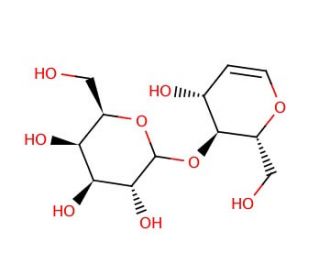

D-Lactal 의 분자 구조, CAS 번호: 65207-55-8
D-Lactal (CAS 65207-55-8)
CAS 등록번호:
65207-55-8
분자량:
308.28
분자식:
C12H20O9
연구용으로만 사용가능합니다. 진단이나 치료용으로 사용불가합니다.
* 참조분석증명서대량의 측정 데이터(함수량포함).
빠른 링크
주문정보
설명
기술정보
안전정보
SDS 및 분석 증명서
D-글루콘산 δ-락톤으로도 알려진 D-락탈은 글루콘산에서 형성된 고리형 에스테르입니다. 이 물질의 특성과 다양한 응용 분야로 인해 생화학 및 화학 연구에서 중요한 역할을 합니다. 주요 작용 메커니즘은 수용액에서 가수분해되어 펜토오스 인산염 경로를 포함한 다양한 대사 경로에서 중요한 중간체 역할을 하는 글루콘산을 생성하는 것입니다. 이 가수분해 반응은 pH에 따라 달라지므로 산-염기 화학 및 동역학을 연구하는 데 유용한 모델을 제공합니다. 연구에서 D-Lactal은 포도당을 글루코노락톤으로 산화시킨 다음 글루콘산으로 산화시키는 글루코노락토나제와 글루코스 옥시다아제의 효소 활성을 조사하는 데 활용됩니다. 이러한 연구는 탄수화물 대사와 에너지 생산에 관련된 생화학적 경로를 이해하는 데 매우 중요합니다. 또한 D-락탈은 바이오 센서와 바이오 연료 전지를 개발하기 위한 기질로 사용되며, 산화를 통해 측정 가능한 전기 신호 또는 전력 출력을 생성합니다. 또한 다양한 산업 응용 분야에서 중요한 글루코네이트 유도체의 화학 합성 연구에도 사용됩니다. 금속 이온과의 착화 반응에서의 역할은 효율적인 금속 킬레이터를 개발하고 금속-리간드 상호 작용을 이해하기 위해 탐구됩니다. 전반적으로 D-Lactal은 효소학, 대사 경로 및 화학 합성 연구를 발전시키는 데 중요한 화합물로, 기본적인 생화학 과정과 실용적인 응용 분야에 대한 통찰력을 제공합니다.
D-Lactal (CAS 65207-55-8) 참고자료
- 아세틸화된 글리칼 및 트리클로로 에톡시 설폰 아미드를 사용한 알코올의 편리한 입체 제어 아미도글리코실화. | Murakami, T., et al. 2016. Carbohydr Res. 434: 121-131. PMID: 27639338
- 글리칼형 기질에서 방향성 Pd 촉매를 이용한 C-아릴/알케닐글리코시드에 대한 이성질체 위치의 C-H 기능화를 통해 접근합니다. | de Robichon, M., et al. 2019. Chem Commun (Camb). 55: 11806-11808. PMID: 31532405
- 팔라듐(ii)-촉매를 이용한 글리칼에서 디아릴리오도늄 염을 이용한 C-배당체의 입체 선택적 합성. | Pal, KB., et al. 2020. Org Biomol Chem. 18: 2242-2251. PMID: 32159571
- 팔라듐 촉매 C(sp3)/C(sp2)-H 결합 기능화의 최근 발전: C-분지 배당체에 대한 접근. | Azeem, Z. and Mandal, PK. 2022. Org Biomol Chem. 20: 264-281. PMID: 34904995
- 리슈마니아 균의 리포포글리칸 관련 βGal(1,4)만 이당류를 합성하기 위한 페리어 글리코실화/시스-디하이드록실화 전략. | Budhathoki, D., et al. 2022. RSC Adv. 12: 28207-28216. PMID: 36320230
- 크로몬 C-배당체의 Pd 촉매 입체 선택적 합성. | Sharma, MK., et al. 2024. Chem Commun (Camb). 60: 4838-4841. PMID: 38619439
- 전이 진행의 특정 결정 요인인 gal-α-(1→ 3)-gal-β-(1→ 4)-GlcNAc 에피토프의 종양 관련 항원 합성은? | Schaubach, Regine, et al. 1991. Liebigs Annalen der Chemie. 1991.7: 607-614.
- 원생동물 리슈마니아 주요 기생충의 항원 분지 포스포글리칸에 대한 간편하고 새로운 경로. | Ruhela, Dipali and Ram A. Vishwakarma. 2004. Tetrahedron letters. 45.12: 2589-2592.
- 유기 합성의 글리칼: 흔하지 않은 피페리딘 1, 2-디데옥시-l-아자당 및 2-데옥시-1, 5-안하이드로-l-헥시톨의 제조를 위한 체계적 전략. | Ciliberti, Elena, et al. 2007. EurJOC. Volume 2007, Issue 9: 1463-1473.
- 구리 매개 요오드 아세톡실화 및 글리코실화: 2-데옥시-2-요오도 배당체의 입체 선택적 합성을 위한 효과적이고 편리한 접근법. | Battina, Suresh Kumar and Sudhir Kashyap. 2016. Tetrahedron Letters. 57.7: 811-814.
주문정보
| 제품명 | 카탈로그 번호 | 단위 | 가격 | 수량 | 관심품목 | |
D-Lactal, 100 mg | sc-257289 | 100 mg | $108.00 |