
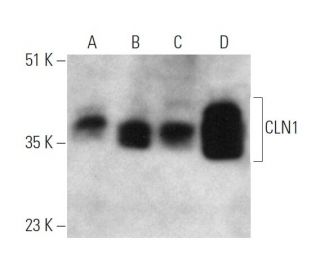

CLN1 Antibody (1117CT11.2.1.4): sc-517323
- CLN1 Antibody (1117CT11.2.1.4) is a mouse monoclonal IgG1 CLN1 antibody, cited in 1 publications, provided at 100 µg/ml
- raised against a recombinant protein corresponding to CLN1 of human origin
- recommended for detection of CLN1 of human origin by WB, IP, IF, IHC(P) and FCM
- At present, we have not yet completed the identification of the preferred secondary detection reagent(s) for CLN1 Antibody (1117CT11.2.1.4). This work is in progress.

QUICK LINKS
CLN1 Antibody (1117CT11.2.1.4) is a mouse monoclonal IgG1 antibody that detects CLN1 of human origin by western blotting (WB), immunoprecipitation (IP), immunofluorescence (IF), immunohistochemistry with paraffin-embedded sections (IHCP), and flow cytometry (FCM). Anti-CLN1 antibody (1117CT11.2.1.4) is available as a non-conjugated format. CLN1, also known as palmitoyl-protein thioesterase 1 (PPT1), is a 306 amino acid glycosylated protein primarily localized to the lysosome, where CLN1 plays a crucial role in substrate degradation. CLN1 functions to hydrolyze thioester-linked fatty acyl groups from modified cysteine residues in proteins or peptides, a process vital for maintaining cellular homeostasis and preventing toxic metabolite accumulation. Deficiencies in CLN1 lead to severe neurodegenerative disorders, including infantile neuronal ceroid lipofuscinosis 1 (INCL) and neuronal ceroid lipofuscinosis 4 (CLN4), both characterized by progressive accumulation of autofluorescent liposomal material within cells. These conditions manifest clinically with symptoms such as seizures, dementia, visual impairment, and cerebral atrophy, underscoring CLN1′s importance in neuronal health and function.
Alexa Fluor® is a trademark of Molecular Probes Inc., OR., USA
LI-COR® and Odyssey® are registered trademarks of LI-COR Biosciences
CLN1 Antibody (1117CT11.2.1.4) References:
- Adult neuronal ceroid lipofuscinosis with palmitoyl-protein thioesterase deficiency: first adult-onset patients of a childhood disease. | van Diggelen, OP., et al. 2001. Ann Neurol. 50: 269-72. PMID: 11506414
- Disruption of PPT1 or PPT2 causes neuronal ceroid lipofuscinosis in knockout mice. | Gupta, P., et al. 2001. Proc Natl Acad Sci U S A. 98: 13566-71. PMID: 11717424
- [From gene to disease; from CLN1, CLN2 and CLN3 to neuronal ceroid lipofuscinosis]. | Taschner, PE., et al. 2005. Ned Tijdschr Geneeskd. 149: 300-3. PMID: 15730038
- Overexpression in colorectal carcinoma of two lysosomal enzymes, CLN2 and CLN1, involved in neuronal ceroid lipofuscinosis. | Tsukamoto, T., et al. 2006. Cancer. 106: 1489-97. PMID: 16518810
- An integrated strategy for the diagnosis of neuronal ceroid lipofuscinosis types 1 (CLN1) and 2 (CLN2) in eleven Latin American patients. | Kohan, R., et al. 2009. Clin Genet. 76: 372-82. PMID: 19793312
- Structural basis of neuronal ceroid lipofuscinosis 1. | Ohno, K., et al. 2010. Brain Dev. 32: 524-30. PMID: 19793631
- Mutations in the palmitoyl protein thioesterase gene causing infantile neuronal ceroid lipofuscinosis. | Vesa, J., et al. 1995. Nature. 376: 584-7. PMID: 7637805
- Didemnin binds to the protein palmitoyl thioesterase responsible for infantile neuronal ceroid lipofuscinosis. | Crews, CM., et al. 1996. Proc Natl Acad Sci U S A. 93: 4316-9. PMID: 8633062
- cDNA and genomic cloning of human palmitoyl-protein thioesterase (PPT), the enzyme defective in infantile neuronal ceroid lipofuscinosis. | Schriner, JE., et al. 1996. Genomics. 34: 317-22. PMID: 8786130
Ordering Information
| Product Name | Catalog # | UNIT | Price | Qty | FAVORITES | |
CLN1 Antibody (1117CT11.2.1.4) | sc-517323 | 100 µg/ml | $322.00 |