
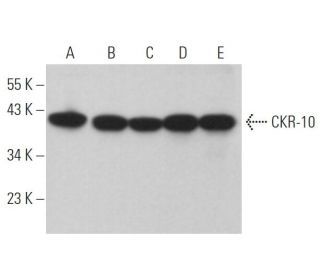
Not CRISPR data: the image illustrates antibody quality for visualizing CRISPR experiment results.
Not CRISPR data: the image illustrates antibody quality for visualizing CRISPR experiment results.
CKR-10 Plasmide KO CRISPR/Cas9 (h): sc-407896
- Specie Target: human
- 20 µg di DNA plasmidico purificato, pronto per trasfezione; sufficiente fino a 20 trasfezioni
- CKR-10 Il plasmide CRISPR/Cas9 Knockout (KO) (h) è un pool di plasmidi, ciascuno dei quali codifica la nucleasi Cas9 e un RNA guida (gRNA) specifico per il bersaglio di 20 nt, progettato per la massima efficienza di knockout utilizzando sequenze derivate dalla libreria GeCKO v2
- Le sequenze gRNA indirizzano Cas9 a indurre rotture a doppio filamento (DSB) sito-specifiche nel locus genomico CKR-10, con conseguente knockout genico tramite giunzione non omologa (NHEJ)
- I geni di resistenza alla puromicina e RFP sono fiancheggiati da siti LoxP, consentendo la rimozione dei marcatori di selezione tramite la ricombinasi Cre (Cre Vector: sc-418923) dopo aver stabilito linee cellulari knockout stabili
- In seguito alla trasfezione, l'efficienza dll'attivazione genica può essere testata con WB, IF o IHC utilizzando l'anticorpo: CKR-10 Antibody (E-2): sc-365957

Informazioni ordini
| Nome del prodotto | Codice del prodotto | UNITÀ | Prezzo | Quantità | Preferiti | |
CKR-10 Plasmide KO CRISPR/Cas9 (h) | sc-407896 | 20 µg | $397.00 |
Panoramica
CCR10 codifica per il recettore delle chemochine CKR-10, un GPCR a sette domini transmembrana che lega i ligandi CCL27 e CCL28 per guidare la chemiotassi dei leucociti e l’homing tessuto-specifico. La segnalazione di CKR-10 coinvolge proteine G eterotrimeriche per regolare i flussi di calcio, le vie dipendenti da MAPK e PI3K, l’attivazione delle integrine e il rimodellamento del citoscheletro, che nel loro insieme determinano la migrazione cellulare e il posizionamento alle barriere epiteliali. Questo recettore è implicato nella sorveglianza immunitaria e nei programmi di traffico infiammatorio nella cute e nei tessuti mucosali, dove un’attività alterata di CCR10 può modificare la composizione locale delle cellule immunitarie. Reti di chemochine associate a CCR10 deregolate sono state studiate nel contesto dell’infiammazione cronica e della biologia del microambiente tumorale, a supporto della sua rilevanza come nodo meccanicistico per ricerche focalizzate sulla migrazione.
Il plasmide CRISPR/Cas9 KO CKR-10 (h) è un pool di plasmidi progettato per la distruzione mirata del gene CCR10 in linee cellulari human. Ciascun plasmide co-esprime un singolo RNA guida (sgRNA) unico che prende di mira un sito distinto all'interno del CCR10 insieme alla nucleasi Cas9 di Streptococcus pyogenes. I plasmidi codificano anche per la GFP, consentendo l'identificazione fluorescente e l'arricchimento delle cellule trasfettate con successo tramite microscopia a fluorescenza o citometria a flusso.
Il design multi-guida aumenta la probabilità di generare inserzioni o delezioni (indels) che interrompono il frame di lettura aperto CCR10 a seguito della formazione di rotture a doppio filamento mediate da Cas9. Le rotture del DNA introdotte dal sistema CRISPR/Cas9 vengono riparate attraverso vie endogene di giunzione non omologa (NHEJ), che spesso provocano mutazioni con spostamento del frame che annullano l'espressione della proteina CKR-10.
Questo sistema di knockout CRISPR consente la generazione efficiente di modelli cellulari carenti di CCR10 per lo studio della segnalazione di CKR-10, studi di genomica funzionale, ricerca sulla biologia del cancro e valutazione delle risposte terapeutiche in linee cellulari umane.
Caratteristiche principali
- sgRNA mirati agli esoni CCR10 critici per la funzione di CKR-10
Co-espressione di SpCas9 e sgRNA da un singolo plasmide per una somministrazione semplificata
Reporter GFP per l'identificazione delle cellule trasfettate
Pool di plasmidi mirati a più siti genomici di CCR10 per migliorare l'efficienza del knockout
Compatibile con la somministrazione tramite trasfezione
Varianti di progettazione
CRISPR +/- HDR
- Gli gRNA codificati dal CKR-10 CRISPR/Cas9 KO Plasmid (h) e dal CKR-10 CRISPR/Cas9 KO Plasmid (h2) prendono di mira siti distinti all'interno del locus CCR10. Potrebbe essere disponibile uno o entrambi i design di targeting. Vedere Prodotti correlati per la disponibilità.
I costrutti donatori HDR codificati dal CKR-10 Plasmide HDR (h) e il plasmide HDR CKR-10 (h2) contengono una cassetta di resistenza alla puromicina e un reporter RFP affiancato da bracci di omologia CCR10 per supportare la riparazione diretta dall'omologia in siti bersaglio CCR10 definiti corrispondenti ai disegni CRISPR/Cas9 KO. La disponibilità dei donatori HDR può variare. Vedere Prodotti correlati per la disponibilità.
Solo per uso di ricerca. Non destinato a uso diagnostico o terapeutico.