
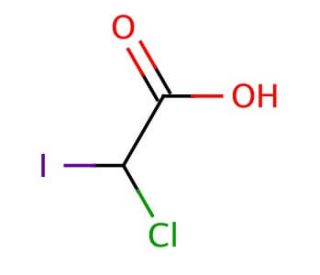

Structure moléculaire de Chloroiodoacetic acid, Numéro CAS: 53715-09-6
Chloroiodoacetic acid (CAS 53715-09-6)
Noms alternatifs:
2-Chloro-2-iodoacetic acid
Numéro CAS:
53715-09-6
Masse Moléculaire:
220.39
Formule Moléculaire:
C2H2ClIO2
Information supplémentaire:
Ce produit est classé comme marchandise dangereuse pour le transport et peut faire l'objet de frais d'expédition supplémentaires.
Pour la Recherche Uniquement. Non conforme pour le Diagnostic ou pour une Utilisation Thérapeutique.
* Consulter le Certificat d'Analyses pour les données spécifiques à un lot (incluant la teneur en eau).
ACCÈS RAPIDE AUX LIENS
Informations pour la commande
Description
Information Technique
Données de Sécurité
SDS & Certificat d’Analyses
L'acide chloroiodoacétique, composé de chlore, d'iode et d'acide acétique, est un solide cristallin incolore dégageant une odeur piquante. Son utilité s'étend à divers domaines, notamment la synthèse pharmaceutique, la production chimique et les recherches scientifiques. Ce composé polyvalent trouve des applications dans la synthèse de produits pharmaceutiques, de polymères, de colorants et de divers matériaux. En outre, il a été utilisé dans la recherche scientifique pour explorer l'expression des gènes, la fonctionnalité des enzymes et d'autres processus biochimiques complexes.
Chloroiodoacetic acid (CAS 53715-09-6) Références
- Détermination de l'acide iodoacétique par chromatographie liquide/spectrométrie de masse en tandem par électrospray. | Lau, BP. and Becalski, A. 2008. Rapid Commun Mass Spectrom. 22: 1787-91. PMID: 18470871
- Méthode rapide IC-ICP/MS pour l'analyse simultanée des acides iodoacétiques, des acides bromoacétiques, du bromate et d'autres composés halogénés apparentés dans l'eau. | Shi, H. and Adams, C. 2009. Talanta. 79: 523-7. PMID: 19559915
- Une image des sous-produits de désinfection iodés polaires dans l'eau potable par (UPLC/)ESI-tqMS. | Ding, G. and Zhang, X. 2009. Environ Sci Technol. 43: 9287-93. PMID: 20000522
- Analyse des acides haloacétiques iodés dans l'eau potable par chromatographie liquide en phase inversée/ionisation par électronébulisation/spectrométrie de masse en tandem avec injection aqueuse directe de grand volume. | Li, Y., et al. 2012. J Chromatogr A. 1245: 75-82. PMID: 22658134
- Identification, toxicité et contrôle des sous-produits de désinfection iodés dans la cuisine avec de l'eau du robinet simulée chlorée et du sel de table iodé. | Pan, Y., et al. 2016. Water Res. 88: 60-68. PMID: 26474150
- Formation et apparition de nouveaux sous-produits de désinfection iodés polaires dans l'eau potable. | Pan, Y., et al. 2016. Chemosphere. 144: 2312-20. PMID: 26606185
- Analyse des acides haloacétiques, du bromate et du dalapon dans les eaux naturelles par chromatographie ionique et spectrométrie de masse en tandem. | Wu, S., et al. 2017. J Chromatogr A. 1487: 100-107. PMID: 28118976
- Formation d'iodo-trihalométhanes, d'acides iodo-halogénoacétiques et d'haloacétaldéhydes lors de la chloration et de la chloramination d'eaux contenant de l'iode dans des réactions contrôlées en laboratoire. | Postigo, C., et al. 2017. J Environ Sci (China). 58: 127-134. PMID: 28774601
- Dépistage suspect des acides carboxyliques halogénés dans l'eau potable à l'aide de la chromatographie par échange d'ions - spectrométrie de masse à haute résolution (Orbitrap) (IC-HRMS). | Gallidabino, MD., et al. 2018. Talanta. 178: 57-68. PMID: 29136864
- Stabilité des haloacétamides chlorés, bromés et iodés dans l'eau potable. | Ding, S., et al. 2018. Water Res. 142: 490-500. PMID: 29920459
- Chloration de l'eau de source contenant des produits de contraste iodés pour rayons X. Mutagénicité et identification de nouveaux sous-produits de désinfection iodés: Mutagénicité et identification de nouveaux sous-produits de désinfection iodés. | Postigo, C., et al. 2018. Environ Sci Technol. 52: 13047-13056. PMID: 30339747
- Rendre les piscines plus sûres: L'ionisation cuivre-argent du chlore réduit-elle la toxicité et la formation de sous-produits de désinfection ? | Allen, JM., et al. 2021. Environ Sci Technol. 55: 2908-2918. PMID: 33594894
- Les sous-produits de désinfection (SPD) se forment-ils dans ma tasse de thé ? Les SPD réglementés, prioritaires et inconnus. | Li, J., et al. 2021. Environ Sci Technol. 55: 12994-13004. PMID: 34523331
- Les algues Microseira wollei et Phormidium font plus que doubler les concentrations de DBP et la toxicité calculée dans l'eau potable. | Aziz, MT., et al. 2022. Water Res. 216: 118316. PMID: 35367941
- Les SPD nagent-ils dans les piscines d'eau salée ? Comparaison de 60 SPD formés par le chlore généré électrochimiquement et le chlore conventionnel. | Granger, CO. and Richardson, SD. 2022. J Environ Sci (China). 117: 232-241. PMID: 35725075
Informations pour la commande
| Nom du produit | Ref. Catalogue | COND. | Prix HT | QTÉ | Favoris | |
Chloroiodoacetic acid, 5 mg | sc-471178 | 5 mg | $374.00 | |||
Chloroiodoacetic acid, 50 mg | sc-471178A | 50 mg | $3131.00 |