
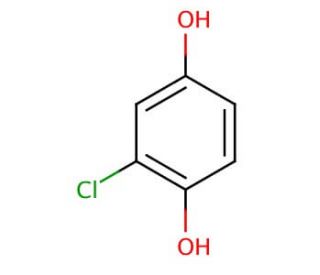

Chlorohydroquinone (CAS 615-67-8)
QUICK LINKS
Chlorohydroquinone is an organic compound that is structurally related to hydroquinone, with the addition of a chlorine atom attached to the benzene ring. This structural modification significantly impacts its chemical and physical properties, making it an important compound in various research fields, particularly in organic synthesis and environmental chemistry. In research, chlorohydroquinone′s primary mechanism of action involves its role as a reactive intermediate and a reducing agent. The presence of the hydroxyl groups and the electronegative chlorine atom makes this compound a versatile reagent in redox reactions. It can undergo oxidation to form quinones or reduction to form aminophenols, depending on the conditions of the reaction. This redox versatility is essential for synthesizing a wide array of organic compounds, including dyes, pigments, and other aromatic compounds. Chlorohydroquinone is also frequently used in studies of enzymatic processes and bioremediation due to its structural similarity to natural phenolic compounds. Researchers explore how this compound interacts with natural enzymes, particularly those involved in the detoxification and degradation of environmental pollutants. Understanding these interactions helps in developing strategies for the bioremediation of chlorinated organic compounds, which are common pollutants in soil and water. Additionally, chlorohydroquinone has been employed as a standard in analytical chemistry, particularly in the development of chromatographic methods. Its distinctive UV/Vis absorption characteristics make it suitable for use as a reference compound in the calibration of analytical instruments and the development of analytical protocols for phenols and related substances.
Chlorohydroquinone (CAS 615-67-8) References
- Identification and characterization of genes involved in the downstream degradation pathway of gamma-hexachlorocyclohexane in Sphingomonas paucimobilis UT26. | Endo, R., et al. 2005. J Bacteriol. 187: 847-53. PMID: 15659662
- Synthesis, characterization and texture observations of calamitic liquid crystalline compounds. | Qaddoura, MA. and Belfield, KD. 2009. Int J Mol Sci. 10: 4772-4788. PMID: 20087464
- Induction of prophage lambda by chlorophenols. | DeMarini, DM., et al. 1990. Environ Mol Mutagen. 15: 1-9. PMID: 2137084
- Pathway for degradation of 2-chloro-4-nitrophenol in Arthrobacter sp. SJCon. | Arora, PK. and Jain, RK. 2011. Curr Microbiol. 63: 568-73. PMID: 21960016
- Enzymes involved in the biodegradation of hexachlorocyclohexane: a mini review. | Camacho-Pérez, B., et al. 2012. J Environ Manage. 95 Suppl: S306-18. PMID: 21992990
- Degradation of the chlorinated phenoxyacetate herbicides 2,4-dichlorophenoxyacetic acid and 2,4,5-trichlorophenoxyacetic acid by pure and mixed bacterial cultures. | Haugland, RA., et al. 1990. Appl Environ Microbiol. 56: 1357-62. PMID: 2339889
- Metagenomic screening for aromatic compound-responsive transcriptional regulators. | Uchiyama, T. and Miyazaki, K. 2013. PLoS One. 8: e75795. PMID: 24098725
- Metabolic pathway for degradation of 2-chloro-4-aminophenol by Arthrobacter sp. SPG. | Arora, PK., et al. 2014. Microb Cell Fact. 13: 164. PMID: 25427856
- A Two-Component para-Nitrophenol Monooxygenase Initiates a Novel 2-Chloro-4-Nitrophenol Catabolism Pathway in Rhodococcus imtechensis RKJ300. | Min, J., et al. 2016. Appl Environ Microbiol. 82: 714-23. PMID: 26567304
- Regiospecific Oxidation of Chlorobenzene to 4-Chlororesorcinol, Chlorohydroquinone, 3-Chlorocatechol and 4-Chlorocatechol by Engineered Toluene o-Xylene Monooxygenases. | Yanık-Yıldırım, KC., et al. 2022. Appl Environ Microbiol. 88: e0035822. PMID: 35736230
Ordering Information
| Product Name | Catalog # | UNIT | Price | Qty | FAVORITES | |
Chlorohydroquinone, 25 g | sc-397379 | 25 g | $53.00 | |||
Chlorohydroquinone, 100 g | sc-397379A | 100 g | $187.00 | |||
Chlorohydroquinone, 250 g | sc-397379B | 250 g | $300.00 | |||
Chlorohydroquinone, 500 g | sc-397379C | 500 g | $550.00 |