
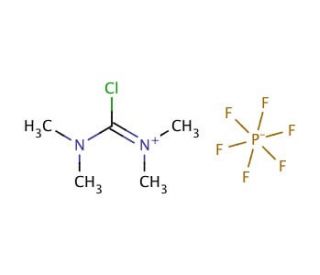

Chloro-N,N,N′,N′-tetramethylformamidinium hexafluorophosphate (CAS 207915-99-9)
ACCÈS RAPIDE AUX LIENS
L'hexafluorophosphate de chloro-N,N,N',N'-tétraméthylformamidinium (CMF-HFP) est un sel d'ammonium quaternaire polyvalent largement utilisé dans diverses applications scientifiques. Ce composé organique est soluble dans l'eau, non volatil et incolore. Doté d'un fort caractère basique, le chloro-N,N,N',N'-tétraméthylformamidinium hexafluorophosphate présente un point de fusion de 130°C et possède une polarité élevée, qui se manifeste par un moment dipolaire important. La solubilité, la stabilité et la réactivité de ce composé le rendent particulièrement adapté à diverses applications. Il sert de réactif pour la synthèse d'autres composés, de catalyseur pour les réactions organiques et de solvant pour divers processus chimiques. En outre, il sert de ligand dans la synthèse de complexes de coordination, d'agent stabilisateur dans les réactions enzymatiques et de surfactant dans les solutions aqueuses. L'utilité du chloro-N,N,N',N'-tétraméthylformamidinium hexafluorophosphate s'étend également à la synthèse des polymères. Le mécanisme d'action exact de l'hexafluorophosphate de chloro-N,N,N',N'-tétraméthylformamidinium reste incomplètement compris. Néanmoins, on pense qu'il fonctionne comme une base de Lewis, formant des complexes avec les métaux de transition, et comme un acide de Lewis, interagissant avec les molécules riches en électrons. En outre, on pense que le chloro-N,N,N',N'-tétraméthylformamidinium hexafluorophosphate agit comme un nucléophile, ciblant les sites électrophiles dans les molécules.
Chloro-N,N,N′,N′-tetramethylformamidinium hexafluorophosphate (CAS 207915-99-9) Références
- Rétention de sélecteurs chiraux fluorés dans des systèmes de solvants fluorés biphasiques et application à la séparation d'énantiomères par chromatographie à contre-courant. | Pérez, AM. and Minguillón, C. 2010. J Chromatogr A. 1217: 1094-100. PMID: 19833342
- Identification de nouveaux agonistes puissants du GPR119 en combinant le criblage virtuel et la chimie combinatoire. | Wellenzohn, B., et al. 2012. J Med Chem. 55: 11031-41. PMID: 23211099
- Substitution nucléophile mécanochimique d'alcools par des intermédiaires isouroniens. | Dalidovich, T., et al. 2022. ChemSusChem. 15: e202102286. PMID: 34932893
- Conception, synthèse et caractérisation biologique de chimères ciblant la protéolyse de l'histone désacétylase 8 (HDAC8) (PROTACs) avec une activité anti-neuroblastome. | Darwish, S., et al. 2022. Int J Mol Sci. 23: PMID: 35886887
- Utilisation de ligands G-Quadruplex macrocycliques pour déchiffrer les interactions entre les petites molécules et l'ADN G-Quadruplex. | Andréasson, M., et al. 2022. Chemistry. 28: e202202020. PMID: 35997141
- Synthèse totale du produit naturel dihydrooxépine-spiroisoxazoline Psammaplysine A. | Paciorek, J., et al. 2022. J Am Chem Soc. 144: 19704-19708. PMID: 36270001
- Avancées récentes dans la synthèse d'ingrédients pharmaceutiques et agrochimiques actifs en milieu micellaire | Nicola Compagno 1 2, Roberto Profeta 1, Alessandro Scarso 2. 2023. Current Opinion in Green and Sustainable Chemistry. 39.
Informations pour la commande
| Nom du produit | Ref. Catalogue | COND. | Prix HT | QTÉ | Favoris | |
Chloro-N,N,N′,N′-tetramethylformamidinium hexafluorophosphate, 5 g | sc-239504 | 5 g | $144.00 |