
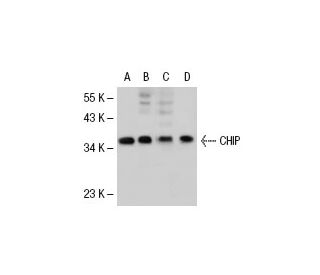


CHIP/STUB1 Antibody (G-2): sc-133066
- CHIP/STUB1 Antibody (G-2) is a mouse monoclonal IgG1 κ CHIP/STUB1 antibody, cited in 35 publications, provided at 200 µg/ml
- raised against amino acids 73-303 mapping at the C-terminus of CHIP of human origin
- CHIP/STUB1 Antibody (G-2) is recommended for detection of CHIP of mouse, rat and human origin by WB, IP, IF and ELISA
- Anti-CHIP/STUB1 Antibody (G-2) is available conjugated to agarose for IP; HRP for WB, IHC(P) and ELISA; and to either phycoerythrin or FITC for IF, IHC(P) and FCM
- also available conjugated to Alexa Fluor® 488, Alexa Fluor® 546, Alexa Fluor® 594 or Alexa Fluor® 647 for WB (RGB), IF, IHC(P) and FCM, and for use with RGB fluorescent imaging systems, such as iBright™ FL1000, FluorChem™, Typhoon, Azure and other comparable systems
- also available conjugated to Alexa Fluor® 680 or Alexa Fluor® 790 for WB (NIR), IF and FCM; for use with Near-Infrared (NIR) detection systems, such as LI-COR®Odyssey®, iBright™ FL1000, FluorChem™, Typhoon, Azure and other comparable systems
- m-IgG Fc BP-HRP and m-IgG1 BP-HRP are the preferred secondary detection reagents for CHIP/STUB1 Antibody (G-2) for WB applications. These reagents are now offered in bundles with CHIP/STUB1 Antibody (G-2) (see ordering information below).

QUICK LINKS
SEE ALSO...
CHIP Antibody (G-2) is a mouse monoclonal IgG1 kappa light chain antibody that specifically binds to the human CHIP protein, recognizing an epitope corresponding to amino acids 73-303 at the C-terminus. CHIP, also known as STUB1 (STIP1 homology and U-box containing protein 1), is a cytoplasmic E3 ubiquitin ligase that plays a crucial role in protein quality control by mediating the ubiquitination and subsequent degradation of misfolded or damaged proteins. This function is vital for maintaining cellular homeostasis and preventing the accumulation of potentially toxic proteins that can lead to disease. CHIP interacts with molecular chaperones Hsp70 and Hsp90, facilitating the degradation of client proteins such as ErbB2 and CFTR, which is significant in regulating signaling pathways and stress responses. Additionally, CHIP can modulate signaling pathways by interacting with Smad1/Smad4 and inhibiting BMP signaling through the ubiquitin-mediated degradation of Smad proteins. CHIP is most abundantly expressed in striated muscle tissues, including heart and skeletal muscle, with lower levels observed in the pancreas and brain. Anti-CHIP antibody (G-2) reacts with CHIP from mouse, rat, and human origins and is validated for use in western blotting (WB), immunoprecipitation (IP), immunofluorescence (IF), and enzyme-linked immunosorbent assay (ELISA) applications.
Alexa Fluor® is a trademark of Molecular Probes Inc., OR., USA
LI-COR® and Odyssey® are registered trademarks of LI-COR Biosciences
CHIP/STUB1 Antibody (G-2) References:
- Identification of CHIP, a novel tetratricopeptide repeat-containing protein that interacts with heat shock proteins and negatively regulates chaperone functions. | Ballinger, CA., et al. 1999. Mol Cell Biol. 19: 4535-45. PMID: 10330192
- CHIP is a U-box-dependent E3 ubiquitin ligase: identification of Hsc70 as a target for ubiquitylation. | Jiang, J., et al. 2001. J Biol Chem. 276: 42938-44. PMID: 11557750
- CHIP is associated with Parkin, a gene responsible for familial Parkinson's disease, and enhances its ubiquitin ligase activity. | Imai, Y., et al. 2002. Mol Cell. 10: 55-67. PMID: 12150907
- Chaperone-dependent E3 ubiquitin ligase CHIP mediates a degradative pathway for c-ErbB2/Neu. | Xu, W., et al. 2002. Proc Natl Acad Sci U S A. 99: 12847-52. PMID: 12239347
- Chaperone-dependent regulation of endothelial nitric-oxide synthase intracellular trafficking by the co-chaperone/ubiquitin ligase CHIP. | Jiang, J., et al. 2003. J Biol Chem. 278: 49332-41. PMID: 14507928
- The cochaperone HspBP1 inhibits the CHIP ubiquitin ligase and stimulates the maturation of the cystic fibrosis transmembrane conductance regulator. | Alberti, S., et al. 2004. Mol Biol Cell. 15: 4003-10. PMID: 15215316
- Intracellular localization of ornithine decarboxylase and its regulatory protein, antizyme-1. | Schipper, RG., et al. 2004. J Histochem Cytochem. 52: 1259-66. PMID: 15385572
- A foldable CFTR{Delta}F508 biogenic intermediate accumulates upon inhibition of the Hsc70-CHIP E3 ubiquitin ligase. | Younger, JM., et al. 2004. J Cell Biol. 167: 1075-85. PMID: 15611333
Ordering Information
| Product Name | Catalog # | UNIT | Price | Qty | FAVORITES | |
CHIP/STUB1 Antibody (G-2) | sc-133066 | 200 µg/ml | $322.00 | |||
CHIP/STUB1 Antibody (G-2): m-IgG Fc BP-HRP Bundle | sc-527090 | 200 µg Ab; 10 µg BP | $361.00 | |||
CHIP/STUB1 Antibody (G-2): m-IgG1 BP-HRP Bundle | sc-532463 | 200 µg Ab; 20 µg BP | $361.00 | |||
CHIP/STUB1 Antibody (G-2) AC | sc-133066 AC | 500 µg/ml, 25% agarose | $424.00 | |||
CHIP/STUB1 Antibody (G-2) HRP | sc-133066 HRP | 200 µg/ml | $322.00 | |||
CHIP/STUB1 Antibody (G-2) FITC | sc-133066 FITC | 200 µg/ml | $336.00 | |||
CHIP/STUB1 Antibody (G-2) PE | sc-133066 PE | 200 µg/ml | $349.00 | |||
CHIP/STUB1 Antibody (G-2) Alexa Fluor® 488 | sc-133066 AF488 | 200 µg/ml | $364.00 | |||
CHIP/STUB1 Antibody (G-2) Alexa Fluor® 546 | sc-133066 AF546 | 200 µg/ml | $364.00 | |||
CHIP/STUB1 Antibody (G-2) Alexa Fluor® 594 | sc-133066 AF594 | 200 µg/ml | $364.00 | |||
CHIP/STUB1 Antibody (G-2) Alexa Fluor® 647 | sc-133066 AF647 | 200 µg/ml | $364.00 | |||
CHIP/STUB1 Antibody (G-2) Alexa Fluor® 680 | sc-133066 AF680 | 200 µg/ml | $364.00 | |||
CHIP/STUB1 Antibody (G-2) Alexa Fluor® 790 | sc-133066 AF790 | 200 µg/ml | $364.00 |