
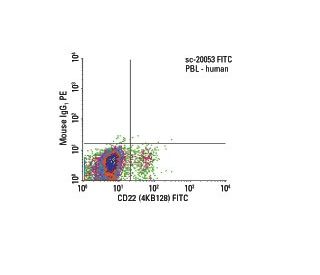


CD22 Antibody (4KB128): sc-20053
- CD22 Antibody (4KB128) is a mouse monoclonal IgG1 κ provided at 200 µg/ml
- raised against human neoplastic cells from a case of hairy cell leukemia
- recommended for detection of CD22 of human origin by IF and FCM
- available conjugated to either phycoerythrin or FITC for IF, IHC(P) and FCM
- m-IgG Fc BP-HRP is the preferred secondary detection reagent for CD22 Antibody (4KB128). This reagent is now offered in a bundle with CD22 Antibody (4KB128) (see ordering information below).

QUICK LINKS
SEE ALSO...
CD22 Antibody (4KB128) is a mouse monoclonal IgG1 antibody that detects CD22 in human samples through immunofluorescence (IF) and flow cytometry (FCM) applications. CD22 is a critical regulator of B cell signaling and plays a vital role in the immune response by modulating B cell activation and proliferation. This integral membrane glycoprotein, also known as B-lymphocyte cell adhesion molecule (BLCAM) and sialic acid-binding Ig-like lectin 2 (Siglec-2), is predominantly expressed on the surface of B lymphocytes, where CD22 functions to maintain B cell homeostasis and prevent excessive activation. CD22 exists in two main isoforms, CD22α and CD22β, resulting from alternative splicing, with CD22β being the more prevalent form. CD22 presence on mature B cells is crucial for their differentiation into plasma cells, and CD22 cytoplasmic form serves as a significant marker for acute lymphocytic leukemia, highlighting CD22′s importance in both normal immune function and disease states. Anti-CD22 antibody (4KB128) is an essential tool for researchers studying B cell biology and related pathologies, providing insights into the mechanisms of B cell regulation and potential therapeutic targets.
Alexa Fluor® is a trademark of Molecular Probes Inc., OR., USA
LI-COR® and Odyssey® are registered trademarks of LI-COR Biosciences
CD22 Antibody (4KB128) References:
- CD22: a multifunctional receptor that regulates B lymphocyte survival and signal transduction. | Tedder, TF., et al. 2005. Adv Immunol. 88: 1-50. PMID: 16227086
- Targeting B lymphoma with nanoparticles bearing glycan ligands of CD22. | Chen, WC., et al. 2012. Leuk Lymphoma. 53: 208-10. PMID: 21756025
- CD22 monoclonal antibody therapies in relapsed/refractory acute lymphoblastic leukemia. | Hoelzer, D. 2013. Cancer. 119: 2671-4. PMID: 23633448
- CD22 and Siglec-G regulate inhibition of B-cell signaling by sialic acid ligand binding and control B-cell tolerance. | Nitschke, L. 2014. Glycobiology. 24: 807-17. PMID: 25002414
- N-Linked Glycosylation Regulates CD22 Organization and Function. | Wasim, L., et al. 2019. Front Immunol. 10: 699. PMID: 31019513
- Coordinated roles for glycans in regulating the inhibitory function of CD22 on B cells. | Enterina, JR., et al. 2019. Biomed J. 42: 218-232. PMID: 31627864
- Upregulation of CD22 by Chidamide promotes CAR T cells functionality. | Yang, X., et al. 2021. Sci Rep. 11: 20637. PMID: 34667217
- Associations of plasma soluble CD22 levels with brain amyloid burden and cognitive decline in Alzheimer's disease. | Bu, XL., et al. 2022. Sci Adv. 8: eabm5667. PMID: 35363517
- CD19/CD22 CAR-T-cell cocktail therapy following autologous transplantation is an optimizing strategy for treating relapsed/refractory central nervous system lymphoma. | Zhou, X., et al. 2024. Exp Hematol Oncol. 13: 100. PMID: 39397022
- Inotuzumab Ozogamicin and Low-Intensity Chemotherapy in Older Patients With Newly Diagnosed CD22+ Philadelphia Chromosome-Negative B-Cell Precursor Acute Lymphoblastic Leukemia. | Chevallier, P., et al. 2024. J Clin Oncol. 42: 4327-4341. PMID: 39418626
Ordering Information
| Product Name | Catalog # | UNIT | Price | Qty | FAVORITES | |
CD22 Antibody (4KB128) | sc-20053 | 200 µg/ml | $322.00 | |||
CD22 Antibody (4KB128): m-IgG Fc BP-HRP Bundle | sc-552833 | 200 µg Ab; 10 µg BP | $361.00 | |||
CD22 Antibody (4KB128) FITC | sc-20053 FITC | 200 µg/ml | $336.00 | |||
CD22 Antibody (4KB128) PE | sc-20053 PE | 200 µg/ml | $349.00 |