
Date published: 2025-12-5

1-800-457-3801

SCBT Portrait Logo
Seach Input

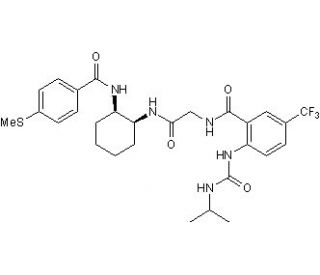
CCR2 Antagonist (CAS 445479-97-0)

5.0(2)
Write a reviewAsk a question

See product citations (34)

Alternate Names:
CCR2 Antagonist is also known as CC Chemokine Receptor 2 Antagonist.
Application:
CCR2 Antagonist is a cis-diamidocyclohexyl urea compound that potently competes against MCP-1 binding to CCR2 (IC50 = 5.1 nM).
CAS Number:
445479-97-0
Purity:
≥97%
Molecular Weight:
593.7
Molecular Formula:
C28H34F3N5O4S
For Research Use Only. Not Intended for Diagnostic or Therapeutic Use.
* Refer to Certificate of Analysis for lot specific data.

QUICK LINKS

CCR2 Antagonist is a cell-permeable cis-diamidocyclohexyl urea compound with high affinity binding to CKR-2B (chemokine (C-C motif) receptor 2 CCR2), also known as CD192 (cluster of differentiation 192). CKR-2B is a G protein-coupled receptor with a unique conserved glutamic acid residue in transmembrane 7, Glu291. Research shows that this conserved residue is a critical site for small molecule antagonist binding. MCP-1 (chemokine (C-C motif) ligand 2 CCL2) is a specific chemokine for the CKR-2B receptor and is responsible for recruiting monocytes, memory T cells, and dendritic cells to sites of tissue injury and infection. CCR2 Antagonist displays high affinity binding for CKR-2B (IC50 = 5.1 nM) and potent functional antagonism (calcium flux IC50 = 18 nM and chemotaxis IC 50 = 1 nM). Although Glu291 is a key receptor residue for CKR-2B, CCR2 Antagonist studies show that this inhibitor is not reliant upon Glu291 for its affinity binding, rather a nearby site. CCR2 Antagonist exhibits preferential binding for CKR-2B over CKR-3 (CCR3).


CCR2 Antagonist (CAS 445479-97-0) References

  1. Discovery of disubstituted cyclohexanes as a new class of CC chemokine receptor 2 antagonists.  |  Cherney, RJ., et al. 2008. J Med Chem. 51: 721-4. PMID: 18232650
  2. Recent developments in CCR2 antagonists.  |  Xia, M. and Sui, Z. 2009. Expert Opin Ther Pat. 19: 295-303. PMID: 19441905
  3. Targeting of tumour-infiltrating macrophages via CCL2/CCR2 signalling as a therapeutic strategy against hepatocellular carcinoma.  |  Li, X., et al. 2017. Gut. 66: 157-167. PMID: 26452628
  4. ECL1i, d(LGTFLKC), a novel, small peptide that specifically inhibits CCL2-dependent migration.  |  Auvynet, C., et al. 2016. FASEB J. 30: 2370-81. PMID: 26979087
  5. CCL2/CCR2, but not CCL5/CCR5, mediates monocyte recruitment, inflammation and cartilage destruction in osteoarthritis.  |  Raghu, H., et al. 2017. Ann Rheum Dis. 76: 914-922. PMID: 27965260
  6. Cenicriviroc inhibits trans-endothelial passage of monocytes and is associated with impaired E-selectin expression.  |  D'Antoni, ML., et al. 2018. J Leukoc Biol. 104: 1241-1252. PMID: 30088682
  7. CCR2/CCR5 inhibitor permits the radiation-induced effector T cell infiltration in pancreatic adenocarcinoma.  |  Wang, J., et al. 2022. J Exp Med. 219: PMID: 35404390
  8. Structure-Guide Design and Optimization of Potential Druglikeness Inhibitors for TGFβRI with the Pyrrolopyrimidine Scaffold.  |  Meng, D., et al. 2022. Pharmaceuticals (Basel). 15: PMID: 36297376
  9. Monocyte chemoattractant protein 1 acts as a T-lymphocyte chemoattractant.  |  Carr, MW., et al. 1994. Proc Natl Acad Sci U S A. 91: 3652-6. PMID: 8170963

Ordering Information

Product NameCatalog #UNITPriceQtyFAVORITES

CCR2 Antagonist, 5 mg

sc-202525
5 mg
$299.00

What are the storage instructions for the stock solution in DMSO?

Asked by: rm1234
Thank you for your question. We recommend storing the product undissolved at +4 °C and preparing working solutions fresh. We do not have stability data for solutions of this product in DMSO.
Answered by: Tech Support Europe
Date published: 2020-08-26
  • y_2025, m_11, d_13, h_10CST
  • bvseo_bulk, prod_bvqa, vn_bulk_3.0.42
  • cp_1, bvpage1
  • co_hasquestionsanswers, tq_1
  • loc_en_US, sid_202525, prod, sort_[SortEntry(order=LAST_APPROVED_ANSWER_SUBMISSION_TIME, direction=DESCENDING)]
  • clientName_scbt
  • bvseo_sdk, java_sdk, bvseo-4.0.0
  • CLOUD, getContent, 107ms
  • QUESTIONS, PRODUCT
Rated 5 out of 5 by from Works greatWorks great - no issues.
Date published: 2015-10-28
Rated 5 out of 5 by from Kitagawa et alKitagawa et al. (PubMed ID 15215179) used CCR2 antagonist to alleviate progressive fibrosis in diseased kidneys by reducing CCR2-mediated MCP-1 expression. -SCBT Publication Review
Date published: 2015-01-28
  • y_2025, m_11, d_13, h_10
  • bvseo_bulk, prod_bvrr, vn_bulk_3.0.42
  • cp_1, bvpage1
  • co_hasreviews, tv_0, tr_2
  • loc_en_US, sid_202525, prod, sort_[SortEntry(order=SUBMISSION_TIME, direction=DESCENDING)]
  • clientName_scbt
  • bvseo_sdk, java_sdk, bvseo-4.0.0
  • CLOUD, getReviews, 12ms
  • REVIEWS, PRODUCT
CCR2 Antagonist is rated 5.0 out of 5 by 2.
  • y_2025, m_11, d_13, h_10
  • bvseo_bulk, prod_bvrr, vn_bulk_3.0.42
  • cp_1, bvpage1
  • co_hasreviews, tv_0, tr_2
  • loc_en_US, sid_202525, prod, sort_[SortEntry(order=SUBMISSION_TIME, direction=DESCENDING)]
  • clientName_scbt
  • bvseo_sdk, java_sdk, bvseo-4.0.0
  • CLOUD, getAggregateRating, 115ms
  • REVIEWS, PRODUCT