
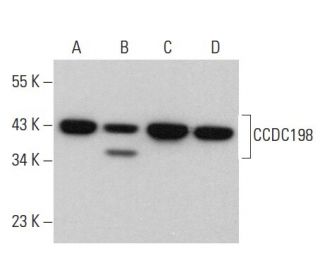


CCDC198 Antibody (G-3): sc-514267
- CCDC198 Antibody (G-3) is a mouse monoclonal IgG2b κ provided at 200 µg/ml
- specific for an epitope mapping between amino acids 37-61 within an internal region of CCDC198 of mouse origin
- Anti-CCDC198 Antibody (G-3) is recommended for detection of CCDC198 of mouse, rat and human origin by WB, IP, IF and ELISA
- Anti-CCDC198 Antibody (G-3) is available conjugated to agarose for IP; HRP for WB, IHC(P) and ELISA; and to either phycoerythrin or FITC for IF, IHC(P) and FCM
- also available conjugated to Alexa Fluor® 488, Alexa Fluor® 546, Alexa Fluor® 594 or Alexa Fluor® 647 for WB (RGB), IF, IHC(P) and FCM, and for use with RGB fluorescent imaging systems, such as iBright™ FL1000, FluorChem™, Typhoon, Azure and other comparable systems
- also available conjugated to Alexa Fluor® 680 or Alexa Fluor® 790 for WB (NIR), IF and FCM; for use with Near-Infrared (NIR) detection systems, such as LI-COR®Odyssey®, iBright™ FL1000, FluorChem™, Typhoon, Azure and other comparable systems
- m-IgGκ BP-HRP is the preferred secondary detection reagent for CCDC198 Antibody (G-3) for WB applications. This reagent is now offered in a bundle with CCDC198 Antibody (G-3) (see ordering information below). For additional m-IgGκ BP conjugates see our complete list of Mouse IgG Binding Proteins.

QUICK LINKS
SEE ALSO...
CCDC198 Antibody (G-3) is a mouse monoclonal IgG2b kappa light chain antibody that detects CCDC198 in mouse, rat, and human samples through applications such as western blotting (WB), immunoprecipitation (IP), immunofluorescence (IF), and enzyme-linked immunosorbent assay (ELISA). CCDC198 (G-3) antibody is available in both non-conjugated and various conjugated forms, including agarose, horseradish peroxidase (HRP), phycoerythrin (PE), fluorescein isothiocyanate (FITC), and multiple Alexa Fluor® conjugates. CCDC198 is primarily located in the cytoplasm and plays a significant role in cellular processes, particularly in metabolism and energy homeostasis regulation. CCDC198′s cytoplasmic localization enables interactions with various metabolic pathways and cellular structures, influencing energy production and utilization. CCDC198′s presence in the cytoplasm suggests involvement in signaling pathways that respond to cellular energy demands, potentially affecting mitochondrial function and lipid metabolism. Understanding CCDC198′s precise cellular location and function is essential for elucidating metabolic regulation roles and contributions to energy imbalance conditions. Ongoing research continues to explore CCDC198′s interactions and pathways, aiming to uncover full biological significance.
Alexa Fluor® is a trademark of Molecular Probes Inc., OR., USA
LI-COR® and Odyssey® are registered trademarks of LI-COR Biosciences
CCDC198 Antibody (G-3) References:
- The DNA sequence and analysis of human chromosome 14. | Heilig, R., et al. 2003. Nature. 421: 601-7. PMID: 12508121
- A presenilin 1 R278I mutation presenting with language impairment. | Godbolt, AK., et al. 2004. Neurology. 63: 1702-4. PMID: 15534260
- Pathological and physiological functions of presenilins. | Vetrivel, KS., et al. 2006. Mol Neurodegener. 1: 4. PMID: 16930451
- Presenilin-1 mutation E318G and familial Alzheimer's disease in the Italian population. | Albani, D., et al. 2007. Neurobiol Aging. 28: 1682-8. PMID: 16952411
- Molecular cytogenetic characterization of t(14;19)(q32;p13), a new recurrent translocation in B cell malignancies. | Micci, F., et al. 2007. Virchows Arch. 450: 559-65. PMID: 17406891
- A comprehensive genetic and histopathologic analysis identifies two subgroups of B-cell malignancies carrying a t(14;19)(q32;q13) or variant BCL3-translocation. | Martín-Subero, JI., et al. 2007. Leukemia. 21: 1532-44. PMID: 17495977
- The genetics of very early onset Alzheimer disease. | Filley, CM., et al. 2007. Cogn Behav Neurol. 20: 149-56. PMID: 17846513
- The promise of gene therapy for the treatment of alpha-1 antitrypsin deficiency. | Cruz, PE., et al. 2007. Pharmacogenomics. 8: 1191-8. PMID: 17924834
- Alpha1-antitrypsin deficiency: current perspective on research, diagnosis, and management. | Stolk, J., et al. 2006. Int J Chron Obstruct Pulmon Dis. 1: 151-60. PMID: 18046892
Ordering Information
| Product Name | Catalog # | UNIT | Price | Qty | FAVORITES | |
CCDC198 Antibody (G-3) | sc-514267 | 200 µg/ml | $322.00 | |||
CCDC198 Antibody (G-3): m-IgGκ BP-HRP Bundle | sc-524666 | 200 µg Ab, 40 µg BP | $361.00 | |||
CCDC198 Antibody (G-3) AC | sc-514267 AC | 500 µg/ml, 25% agarose | $424.00 | |||
CCDC198 Antibody (G-3) HRP | sc-514267 HRP | 200 µg/ml | $322.00 | |||
CCDC198 Antibody (G-3) FITC | sc-514267 FITC | 200 µg/ml | $336.00 | |||
CCDC198 Antibody (G-3) PE | sc-514267 PE | 200 µg/ml | $349.00 | |||
CCDC198 Antibody (G-3) Alexa Fluor® 488 | sc-514267 AF488 | 200 µg/ml | $364.00 | |||
CCDC198 Antibody (G-3) Alexa Fluor® 546 | sc-514267 AF546 | 200 µg/ml | $364.00 | |||
CCDC198 Antibody (G-3) Alexa Fluor® 594 | sc-514267 AF594 | 200 µg/ml | $364.00 | |||
CCDC198 Antibody (G-3) Alexa Fluor® 647 | sc-514267 AF647 | 200 µg/ml | $364.00 | |||
CCDC198 Antibody (G-3) Alexa Fluor® 680 | sc-514267 AF680 | 200 µg/ml | $364.00 | |||
CCDC198 Antibody (G-3) Alexa Fluor® 790 | sc-514267 AF790 | 200 µg/ml | $364.00 | |||
CCDC198 (G-3) Neutralizing Peptide | sc-514267 P | 100 µg/0.5 ml | $69.00 |