
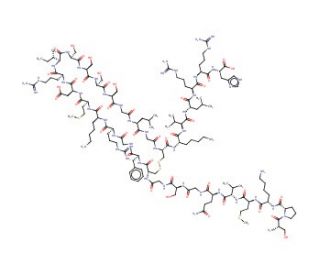

BNP (1-32), human (CAS 114471-18-0)
LINK RAPIDI
Il BNP (1-32) umano è un ormone peptidico biologicamente attivo appartenente alla famiglia dei peptidi natriuretici. La ricerca sul BNP (1-32) umano si è concentrata prevalentemente sul suo ruolo fisiologico nell'omeostasi cardiovascolare e sulle sue potenziali applicazioni nella ricerca cardiovascolare. Questo ormone peptidico è sintetizzato e rilasciato principalmente dal miocardio ventricolare in risposta all'aumento dello stress della parete cardiaca e al sovraccarico di volume. Meccanicamente, il BNP (1-32) umano esercita i suoi effetti legandosi e attivando il recettore del peptide natriuretico-A (NPR-A), un recettore della guaniliciclasi legato alla membrana. All'attivazione, l'NPR-A catalizza la conversione della guanosina trifosfato (GTP) in guanosina monofosfato ciclico (cGMP), portando a cascate di segnalazione intracellulare che promuovono la vasodilatazione, la natriuresi e la diuresi. In ambito di ricerca, il BNP (1-32) umano è stato utilizzato per studiare i meccanismi fisiologici alla base della regolazione cardiovascolare, tra cui il controllo della pressione sanguigna, l'equilibrio dei fluidi e il rimodellamento cardiaco. Inoltre, questo ormone peptidico è stato fondamentale per chiarire la fisiopatologia di vari disturbi cardiovascolari, come l'insufficienza cardiaca, l'ipertensione e l'infarto del miocardio, fornendo indicazioni sui meccanismi di compensazione attivati in risposta alla disfunzione cardiaca. Inoltre, il BNP (1-32) umano è stato impiegato in modelli sperimentali per esplorare nuove strategie mirate al sistema dei peptidi natriuretici per la gestione delle malattie cardiovascolari. Nel complesso, il BNP (1-32) umano è uno strumento prezioso per la ricerca cardiovascolare, in quanto offre spunti di riflessione sulla complessa interazione tra peptidi e recettori nella fisiologia e nella fisiopatologia cardiovascolare.
BNP (1-32), human (CAS 114471-18-0) Referenze
- Il peptide natriuretico cerebrale è prodotto nei fibroblasti cardiaci e induce le metalloproteinasi della matrice. | Tsuruda, T., et al. 2002. Circ Res. 91: 1127-34. PMID: 12480813
- La dipeptidil-peptidasi IV converte il peptide natriuretico di tipo B intatto nella sua forma des-SerPro. | Brandt, I., et al. 2006. Clin Chem. 52: 82-7. PMID: 16254193
- Forme alterne di peptide natriuretico di tipo pro-B circolante e di peptide natriuretico di tipo B nella popolazione generale. | Lam, CS., et al. 2007. J Am Coll Cardiol. 49: 1193-202. PMID: 17367664
- Immunoreattività e azioni di attivazione del monofosfato guanosinico 3',5'-ciclico di varie forme molecolari di peptide natriuretico di tipo B umano. | Heublein, DM., et al. 2007. Hypertension. 49: 1114-9. PMID: 17372040
- Biochimica del peptide natriuretico di tipo B: a che punto siamo? | Mair, J. 2008. Clin Chem Lab Med. 46: 1507-14. PMID: 18842106
- Dipeptidil-peptidasi IV e peptide natriuretico di tipo B. Dal banco al letto del malato. | Vanderheyden, M., et al. 2009. Clin Chem Lab Med. 47: 248-52. PMID: 19327104
- Il peptide natriuretico di tipo B 8-32, prodotto dal BNP 1-32 maturo dalla metalloproteasi meprina A, ha una bioattività ridotta. | Boerrigter, G., et al. 2009. Am J Physiol Regul Integr Comp Physiol. 296: R1744-50. PMID: 19386989
- Il peptide natriuretico di tipo B umano non viene degradato dalla meprina A. | Dickey, DM. and Potter, LR. 2010. Biochem Pharmacol. 80: 1007-11. PMID: 20599787
- Diversa suscettibilità del peptide natriuretico di tipo B (BNP) e del precursore del BNP (proBNP) alla scissione da parte della neprilisina: La parte N-terminale è importante. | Semenov, AG. and Katrukha, AG. 2016. Clin Chem. 62: 617-22. PMID: 26864319
Informazioni ordini
| Nome del prodotto | Codice del prodotto | UNITÀ | Prezzo | Quantità | Preferiti | |
BNP (1-32), human, 500 µg | sc-391192 | 500 µg | $360.00 | |||
BNP (1-32), human, 1 mg | sc-391192A | 1 mg | $600.00 |