
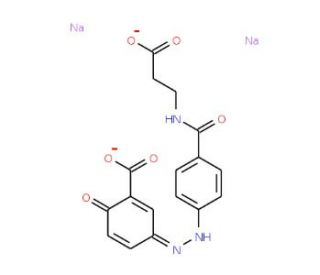

Balsalazide disodium (CAS 213594-60-6)
QUICK LINKS
Balsalazide disodium, a prodrug of 5-aminosalicylic acid (5-ASA), has been extensively investigated for its potential applications in scientific research, particularly in the field of inflammatory bowel disease (IBD). Upon oral administration, balsalazide disodium undergoes enzymatic cleavage by bacterial azoreductases in the colon, releasing 5-ASA and the carrier molecule, 4-aminobenzoyl-β-alanine. This mechanism enables targeted delivery of 5-ASA to the inflamed intestinal mucosa, where it exerts its anti-inflammatory effects by inhibiting the synthesis of pro-inflammatory cytokines, such as tumor necrosis factor-alpha (TNF-α), and modulating the activity of nuclear factor-kappa B (NF-κB) and other transcription factors involved in the inflammatory response. In research settings, balsalazide disodium and its active metabolite, 5-ASA, have been utilized in various in vitro and in vivo models to investigate their anti-inflammatory properties and explain the underlying mechanisms of action in IBD pathogenesis. Furthermore, studies have explored the potential of balsalazide disodium in combination therapies and novel drug delivery systems aimed at enhancing its efficacy and bioavailability for the treatment of IBD. Beyond IBD, research efforts have also investigated the potential of balsalazide disodium in other inflammatory conditions, such as rheumatoid arthritis and psoriasis, highlighting its versatility as a research tool in understanding and managing chronic inflammatory disorders.
Balsalazide disodium (CAS 213594-60-6) References
- Chemoprevention of colon cancer carcinogenesis by balsalazide: inhibition of azoxymethane-induced aberrant crypt formation in the rat colon and intestinal tumor formation in the B6-Min/+ mouse. | MacGregor, DJ., et al. 2000. Int J Oncol. 17: 173-9. PMID: 10853036
- Integrated Photoresponsive Alkaline Earth Metal Coordination Networks: Synthesis, Topology, Photochromism and Photoluminescence Investigation. | You, ZX., et al. 2021. Chemistry. 27: 9605-9619. PMID: 33871899
- Smart crystalline framework materials with a triazole carboxylic acid ligand: fluorescence sensing and catalytic reduction of PNP. | Lv, Q., et al. 2023. Dalton Trans. 52: 17201-17212. PMID: 37943065
- Kinetics and thermodynamic study of balsalazide adsorption by unsaturated polyester resin (UPR): a non-carbon adsorbent. | Sikarwar, Shalini and Rajeev Jain. 2014. Water, Air, & Soil Pollution. 225: 1-10.
- Development and validation of stability indicating HPLC method for Balsalazide in bulk drug development. | Bammidi, Eswara Rao, et al. 2016. International Journal of Modern Chemistry and Applied Science. 3.1: 315-322.
- A three-dimensional supramolecular network structure through hydrogen bonding and π–π interaction: synthesis, structure, and the fluorescence detection of balsalazide disodium. | Wang, Chen, et al. 2021. CrystEngComm. 23.27: 4840-4847.
- Characterization of degradation products of the Balsalazide by Mass spectrometry: Optimization of stability-indicating HPLC method for separation and quantification of process related impurities of Balsalazide. | Babu, Chilakabattina Naga Narasimha, et al. 2024. 분석과학. 37.1: 25-38.
Ordering Information
| Product Name | Catalog # | UNIT | Price | Qty | FAVORITES | |
Balsalazide disodium, 500 mg | sc-337547 | 500 mg | $1400.00 |