
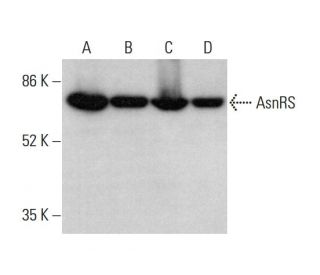
AsnRS Antibody (G-8): sc-271059
- AsnRS Antibody (G-8) is a mouse monoclonal IgM κ AsnRS antibody provided at 200 µg/ml
- raised against amino acids 1-289 mapping at the N-terminus of AsnRS of human origin
- recommended for detection of AsnRS of mouse, rat and human origin by WB, IP, IF, IHC(P) and ELISA
- m-IgGκ BP-HRP is the preferred secondary detection reagent for AsnRS Antibody (G-8) for WB and IHC(P) applications. This reagent is now offered in a bundle with AsnRS Antibody (G-8) (see ordering information below). For additional m-IgGκ BP conjugates see our complete list of Mouse IgG Binding Proteins.

QUICK LINKS
SEE ALSO...
AsnRS Antibody (G-8) is a mouse monoclonal IgM antibody that detects AsnRS protein of mouse, rat, and human origin by western blotting (WB), immunoprecipitation (IP), immunofluorescence (IF), immunohistochemistry, and enzyme-linked immunosorbent assay (ELISA). Anti-AsnRS antibody (G-8) is available as the non-conjugated monoclonal isotype antibody. AsnRS protein, also known as cytoplasmic asparaginyl-tRNA synthetase, is encoded by the human gene NARS and plays a crucial role in protein synthesis by catalyzing the attachment of asparagine to its corresponding tRNA. This process is vital for the accurate translation of genetic information into proteins, as it ensures that the correct amino acids are incorporated into the growing polypeptide chain. AsnRS belongs to the class-II aminoacyl-tRNA synthetase family, which is characterized by its ability to recognize specific amino acids and their cognate tRNAs, thereby maintaining the fidelity of protein synthesis. AsnRS is primarily located in the cytoplasm, where AsnRS interacts with various tRNA molecules to facilitate the charging process. Notably, AsnRS autoantibodies have been linked to interstitial lung disease, highlighting AsnRS′s potential role in autoimmune conditions. Understanding the function and importance of AsnRS is essential for elucidating its involvement in both normal cellular processes and disease states, making AsnRS (G-8) monoclonal antibody a valuable tool for researchers studying these mechanisms.
Alexa Fluor® is a trademark of Molecular Probes Inc., OR., USA
LI-COR® and Odyssey® are registered trademarks of LI-COR Biosciences
AsnRS Antibody (G-8) References:
- Brugia malayi asparaginyl-transfer RNA synthetase induces chemotaxis of human leukocytes and activates G-protein-coupled receptors CXCR1 and CXCR2. | Ramirez, BL., et al. 2006. J Infect Dis. 193: 1164-71. PMID: 16544258
- Discovering new classes of Brugia malayi asparaginyl-tRNA synthetase inhibitors and relating specificity to conformational change. | Sukuru, SC., et al. 2006. J Comput Aided Mol Des. 20: 159-78. PMID: 16645791
- Structural basis of the water-assisted asparagine recognition by asparaginyl-tRNA synthetase. | Iwasaki, W., et al. 2006. J Mol Biol. 360: 329-42. PMID: 16753178
- The nondiscriminating aspartyl-tRNA synthetase from Helicobacter pylori: anticodon-binding domain mutations that impact tRNA specificity and heterologous toxicity. | Chuawong, P. and Hendrickson, TL. 2006. Biochemistry. 45: 8079-87. PMID: 16800632
- Clinical and immunogenetic features of patients with autoantibodies to asparaginyl-transfer RNA synthetase. | Hirakata, M., et al. 2007. Arthritis Rheum. 56: 1295-303. PMID: 17393393
- Structure of the nondiscriminating aspartyl-tRNA synthetase from the crenarchaeon Sulfolobus tokodaii strain 7 reveals the recognition mechanism for two different tRNA anticodons. | Sato, Y., et al. 2007. Acta Crystallogr D Biol Crystallogr. 63: 1042-7. PMID: 17881821
Ordering Information
| Product Name | Catalog # | UNIT | Price | Qty | FAVORITES | |
AsnRS Antibody (G-8) | sc-271059 | 200 µg/ml | $322.00 | |||
AsnRS Antibody (G-8): m-IgGκ BP-HRP Bundle | sc-550741 | 200 µg Ab; 40 µg BP | $361.00 |