
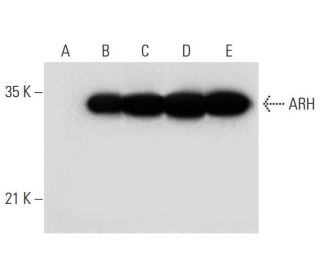


Anticorps ARH (F-11): sc-514106
- L'anticorps ARH F-11 est un monoclonal IgG3 (chaîne légère kappa) L'Anticorps ARH fourni en 200 µg/ml
- dirigé contre les acides aminés 74-192 dans une région interne de ARH d'origine human
- recommandé pour la détection de ARH d'origine human par WB, IP, IF et ELISA
- m-IgG3 BP-HRP est le réactif de détection secondaire préféré pour ARH Anticorps (F-11) pour les applications WB. Ce réactif est désormais proposé dans un ensemble avec ARH Anticorps (F-11)(voir les informations de commande ci-dessous).

ACCÈS RAPIDE AUX LIENS
VOIR ÉGALEMENT...
L'anticorps ARH (F-11) est un anticorps monoclonal ARH de souris IgG3 κ (également désigné anticorps ARH) qui détecte la protéine ARH d'origine humaine par WB, IP, IF et ELISA. L'anticorps ARH (F-11) est disponible sous forme d'anticorps non conjugué anti-ARH. La protéine ARH (protéine d'hypercholestérolémie récessive autosomique), également connue sous le nom de LDLRAP1 (protéine adaptatrice 1 du récepteur des lipoprotéines de faible densité), est une protéine cytoplasmique de 308 acides aminés qui contient un domaine PID. L'ARH est une protéine adaptatrice nécessaire à l'endocytose efficace du récepteur des LDL (LDLR) à partir de puits enrobés dans les cellules polarisées telles que les hépatocytes et les lymphocytes. Pour ce faire, ARH agit pour stabiliser l'interaction entre le récepteur et les composants structurels des puits. Bien qu'elle soit exprimée à des niveaux élevés dans les reins, le foie et le placenta, l'ARH est exprimée à des niveaux faibles dans le cerveau, le cœur, les muscles, le côlon, la rate, l'intestin, les poumons et les leucocytes. Les défauts du gène ARH sont à l'origine de l'hypercholestérolémie autosomique récessive, une maladie causée par une internalisation défectueuse des récepteurs LDL (LDLR) dans le foie. L'hypercholestérolémie autosomique récessive présente les caractéristiques cliniques de l'hypercholestérolémie familiale (FH), notamment un taux plasmatique de cholestérol LDL très élevé, des xanthomes tubéreux et tendineux et une athérosclérose prématurée.
Alexa Fluor® est une marque déposée de Molecular Probes Inc., OR., USA
LI-COR® et Odyssey® sont marques déposées de LI-COR Biosciences
Anticorps ARH (F-11) Références:
- Hypercholestérolémie autosomique récessive causée par des mutations dans une protéine adaptatrice putative du récepteur LDL. | Garcia, CK., et al. 2001. Science. 292: 1394-8. PMID: 11326085
- Une mutation du gène ARH et un locus du chromosome 13q influencent les taux de cholestérol dans une nouvelle forme d'hypercholestérolémie familiale digénique récessive. | Al-Kateb, H., et al. 2002. Circ Res. 90: 951-8. PMID: 12016260
- ARH est une protéine adaptatrice modulaire qui interagit avec le récepteur LDL, la clathrine et AP-2. | He, G., et al. 2002. J Biol Chem. 277: 44044-9. PMID: 12221107
- Mécanismes moléculaires de l'hypercholestérolémie autosomique récessive. | Wilund, KR., et al. 2002. Hum Mol Genet. 11: 3019-30. PMID: 12417523
- La protéine de l'hypercholestérolémie autosomique récessive (ARH) s'interface directement avec la machinerie clathrine-coat. | Mishra, SK., et al. 2002. Proc Natl Acad Sci U S A. 99: 16099-104. PMID: 12451172
- Dissection fonctionnelle d'une séquence de liaison à l'appendice AP-2 bêta2 dans la protéine d'hypercholestérolémie autosomique récessive. | Mishra, SK., et al. 2005. J Biol Chem. 280: 19270-80. PMID: 15728179
- La protéine adaptatrice ARH est recrutée à la membrane plasmique par la liaison des lipoprotéines de faible densité (LDL) et module l'endocytose du complexe récepteur LDL/LDL dans les hépatocytes. | Sirinian, MI., et al. 2005. J Biol Chem. 280: 38416-23. PMID: 16129683
- La protéine adaptatrice modulaire de l'hypercholestérolémie récessive autosomique (ARH) favorise le regroupement des récepteurs des lipoprotéines de faible densité dans des puits recouverts de clathrine. | Garuti, R., et al. 2005. J Biol Chem. 280: 40996-1004. PMID: 16179341
Informations pour la commande
| Nom du produit | Ref. Catalogue | COND. | Prix HT | QTÉ | Favoris | |
Anticorps ARH (F-11) | sc-514106 | 200 µg/ml | $322.00 | |||
ARH (F-11): m-IgG3 BP-HRP Kit | sc-550608 | 200 µg Ab; 40 µg BP | $361.00 |