
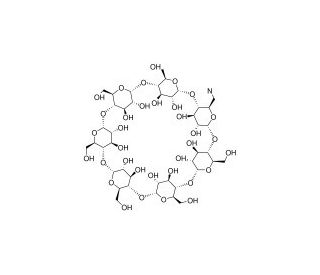

6-Monodeoxy-6-monoamino-β-cyclodextrin (CAS 126927-47-7)
QUICK LINKS
6-Monodeoxy-6-monoamino-β-cyclodextrin is a functionalized β-cyclodextrin derivative widely used in chemical, materials, and supramolecular chemistry research. The amino substitution at the 6-position provides a reactive site for chemical conjugation while preserving the characteristic host-guest binding properties of the cyclodextrin cavity. This compound is commonly employed for the covalent attachment of polymers, fluorophores, ligands, biomolecules, and surface modifiers, making it a valuable tool for studying molecular recognition, molecular encapsulation, and host-guest interactions. It is also used as a building block in the development of supramolecular assemblies, stimuli-responsive materials, molecular machines, and functional sensors for analytical research. Due to its versatile chemical reactivity and inclusion complex-forming ability, 6-Monodeoxy-6-monoamino-β-cyclodextrin is an important reagent for the synthesis and characterization of advanced cyclodextrin-based materials and conjugates for research applications.
6-Monodeoxy-6-monoamino-β-cyclodextrin (CAS 126927-47-7) References
- Protein nanopores with covalently attached molecular adapters. | Wu, HC., et al. 2007. J Am Chem Soc. 129: 16142-8. PMID: 18047341
- Ester hydrolysis by a cyclodextrin dimer catalyst with a metallophenanthroline linking group. | Zhou, YH., et al. 2008. Chemistry. 14: 7193-201. PMID: 18601233
- Bioadhesive properties and biodistribution of cyclodextrin-poly(anhydride) nanoparticles. | Agüeros, M., et al. 2009. Eur J Pharm Sci. 37: 231-40. PMID: 19491010
- Ester hydrolysis by a cyclodextrin dimer catalyst with a tridentate N,N',N''-zinc linking group. | Tang, SP., et al. 2009. Chem Asian J. 4: 1354-60. PMID: 19579255
- Increased oral bioavailability of paclitaxel by its encapsulation through complex formation with cyclodextrins in poly(anhydride) nanoparticles. | Agüeros, M., et al. 2010. J Control Release. 145: 2-8. PMID: 20347897
- Beta-cyclodextrin/surface plasmon resonance detection system for sensing bitter-astringent taste intensity of green tea catechins. | Hayashi, N., et al. 2010. J Agric Food Chem. 58: 8351-6. PMID: 20572674
- Optimized alkylated cyclodextrin polysulphates with reduced risks on thromboembolic accidents improve osteoarthritic chondrocyte metabolism. | Groeneboer, S., et al. 2011. Rheumatology (Oxford). 50: 1226-35. PMID: 21345936
- Generalized model of electromigration with 1:1 (analyte:selector) complexation stoichiometry: part II. Application to dual systems and experimental verification. | Müllerová, L., et al. 2015. J Chromatogr A. 1384: 147-54. PMID: 25666498
- Injectable Glycol Chitosan Hydrogel Containing Folic Acid-Functionalized Cyclodextrin-Paclitaxel Complex for Breast Cancer Therapy. | Hyun, H., et al. 2021. Nanomaterials (Basel). 11: PMID: 33513732
- Cyclodextrins as selectivity enhancers in capillary zone electrophoresis of proteins. | Rathore, AS. and Horváth, C. 1998. Electrophoresis. 19: 2285-9. PMID: 9788310
Ordering Information
| Product Name | Catalog # | UNIT | Price | Qty | FAVORITES | |
6-Monodeoxy-6-monoamino-β-cyclodextrin, 1 g | sc-300036 | 1 g | $1375.00 |