
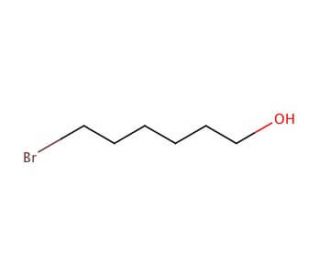

6-Bromo-1-hexanol (CAS 4286-55-9)
QUICK LINKS
6-Bromo-1-hexanol, also referred to as 6-bromohexanol, is an organic compound of the bromoalcohol class, serving as a valuable resource in proteomics research. It acts as a reagent for synthesizing diverse organic compounds, including pharmaceuticals, flavorings, fragrances, brominated polymers, brominated polyesters, and biochemicals such as brominated fatty acids, steroids, and peptides. While the precise mechanism of action of 6-bromo-1-hexanol is not entirely elucidated, its reactivity is attributed to the bromine atom within the molecule. This bromine atom serves as a nucleophile, initiating substrate attack and generating a bromonium ion, which can undergo diverse reactions contingent upon the reaction conditions. The biochemical and physiological effects of 6-bromo-1-hexanol are still being investigated, and current studies have revealed its multifaceted impact on organisms. Notably, it has shown enzyme inhibition properties, induces cell death, and can impede protein synthesis. Additionally, 6-bromo-1-hexanol has been observed to influence gene expression, particularly those involved in regulating cell growth and differentiation. Continued exploration into the full extent of its effects is ongoing, with implications for understanding its broader significance in various biological processes.
6-Bromo-1-hexanol (CAS 4286-55-9) References
- Synthesis of 9,9,9-trideutero-1,4-dihydroxynonane mercapturic acid (d3-DHN-MA), a useful internal standard for DHN-MA urinalysis. | Chantegrel, B., et al. 2002. Lipids. 37: 1013-8. PMID: 12530562
- Study on the surface density of surface-active substances through total-reflection X-ray absorption fine structure measurement. | Kashimoto, K., et al. 2006. Langmuir. 22: 8403-8. PMID: 16981755
- Free-surface molecular command systems for photoalignment of liquid crystalline materials. | Fukuhara, K., et al. 2014. Nat Commun. 5: 3320. PMID: 24534881
- Cucurbit[6]uril in combination with guanidinium ionic liquid as a new type of stationary phase for capillary gas chromatography. | Wang, L., et al. 2014. J Chromatogr A. 1334: 112-7. PMID: 24560922
- A Facile Method for the Conversion of Primary Alkyl Chlorides to the Corresponding Bromides | James H. Babler and & Kenneth P. Spina. 1984. Synthetic Communications. 14(14): 1313-1319.
- Synthesis, evaluation and incorporation into liposomes of 4-functionalised-2,5-diphenyloxazole derivatives for application in scintillation proximity assays | MC McCairn, SJ Culliford, RZ Kozlowski. 2004. Tetrahedron Letters. 45(10): 2163-2166.
- Effect of cation structure on the electrochemical and thermal properties of ion conductive polymers obtained from polymerizable ionic liquids | W Ogihara, S Washiro, H Nakajima, H Ohno. 2006. Electrochimica Acta. 51(13): 2614-2619.
- Imidazolium Polyesters: Structure–Property Relationships in Thermal Behavior, Ionic Conductivity, and Morphology | and Minjae Lee, U. Hyeok Choi, David Salas-de la Cruz, Anuj Mittal, Karen I. Winey, Ralph H. Colby, Harry W. Gibson. 2011. Advanced Functional Materials. 21(4): 708-717.
- Synthesis and physical properties of highly branched perfluorinated polymers from AB and AB2 monomers | Matthew J. Quast, Aaron D. Argall, Cassandra J. Hager, Anja Mueller. 2015. Journal of Polymer Science. 53(16): 1880-1894.
- Synthesis of Polymerizable Ionic Liquid Monomer and Its Characterization | Jagannath Sardar, Uno Mäeorg, Illia Krasnou, Vikram Baddam, Viktoria Gudkova, Andres Krumme, Natalja Savest, Elvira Tarasova and Mihkel Viirsalu. 2015. IOP Conference Series: Materials Science and Engineering. 111: 16–18.
- A visible light responsive azobenzene-functionalized polymer: Synthesis, self-assembly, and photoresponsive properties | and Guojie Wang, Dong Yuan, Tingting Yuan, Jie Dong, Ning Feng, Guoxiang Han. 2015. Journal of Polymer Science. 53(23): 2768-2775.
- A total and convergent synthesis of (7Z,11Z,13E)-7,11,13-Hexadecatrienal, the major sex pheromone component of the citrus leafminer, Phyllocnistis citrella | R Awalekar, P Mohire, N Valekar, S Usmani. 2020. Chemical Data Collections. 30: 100567.
- Continuous synthesis of bromoalkyl glycosides by Fischer glycosylation in a microreactor | , et al. 2022. Journal of Flow Chemistry. 12: 9–15.
Ordering Information
| Product Name | Catalog # | UNIT | Price | Qty | FAVORITES | |
6-Bromo-1-hexanol, 5 g | sc-239090 | 5 g | $92.00 | |||
6-Bromo-1-hexanol, 100 g | sc-239090A | 100 g | $214.00 | |||
6-Bromo-1-hexanol, 500 g | sc-239090B | 500 g | $656.00 | |||
6-Bromo-1-hexanol, 1 kg | sc-239090C | 1 kg | $1082.00 |