
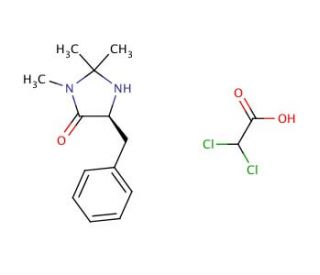

(5S)-(−)-2,2,3-Trimethyl-5-benzyl-4-imidazolidinone dichloroacetic acid (CAS 345358-20-5)
ENLACES RÁPIDOS
El ácido dicloroacético (5S)-(-)-2,2,3-trimetil-5-bencil-4-imidazolidinona funciona como catalizador en reacciones químicas, concretamente en la formación de enlaces carbono-carbono. Su mecanismo de acción implica interactuar con el sustrato y facilitar la formación de nuevos enlaces químicos a través de una serie de pasos intermedios. El Ácido Dicloroacético (5s)-(-)-2,2,3-Trimetil-5-Bencil-4-Imidazolidinona actúa como auxiliar quiral, influyendo en la estereoquímica de los productos de reacción mediante el control de la orientación de las moléculas reaccionantes. Desempeña un papel en la promoción del resultado estereoquímico deseado de la reacción, dando lugar a la formación de enantiómeros o diastereómeros específicos. El mecanismo de acción del compuesto implica su capacidad para estabilizar los estados de transición y reducir la energía de activación de la reacción, aumentando así la velocidad de la transformación química. En aplicaciones experimentales, el ácido dicloroacético (5S)-(-)-2,2,3-trimetil-5-bencil-4-imidazolidinona se utiliza para conseguir una alta selectividad y eficacia en la síntesis de moléculas orgánicas complejas.
Información sobre pedidos
| Nombre del producto | Número de catálogo | UNIDAD | Precio | CANTIDAD | Favoritos | |
(5S)-(−)-2,2,3-Trimethyl-5-benzyl-4-imidazolidinone dichloroacetic acid, 500 mg | sc-291151 | 500 mg | $122.00 |