
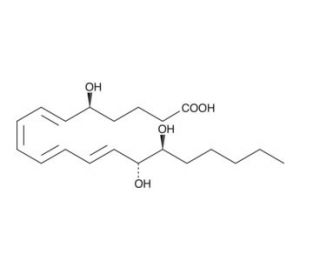

5(S),14(R)-Lipoxin B4 (CAS 98049-69-5)
QUICK LINKS
5(S),14(R)-Lipoxin B4, with the CAS number 98049-69-5, is a specialized lipid molecule classified as a lipoxin, which is part of the larger family of bioactive compounds known as eicosanoids. These molecules are derived from arachidonic acid, a polyunsaturated fatty acid that plays a critical role in the inflammatory response and cellular signaling. Lipoxin B4 specifically is characterized by its unique structural conformation and stereochemistry, which are crucial for its function. In research, 5(S),14(R)-Lipoxin B4 is extensively studied for its role in modulating inflammation through non-classical pathways. Unlike other pro-inflammatory mediators, lipoxins generally act to resolve inflammation and promote the return to homeostasis. This specific isomer of Lipoxin B4 interacts with distinct G-protein-coupled receptors on the surfaces of immune cells, leading to the suppression of chemotactic response and inhibition of the migration of leukocytes to sites of inflammation. Furthermore, it influences the cytokine secretion profile, shifting the balance towards anti-inflammatory and reparative processes. These actions make 5(S),14(R)-Lipoxin B4 a subject of interest in the study of the resolution phase of inflammation, providing insights into the mechanisms of inflammation resolution and the potential for modulating immune responses in pathological conditions without directly invoking immune suppression.
5(S),14(R)-Lipoxin B4 (CAS 98049-69-5) References
- Soluble epoxide hydrolase as an anti-inflammatory target of the thrombolytic stroke drug SMTP-7. | Matsumoto, N., et al. 2014. J Biol Chem. 289: 35826-38. PMID: 25361765
- Resolvin E1 in Follicular Fluid Acts as a Potential Biomarker and Improves Oocyte Developmental Competence by Optimizing Cumulus Cells. | Zhang, Y., et al. 2020. Front Endocrinol (Lausanne). 11: 210. PMID: 32373069
- Lipidomics Profiling of Hidradenitis Suppurativa Skin Lesions Reveals Lipoxygenase Pathway Dysregulation and Accumulation of Proinflammatory Leukotriene B4. | Penno, CA., et al. 2020. J Invest Dermatol. 140: 2421-2432.e10. PMID: 32387270
- Transcriptome sequencing and metabolite analysis reveal the toxic effects of nanoplastics on tilapia after exposure to polystyrene. | Pang, M., et al. 2021. Environ Pollut. 277: 116860. PMID: 33714129
- Lipoxins reduce obesity-induced adipose tissue inflammation in 3D-cultured human adipocytes and explant cultures. | Soták, M., et al. 2022. iScience. 25: 104602. PMID: 35789845
- Involvement of p38 MAPK/cPLA2 and arachidonic acid metabolic pathway in Shengmai injection-induced pseudo-allergic reactions. | Wang, D., et al. 2023. J Ethnopharmacol. 309: 116357. PMID: 36906156
- Corneal metabolic biomarkers for moderate and high myopia in human. | Wu, W., et al. 2023. Exp Eye Res. 237: 109689. PMID: 37871883
- Molybdenum inhibited the growth of Phytophthora nicotiana and improved the resistance of Nicotiana tabacum L. against tobacco black shank. | Yu, B., et al. 2024. Pestic Biochem Physiol. 199: 105803. PMID: 38458661
- Dissection of gut microbiota and metabolites reveals the hypolipidemic effect of green mulberry leaf tea/black mulberry leaf tea in mice | Zhong, S., Yang, Y., Huo, J., Sun, Y., Ren, N., Lu, Q.,.. & Li, Y. 2023. Journal of Functional Foods. 111: 105906.
Ordering Information
| Product Name | Catalog # | UNIT | Price | Qty | FAVORITES | |
5(S),14(R)-Lipoxin B4, 25 µg | sc-205151 | 25 µg | $428.00 | |||
5(S),14(R)-Lipoxin B4, 50 µg | sc-205151A | 50 µg | $818.00 |