
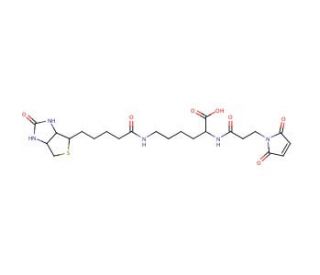

3-(N-Maleimidylpropionyl)biocytin (CAS 102849-12-7)
Ver las publicaciones del producto (4)
ENLACES RÁPIDOS
3-(N-Maleimidylpropionyl)biocytin es una sustancia química que se puede usar para unir biotina a los residuos de cisteína de péptidos y proteínas. 3-(N-Maleimidopropionyl)-biocytin (MPB) es un reactivo altamente adaptable que etiqueta selectivamente los grupos tiol, haciéndolo ideal para la etiquetación específica de tiol. Su especificidad para los grupos sulfhidrilo o los puentes disulfuro reducidos permite una etiquetación precisa de las proteínas que poseen grupos sulfhidrilo libres dentro de un rango de pH de 6.5 a 7.5. Cuando se combina con marcadores conjugados a avidina o estreptavidina, como marcadores fluorescentes o conjugados a enzimas, MPB se convierte en una herramienta valiosa para varias aplicaciones. Se puede utilizar para detectar grupos sulfhidrilo de proteínas en dot blots con una sensibilidad excepcional en el rango de femtomoles. Además, MPB encuentra su utilidad en la clasificación de células, los inmunoensayos enzimáticos, la transferencia de proteínas y una amplia gama de procedimientos citoquímicos.
3-(N-Maleimidylpropionyl)biocytin (CAS 102849-12-7) Referencias
- Un nuevo método de etiquetado apoya el modelo de cinco transmembranas de la subunidad a de la ATP sintasa de Escherichia coli. | Wada, T., et al. 1999. J Biol Chem. 274: 17353-7. PMID: 10358096
- La crioconservación altera el estado sulfhidrilo de la membrana de los espermatozoides de toro: protección por glutatión oxidado. | Chatterjee, S., et al. 2001. Mol Reprod Dev. 60: 498-506. PMID: 11746961
- Caracterización del primer bucle citoplasmático de la subunidad a de la ATP sintasa de Escherichia coli mediante etiquetado superficial, reticulación y mutagénesis. | Long, JC., et al. 2002. J Biol Chem. 277: 27288-93. PMID: 12021273
- Control redox de los cambios en los niveles de sulfhidrilo de las proteínas durante la capacitación del esperma humano. | de Lamirande, E. and Gagnon, C. 2003. Free Radic Biol Med. 35: 1271-85. PMID: 14607526
- La topología de membrana de la subunidad ligera del sistema xc- revela un bucle reentrante con accesibilidad restringida al sustrato. | Gasol, E., et al. 2004. J Biol Chem. 279: 31228-36. PMID: 15151999
- Interacción y asociación funcional de la proteína disulfuro isomerasa con la integrina alfaVbeta3 en células endoteliales. | Swiatkowska, M., et al. 2008. FEBS J. 275: 1813-23. PMID: 18331351
- Los tioles de la integrina alfaIIbbeta3 son necesarios para la agregación plaquetaria. | Manickam, N., et al. 2008. Br J Haematol. 142: 457-65. PMID: 18537975
- El cribado molecular asistido por docking revela que el ácido tánico es un inhibidor natural de la proteína disulfuro isomerasa con actividad antiplaquetaria y antitrombótica. | Ren, L., et al. 2020. J Cell Mol Med. 24: 14257-14269. PMID: 33128352
- Localización del dominio maleimida-reactivo orientado citosolicamente de la H(+)-pirofosfatasa vacuolar. | Zhen, RG., et al. 1994. J Biol Chem. 269: 23342-50. PMID: 8083239
- Identificación del sitio fisiológico de transferencia de electrones de la citocromo c peroxidasa mediante ingeniería basada en estructuras. | Miller, MA., et al. 1996. Biochemistry. 35: 667-73. PMID: 8547245
- Sondas enzimáticas y bioquímicas de residuos externos a la vía de translocación de UhpT, el transportador de fosfato de azúcar de Escherichia coli. | Matos, M., et al. 1996. J Biol Chem. 271: 18571-5. PMID: 8702506
- Topología de la membrana de la subunidad a de la ATP sintasa F1F0 determinada por el etiquetado de residuos de cisteína únicos. | Long, JC., et al. 1998. J Biol Chem. 273: 16235-40. PMID: 9632682
- Topología de la región que rodea Glu681 de la proteína humana AE1, el intercambiador de aniones eritrocitario. | Tang, XB., et al. 1998. J Biol Chem. 273: 22545-53. PMID: 9712881
- Simetría funcional de UhpT, el transportador de fosfato de azúcar de Escherichia coli. | Fann, MC. and Maloney, PC. 1998. J Biol Chem. 273: 33735-40. PMID: 9837961
- Control redox de los tioles/disulfuros proteicos exofaciales por la proteína disulfuro isomerasa. | Jiang, XM., et al. 1999. J Biol Chem. 274: 2416-23. PMID: 9891011
Información sobre pedidos
| Nombre del producto | Número de catálogo | UNIDAD | Precio | CANTIDAD | Favoritos | |
3-(N-Maleimidylpropionyl)biocytin, 50 mg | sc-216373 | 50 mg | $343.00 | |||
3-(N-Maleimidylpropionyl)biocytin, 100 mg | sc-216373A | 100 mg | $617.00 |