
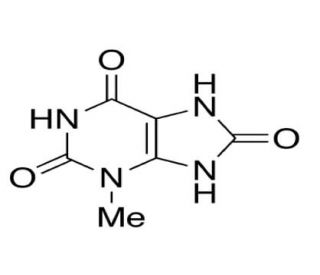

3-Methyluric Acid (CAS 605-99-2)
See product citations (1)
QUICK LINKS
3-Methyluric acid (3-MU) is a naturally occurring purine compound that holds significance as a intermediate in both animal and plant metabolic pathways. Its role extends beyond intermediacy, as it plays a key part in synthesizing various essential compounds, including drugs, vitamins, and hormones. In terms of metabolic regulation, 3-Methyluric acid exhibits inhibitory effects on specific enzymes, such as xanthine oxidase and aldehyde oxidase. Moreover, it acts as an inhibitor of 5-lipoxygenase, an enzyme involved in the production of pro-inflammatory leukotrienes. As such, 3-Methyluric acid contributes significantly to the modulation of certain metabolic pathways while showcasing its inhibitory potential on key enzymes.
3-Methyluric Acid (CAS 605-99-2) References
- Urinary recovery of caffeine and its metabolites in healthy African children. | Akinyinka, OO., et al. 2001. Afr J Med Med Sci. 30: 1-4. PMID: 14510139
- An unusual patient with kidney stones composed of 1-methyluric acid. | Davies, PM., et al. 2006. Urol Res. 34: 58-60. PMID: 16397778
- Two distinct pathways for metabolism of theophylline and caffeine are coexpressed in Pseudomonas putida CBB5. | Yu, CL., et al. 2009. J Bacteriol. 191: 4624-32. PMID: 19447909
- Pharmacological and biochemical activities of some monomethylxanthine and methyluric acid derivatives of theophylline and caffeine. | Williams, JF., et al. 1978. Biochem Pharmacol. 27: 1545-50. PMID: 212074
- The urinary metabolomic profile following the intake of meals supplemented with a cocoa extract in middle-aged obese subjects. | Ibero-Baraibar, I., et al. 2016. Food Funct. 7: 1924-31. PMID: 26961599
- Isolation, characterization and application of theophylline-degrading Aspergillus fungi. | Zhou, B., et al. 2020. Microb Cell Fact. 19: 72. PMID: 32192512
- 3-Methylxanthine production through biodegradation of theobromine by Aspergillus sydowii PT-2. | Zhou, B., et al. 2020. BMC Microbiol. 20: 269. PMID: 32854634
- Reactions of theophylline, theobromine and caffeine with Fenton's reagent--simulation of hepatic metabolism. | Zbaida, S., et al. 1987. Xenobiotica. 17: 617-21. PMID: 3604265
- Action of 8-azaguanine and 8-azaxanthine on Pseudomonas aeruginosa. | Bergmann, F., et al. 1964. Biochem J. 91: 270-6. PMID: 4953816
- Non-linear elimination processes of theophylline. | Gundert-Remy, U., et al. 1983. Eur J Clin Pharmacol. 24: 71-8. PMID: 6832205
- Caffeine does not bind covalently to liver microsomes from different animal species and to proteins and DNA from perfused rat liver. | Szczawinska, K., et al. 1981. Chem Biol Interact. 34: 345-54. PMID: 7460090
- Determination of caffeine and its metabolites in urine by high-performance liquid chromatography and capillary electrophoresis. | Rodopoulos, N. and Norman, A. 1994. Scand J Clin Lab Invest. 54: 305-15. PMID: 7939374
- Elimination of theophylline metabolites in healthy adults. | Rodopoulos, N. and Norman, A. 1997. Scand J Clin Lab Invest. 57: 233-40. PMID: 9238759
Ordering Information
| Product Name | Catalog # | UNIT | Price | Qty | FAVORITES | |
3-Methyluric Acid, 25 mg | sc-500919 | 25 mg | $359.00 | |||
3-Methyluric Acid, 250 mg | sc-500919A | 250 mg | $2502.00 |