
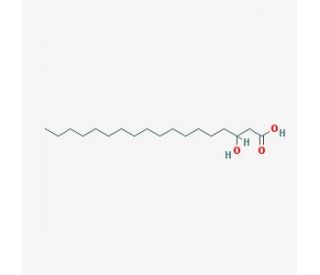

3-Hydroxyoctadecanoic acid (CAS 45261-96-9)
QUICK LINKS
3-Hydroxyoctadecanoic acid, with the CAS number 45261-96-9, is a hydroxy fatty acid that has drawn attention in the field of biochemistry and organic chemistry due to its structural and functional properties. This compound is characterized by the presence of a hydroxyl group at the third carbon of an octadecanoic acid chain, which significantly impacts its chemical behavior and interactions within biological systems. In research environments, 3-hydroxyoctadecanoic acid is frequently utilized as a model compound to study the biochemical pathways and mechanisms involving hydroxylation reactions in fatty acids. These studies are essential for unfolding the complexities of lipid metabolism, particularly in understanding how cells modify fatty acid chains through enzymatic processes. The presence of the hydroxyl group also affects the molecule′s physical properties, such as melting point and solubility, which are pivotal in studies related to lipid membranes and their dynamics. Additionally, this chemical has been used in the synthesis of complex lipids and as a starting material in the production of biologically active molecules in non-medical research, providing a foundation for exploring the roles of modified fatty acids in various biochemical systems. Through these applications, 3-hydroxyoctadecanoic acid serves as a crucial tool in advancing our comprehension of lipid chemistry and its implications in broader scientific contexts.
3-Hydroxyoctadecanoic acid (CAS 45261-96-9) References
- Novel modification of lipid A of Francisella tularensis. | Phillips, NJ., et al. 2004. Infect Immun. 72: 5340-8. PMID: 15322031
- Compositional analysis of Helicobacter pylori rough-form lipopolysaccharides. | Moran, AP., et al. 1992. J Bacteriol. 174: 1370-7. PMID: 1735724
- Structural heterogeneity and environmentally regulated remodeling of Francisella tularensis subspecies novicida lipid A characterized by tandem mass spectrometry. | Shaffer, SA., et al. 2007. J Am Soc Mass Spectrom. 18: 1080-92. PMID: 17446084
- Profiling of 3-hydroxy fatty acids as environmental markers of endotoxin using liquid chromatography coupled to tandem mass spectrometry. | Uhlig, S., et al. 2016. J Chromatogr A. 1434: 119-26. PMID: 26818235
- Isolation and characterization of plant growth-promoting endophytic bacteria Bacillus stratosphericus LW-03 from Lilium wardii. | Khan, MS., et al. 2020. 3 Biotech. 10: 305. PMID: 32612899
- Differentiation of Campylobacter and Campylobacter-like organisms by cellular fatty acid composition. | Lambert, MA., et al. 1987. J Clin Microbiol. 25: 706-13. PMID: 3571478
- Transcriptome and Metabolome Studies on Pre-Harvest Nitrogen Impact on Fruit Yield and Quality of Peach (Prunus persica L.). | Zhang, Y., et al. 2022. Metabolites. 12: PMID: 36295807
- Widely Targeted Metabolomic Profiling Combined with Transcriptome Analysis Provides New Insights into Lipid Biosynthesis in Seed Kernels of Pinus koraiensis. | Li, Y., et al. 2023. Int J Mol Sci. 24: PMID: 37629067
- Characterization and stability evaluation of Egyptian propolis extract nano-capsules and their application. | Amin, AA., et al. 2023. Sci Rep. 13: 16065. PMID: 37752204
- Structure, Physicochemical Properties and Biological Activity of Lipopolysaccharide from the Rhizospheric Bacterium Ochrobactrum quorumnocens T1Kr02, Containing d-Fucose Residues. | Krivoruchko, AA., et al. 2024. Int J Mol Sci. 25: PMID: 38396650
Ordering Information
| Product Name | Catalog # | UNIT | Price | Qty | FAVORITES | |
3-Hydroxyoctadecanoic acid, 25 mg | sc-280370 | 25 mg | $252.00 |