
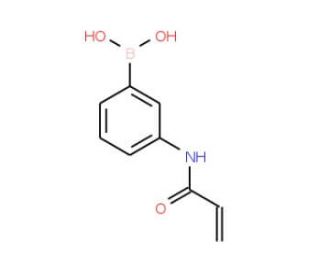

Structure moléculaire de 3-Acrylamidophenylboronic acid, Numéro CAS: 99349-68-5
3-Acrylamidophenylboronic acid (CAS 99349-68-5)
Noms alternatifs:
3-Acrylamidophenylboronic acid is also known as Phenylboronate acrylamide.
Application(s):
3-Acrylamidophenylboronic acid est un acide boronique sensible au glucose utilisé pour les solutions polymères, les gels, les systèmes d'administration de médicaments, les capteurs, les systèmes d'actionnement et les bioréacteurs.
Numéro CAS:
99349-68-5
Pureté:
≥98%
Masse Moléculaire:
190.99
Formule Moléculaire:
C9H10BNO3
Pour la Recherche Uniquement. Non conforme pour le Diagnostic ou pour une Utilisation Thérapeutique.
* Consulter le Certificat d'Analyses pour les données spécifiques à un lot (incluant la teneur en eau).
ACCÈS RAPIDE AUX LIENS
Informations pour la commande
Description
Information Technique
Données de Sécurité
SDS & Certificat d’Analyses
L'acide 3-acrylamidophénylboronique est un monomère d'acrylamide contenant un acide boronique sensible au glucose. L'acide 3-acrylamidophénylboronique est utilisé pour les solutions polymères, les gels, les capteurs, les systèmes d'actionnement et les bioréacteurs. Les polymères dérivés de ce composé peuvent être conçus pour détecter le glucose ou d'autres saccharides. Le groupe acide boronique forme des complexes avec les sucres dans les solutions aqueuses, ce qui peut entraîner des changements dans les propriétés du polymère (comme le gonflement ou la fluorescence) qui sont mesurables et peuvent être corrélés avec la concentration de la molécule cible.
3-Acrylamidophenylboronic acid (CAS 99349-68-5) Références
- Polymère totalement synthétique avec une fonction de type lectine: induction de cellules tueuses par le copolymère de l'acide 3-acrylamidophénylboronique avec le N,N-diméthylacrylamide. | Uchimura, E., et al. 2001. Biotechnol Bioeng. 72: 307-14. PMID: 11135200
- Capteurs holographiques sensibles au glucose pour surveiller la croissance bactérienne. | Lee, MC., et al. 2004. Anal Chem. 76: 5748-55. PMID: 15456294
- Étoiles macromoléculaires covalentes dynamiques avec des liaisons d'esters boroniques. | Bapat, AP., et al. 2011. J Am Chem Soc. 133: 19832-8. PMID: 22103352
- Nanoparticules glycopolymériques fonctionnalisées à l'acide phénylboronique pour l'administration de biomacromolécules dans les voies respiratoires nasales. | Zhang, X., et al. 2012. Eur J Pharm Biopharm. 82: 76-84. PMID: 22659236
- Matériaux d'affinité boronates greffés de polyéthylèneimine pour l'enrichissement sélectif de composés contenant du cis-diol. | Xue, Y., et al. 2015. Talanta. 140: 1-9. PMID: 26048816
- Un capteur de glucose urinaire non enzymatique avec un hydrogel à cristaux photoniques 2-D. | Yan, Z., et al. 2016. Anal Bioanal Chem. 408: 8317-8323. PMID: 27682838
- Nanoparticules sensibles au glucose et à la température pour l'administration d'insuline. | Wu, JZ., et al. 2017. Int J Nanomedicine. 12: 4037-4057. PMID: 28603417
- Les nanoparticules préparées à partir de ptérostilbène réduisent la glycémie et améliorent les complications du diabète. | Zhao, X., et al. 2021. J Nanobiotechnology. 19: 191. PMID: 34176494
- De nouvelles nanoparticules sensibles au glucose, basées sur l'anisate de p-hydroxyphényle et l'acide 3-acrylamidophénylboronique, réduisent la glycémie et améliorent la néphropathie diabétique. | Ma, Q., et al. 2022. Mater Today Bio. 13: 100181. PMID: 34927045
- Incorporation d'acide boronique dans des hydrogels à empreintes moléculaires à base d'aptamères pour une reconnaissance hautement spécifique de l'adénosine. | Li, Y., et al. 2020. ACS Appl Bio Mater. 3: 2568-2576. PMID: 35025389
- Libération contrôlée de l'insuline basée sur des biomicrocapsules sensibles à la température et au glucose. | Fan, X., et al. 2022. Molecules. 27: PMID: 35268787
- Synthèse de copolymères à blocs par polymérisation radicalaire et conjugaison 'click' thiol-maléimide. | Rambarran, T. and Sheardown, HD. 2021. RSC Adv. 11: 34631-34635. PMID: 35494753
- Délivrance d'adénosine assistée par microgel pour accélérer la guérison des fractures. | Hoque, J., et al. 2022. ACS Biomater Sci Eng. 8: 4863-4872. PMID: 36266245
Informations pour la commande
| Nom du produit | Ref. Catalogue | COND. | Prix HT | QTÉ | Favoris | |
3-Acrylamidophenylboronic acid, 1 g | sc-260668 | 1 g | $230.00 | |||
3-Acrylamidophenylboronic acid, 5 g | sc-260668A | 5 g | $903.00 |