
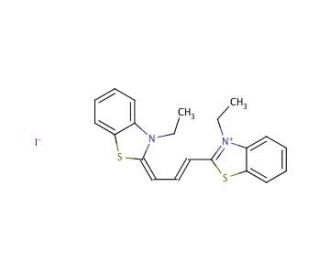


3,3′-Diethylthiacarbocyanine iodide (CAS 905-97-5)
See product citations (1)
QUICK LINKS
3,3′-Diethylthiacarbocyanine iodide, often utilized as a fluorescent dye in the realm of microscopy and spectroscopy, plays a critical role in the study of membrane potentials and the dynamics of lipid membranes. This dye is part of the cyanine family, characterized by its ability to absorb and emit light within the near-infrared region, making it particularly suitable for deep tissue imaging and applications requiring minimal phototoxicity and autofluorescence interference. The unique structure of 3,3′-Diethylthiacarbocyanine iodide, with its conjugated system that includes a central thiacarbocyanine moiety flanked by ethyl groups, contributes to its high extinction coefficient and quantum yield, which are essential properties for sensitive fluorescence detection.
3,3′-Diethylthiacarbocyanine iodide (CAS 905-97-5) References
- Leucine transport is affected by Bacillus thuringiensis Cry1 toxins in brush border membrane vesicles from Ostrinia nubilalis Hb (Lepidoptera: Pyralidae) and Sesamia nonagrioides Lefebvre (Lepidoptera: Noctuidae) midgut. | Leonardi, MG., et al. 2006. J Membr Biol. 214: 157-64. PMID: 17558532
- Accelerated photobleaching of a cyanine dye in the presence of a ternary target DNA, PNA probe, dye catalytic complex: a molecular diagnostic. | Wang, M., et al. 2009. Anal Chem. 81: 2043-52. PMID: 19231844
- Molecular capture in protein nanotubes. | Qu, X. and Komatsu, T. 2010. ACS Nano. 4: 563-73. PMID: 20020754
- [Photosensitizing properties of 3,3'-diethylthiacarbocyanine in biological media]. | Andreev, VM., et al. 2014. Radiats Biol Radioecol. 54: 367-76. PMID: 25775825
- Specific excitonic interactions in the aggregates of hyaluronic acid and cyanine dyes with different lengths of methine group. | Tobata, H. and Sagawa, T. 2016. Photochem Photobiol Sci. 15: 329-33. PMID: 26815728
- Formation of Spherulitic J-Aggregates from the Coassembly of Lithocholic Acid and Cyanine Dye. | Rhodes, S., et al. 2017. J Phys Chem Lett. 8: 4504-4509. PMID: 28872876
- The effect of structural heterogeneity upon the microviscosity of ionic liquids. | Clark, R., et al. 2020. Chem Sci. 11: 6121-6133. PMID: 32874514
- Davydov Split Aggregates of Cyanine Dyes on Self-Assembled Nanotubes. | Reddy, NR., et al. 2020. Langmuir. 36: 13649-13655. PMID: 33143426
- Fluorescent H-Aggregate Vesicles and Tubes of a Cyanine Dye and Their Potential as Light-Harvesting Antennae. | Reddy, NR., et al. 2021. J Phys Chem B. 125: 7911-7918. PMID: 34232656
Ordering Information
| Product Name | Catalog # | UNIT | Price | Qty | FAVORITES | |
3,3′-Diethylthiacarbocyanine iodide, 250 mg | sc-214159 | 250 mg | $104.00 | |||
3,3′-Diethylthiacarbocyanine iodide, 1 g | sc-214159A | 1 g | $304.00 |