
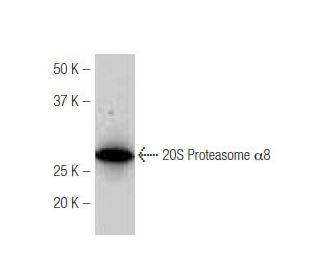

20S Proteasome α8 Antibody (N-96): sc-130488
- 20S Proteasome α8 Antibody (N-96) is a mouse monoclonal IgG1 κ provided at 50 µg/0.5 ml
- raised against recombinant 20S Proteasome α8 of human origin
- recommended for detection of 20S Proteasome α8 of human origin by WB and IP
- At present, we have not yet completed the identification of the preferred secondary detection reagent(s) for 20S Proteasome α8 Antibody (N-96). This work is in progress.

QUICK LINKS
20S Proteasome α8 Antibody (N-96) is a mouse monoclonal IgG1 antibody that detects 20S Proteasome α8 (PSMA8) in human samples through western blotting (WB) and immunoprecipitation (IP) applications. Anti-PSMA8 antibody (N-96) enables researchers to study a crucial component of the 26S proteasome, which maintains cellular homeostasis by degrading unnecessary or damaged proteins through proteolysis. PSMA8 (N-96) monoclonal antibody helps investigate this process, which regulates various cellular functions, including cell cycle, signal transduction, and response to oxidative stress. PSMA8 contributes to proteasome structural integrity and functionality by forming part of the outer rings of the core particle, which consists of multiple α and β subunits. Proper assembly and function of the proteasome prevent misfolded protein accumulation, which can lead to cellular dysfunction and diseases such as cancer and neurodegenerative disorders. Anti-PSMA8 antibody (N-96) helps researchers gain insights into proteasome activity and its implications in various biological processes and disease states.
Alexa Fluor® is a trademark of Molecular Probes Inc., OR., USA
LI-COR® and Odyssey® are registered trademarks of LI-COR Biosciences
20S Proteasome α8 Antibody (N-96) References:
- Identification of a telomeric boundary of the HLA region with potential for predisposition to human narcolepsy. | Miyagawa, T., et al. 2000. Immunogenetics. 52: 12-8. PMID: 11132147
- Physical interaction between hepatitis C virus NS4B protein and CREB-RP/ATF6beta. | Tong, WY., et al. 2002. Biochem Biophys Res Commun. 299: 366-72. PMID: 12445808
- Coronavirus 3CLpro proteinase cleavage sites: possible relevance to SARS virus pathology. | Kiemer, L., et al. 2004. BMC Bioinformatics. 5: 72. PMID: 15180906
- Multisite phosphorylation of the cAMP response element-binding protein (CREB) by a diversity of protein kinases. | Johannessen, M. and Moens, U. 2007. Front Biosci. 12: 1814-32. PMID: 17127423
- Effects of the isoform-specific characteristics of ATF6 alpha and ATF6 beta on endoplasmic reticulum stress response gene expression and cell viability. | Thuerauf, DJ., et al. 2007. J Biol Chem. 282: 22865-78. PMID: 17522056
- cAMP-response element binding protein mediates podocyte injury in diabetic nephropathy by targeting lncRNA DLX6-AS1. | Zheng, W., et al. 2022. Metabolism. 129: 155155. PMID: 35093327
- Fatty acid binding protein 5 promotes the proliferation, migration, and invasion of hepatocellular carcinoma cells by degradation of Krüppel-like factor 9 mediated by miR-889-5p via cAMP-response element binding protein. | Tang, Y., et al. 2022. Cancer Biol Ther. 23: 424-438. PMID: 35816613
- cAMP Response Element-Binding Protein Controls the Appearance of Neuron-Like Traits in Chorion Mesenchymal Cells. | Innamorati, G., et al. 2022. Front Biosci (Landmark Ed). 27: 249. PMID: 36042162
- Therapeutic implications of phosphorylation- and dephosphorylation-dependent factors of cAMP-response element-binding protein (CREB) in neurodegeneration. | Khakha, N., et al. 2023. Pharmacol Rep. 75: 1152-1165. PMID: 37688751
- Influence of lead on cAMP-response element binding protein (CREB) and its implications in neurodegenerative disorders. | Alva, S., et al. 2024. Toxicol Lett. 400: 35-41. PMID: 39117292
Ordering Information
| Product Name | Catalog # | UNIT | Price | Qty | FAVORITES | |
20S Proteasome α8 Antibody (N-96) | sc-130488 | 50 µg/0.5 ml | $339.00 |