
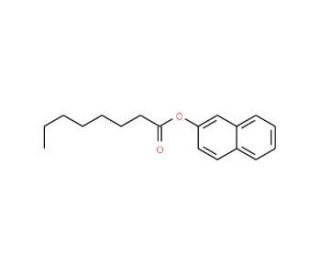

Molecular structure of 2-Naphthyl caprylate, CAS Number: 10251-17-9
2-Naphthyl caprylate (CAS 10251-17-9)
Alternate Names:
2-Naphthyl octanoate; β-Naphthyl caprylate; Octanoic acid β-naphthyl ester
Application:
2-Naphthyl caprylate is a chromogenic substrate
CAS Number:
10251-17-9
Purity:
≥98%
Molecular Weight:
270.37
Molecular Formula:
C18H22O2
Supplemental Information:
This is classified as a Dangerous Good for transport and may be subject to additional shipping charges.
For Research Use Only. Not Intended for Diagnostic or Therapeutic Use.
* Refer to Certificate of Analysis for lot specific data.
QUICK LINKS
Ordering Information
Description
Technical Information
Safety Information
SDS & Certificate of Analysis
2-Naphthyl caprylate is a chromogenic substrate for CES (carboxylesterase) and lipase. 2-naphthol is released upon hydrolyzation. By simultaneous coupling with a diazonium salt, the corresponding azo-dye is formed. Naphthols can also be detected by fluorescence analysis. Used in an colorimetric assay for the extracellular lipase of Pseudomonas fluorescens B52.
2-Naphthyl caprylate (CAS 10251-17-9) References
- Microbacterium gubbeenense sp. nov., from the surface of a smear-ripened cheese. | Brennan, NM., et al. 2001. Int J Syst Evol Microbiol. 51: 1969-1976. PMID: 11760936
- Microfloral contamination and hydrolytic enzyme differences between monsooned and non-monsooned coffees. | Ahmad, R. and Magan, N. 2002. Lett Appl Microbiol. 34: 279-82. PMID: 11940159
- Reclassification of 'Pseudomonas fluorescens subsp. cellulosa' NCIMB 10462 (Ueda et al. 1952) as Cellvibrio japonicus sp. nov. and revival of Cellvibrio vulgaris sp. nov., nom. rev. and Cellvibrio fulvus sp. nov., nom. rev. | Humphry, DR., et al. 2003. Int J Syst Evol Microbiol. 53: 393-400. PMID: 12710603
- Serine protease activity in excretory-secretory products of Oestrus ovis (Diptera: Oestridae) larvae. | Tabouret, G., et al. 2003. Vet Parasitol. 114: 305-14. PMID: 12809756
- Photometric procedure for determining esterase activity. | RAMSEY, HA. 1957. Clin Chem. 3: 185-94. PMID: 13437467
- Chryseobacterium taiwanense sp. nov., isolated from soil in Taiwan. | Tai, CJ., et al. 2006. Int J Syst Evol Microbiol. 56: 1771-1776. PMID: 16902006
- Isolation of Saccharomyces cerevisiae strains from different food matrices and their preliminary selection for a potential use as probiotics. | Pennacchia, C., et al. 2008. J Appl Microbiol. 105: 1919-28. PMID: 19120638
- Pseudo-membranes on internal organs associated with Rhodococcus qingshengii infection in Atlantic salmon (Salmo salar). | Avendaño-Herrera, R., et al. 2011. Vet Microbiol. 147: 200-4. PMID: 20580498
- Metabolism of green tea catechins by the human small intestine. | Schantz, M., et al. 2010. Biotechnol J. 5: 1050-9. PMID: 20931601
- Draft genome of Jeotgalibacillus campisalis SF-57(T), a moderate halophilic bacterium isolated from marine saltern. | Yaakop, AS., et al. 2015. Mar Genomics. 23: 59-60. PMID: 25999308
- Anti-bacterial and anti-biofilm activity of probiotic bacteria against oral pathogens. | Ben Taheur, F., et al. 2016. Microb Pathog. 97: 213-20. PMID: 27317856
- Rapid enzymatic method for biotyping and control of lactic acid bacteria used in the production of yogurt and some cheeses. | Bianchi-Salvadori, B., et al. 1995. Int J Food Microbiol. 27: 253-61. PMID: 8579994
Substrate of:
CES, Chromogenic, and Lipase.Ordering Information
| Product Name | Catalog # | UNIT | Price | Qty | FAVORITES | |
2-Naphthyl caprylate, 250 mg | sc-280282 | 250 mg | $216.00 | |||
2-Naphthyl caprylate, 500 mg | sc-280282A | 500 mg | $255.00 |