
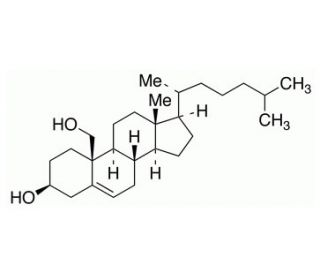

19-Hydroxy Cholesterol (CAS 561-63-7)
QUICK LINKS
19-Hydroxy Cholesterol (19HC), a cholesterol metabolite, is a significant component in various biological processes such as cholesterol metabolism, inflammation, and carcinogenesis. Due to its involvement in numerous biological processes, 19-Hydroxy Cholesterol has been investigated within the scientific community. At the molecular level, 19-Hydroxy Cholesterol acts as an agonist at the liver X receptor (LXR) and retinoid X receptor (RXR) nuclear receptors. Through this binding, gene transcription is activated, influencing cholesterol metabolism, inflammation, and carcinogenesis. 19-Hydroxy Cholesterol interacts with the peroxisome proliferator-activated receptor (PPAR) and farnesoid X receptor (FXR), regulating the expression of genes involved in lipid and bile acid metabolism.
19-Hydroxy Cholesterol (CAS 561-63-7) References
- Suppression of bile acid synthesis, but not of hepatic cholesterol 7alpha-hydroxylase expression, by obstructive cholestasis in humans. | Bertolotti, M., et al. 2001. Hepatology. 34: 234-42. PMID: 11481606
- Inhibition of stigmasterol oxidation by antioxidants in purified sunflower oil. | Rudzińska, M., et al. 2004. J AOAC Int. 87: 499-504. PMID: 15164847
- Gas chromatographic properties of common cholesterol and phytosterol oxidation products. | Apprich, S. and Ulberth, F. 2004. J Chromatogr A. 1055: 169-76. PMID: 15560493
- Influence of storage conditions on cholesterol oxidation in dried egg pasta. | Verardo, V., et al. 2010. J Agric Food Chem. 58: 3586-90. PMID: 20178394
- Phytosterol supplementation reduces metabolic activity and slows cell growth in cultured rat cardiomyocytes. | Danesi, F., et al. 2011. Br J Nutr. 106: 540-8. PMID: 21554812
- A new SPE/GC-fid method for the determination of cholesterol oxidation products. Application to subcutaneous fat from Iberian dry-cured ham. | Narváez-Rivas, M., et al. 2014. Talanta. 122: 58-62. PMID: 24720962
- Switch-like responses of two cholesterol sensors do not require protein oligomerization in membranes. | Gay, A., et al. 2015. Biophys J. 108: 1459-1469. PMID: 25809258
- Evidence for the existence of non-esterified cholesterol carried by albumin in rat serum. | Deliconstantinos, G., et al. 1986. Atherosclerosis. 61: 67-75. PMID: 3015157
- Photooxidation of phytosterols in oil matrix: Effects of the light, photosensitizers and unsaturation degree of the lipids. | Zhao, Y., et al. 2019. Food Chem. 288: 162-169. PMID: 30902277
- Statins interfere with the attachment of S. cerevisiae mtDNA to the inner mitochondrial membrane. | Cirigliano, A., et al. 2020. J Enzyme Inhib Med Chem. 35: 129-137. PMID: 31694426
- Formation of phytosterol photooxidation products: A chemical reaction mechanism for light-induced oxidation. | Yang, BW., et al. 2020. Food Chem. 333: 127430. PMID: 32679413
- Effect of Different Egg Products on Lipid Oxidation of Biscuits. | Verardo, V., et al. 2020. Foods. 9: PMID: 33266449
- Induction of apoptosis in endothelial cells treated with cholesterol oxides. | Lizard, G., et al. 1996. Am J Pathol. 148: 1625-38. PMID: 8623930
- Physical effects of biologically formed cholesterol oxidation products on lipid membranes investigated with fluorescence depolarization spectroscopy and electron spin resonance. | Verhagen, JC., et al. 1996. J Lipid Res. 37: 1488-502. PMID: 8827521
Ordering Information
| Product Name | Catalog # | UNIT | Price | Qty | FAVORITES | |
19-Hydroxy Cholesterol, 5 mg | sc-208882 | 5 mg | $204.00 |