
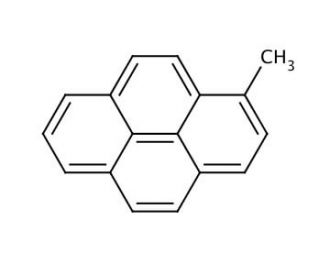

1-Methylpyrene 의 분자 구조, CAS 번호: 2381-21-7
1-Methylpyrene (CAS 2381-21-7)
대체 이름:
3-Methylpyrene
적용:
1-Methylpyrene 는 미셀 응집 수에 유용한 형광 프로브입니다.
CAS 등록번호:
2381-21-7
순도:
≥94%
분자량:
216.28
분자식:
C17H12
연구용으로만 사용가능합니다. 진단이나 치료용으로 사용불가합니다.
* Refer to Certificate of Analysis for lot specific data.
빠른 링크
주문정보
설명
기술정보
안전정보
SDS 및 분석 증명서
방향족 탄화수소 화합물인 1-메틸피렌은 과학 연구 분야에서 중요한 역할을 한다. 반응성이 높기 때문에 다양한 실험실 실험에 유용하다. 이의 작용 메커니즘은 다양한 화합물을 합성하는 데 중요한 중간체 역할을 하기 때문에 세심한 연구가 필요하다. 1-메틸피렌은 과학 연구 분야에서 다양한 응용 분야에서 유용성을 발견한다. 방향족 탄화수소의 구조와 반응성을 탐구하는 데 모범적인 화합물이다. 또한 다환 방향족 탄화수소의 대사를 연구하는 데 모범적인 역할을 한다. 또한 PAHs가 생물체에 미치는 영향을 쉽게 조사할 수 있다. 1-메틸피렌의 작용 메커니즘에 대한 완전한 이해는 아직 밝혀지지 않았지만, 간의 시토크롬 P450 효소계 내에서 대사가 진행되는 것으로 알려져 있다. 이 대사 과정은 이를 다양한 대사산물로 변환시키고, 이 대사산물은 이후 동일한 효소계 내에서 대사된다.
1-Methylpyrene (CAS 2381-21-7) 참고자료
- V79 중국 햄스터 세포에서 개별적으로 발현된 인간 및 쥐 시토크롬 P450에 의한 1-메틸피렌 및 1-에틸피렌의 벤질 하이드록실화. | Engst, W., et al. 1999. Carcinogenesis. 20: 1777-85. PMID: 10469624
- 작은 단량체 l-알파-디미리스토일포스파티딜콜린 소포에서 1-메틸피렌의 형광 붕괴. 온도 및 농도 의존성 연구. | van den Zegel, M., et al. 1984. Biophys Chem. 20: 333-45. PMID: 17005153
- 동위원소 희석 LC-MS/MS 및 32P-포스트라벨링으로 측정한 쥐의 간 1-메틸피렌 DNA 부가체의 시간 경과. | Monien, BH., et al. 2008. Chem Res Toxicol. 21: 2017-25. PMID: 18788758
- 다환 방향족 탄화수소(1-메틸피렌 및 페릴렌)에 의해 유도된 인간 각질 세포의 사이토카인 방출 및 세포 독성. | Bahri, R., et al. 2010. J Toxicol Environ Health A. 73: 552-64. PMID: 20391135
- 1-메틸피렌과 피렌의 형질 전환에 대한 네레이즈 다이시컬러의 효과: 형질 전환 효율 및 1상 및 2상 제품의 식별. | Malmquist, LM., et al. 2013. Environ Sci Technol. 47: 5383-92. PMID: 23611659
- 발암 물질인 1-메틸피렌은 반응성 황산 에스테르를 통해 생체 내 마우스와 쥐 조직에서 벤질 DNA 부가체를 형성합니다. | Bendadani, C., et al. 2014. Arch Toxicol. 88: 815-21. PMID: 24337722
- 인간 CYP2E1과 SULT1A1을 모두 발현하는 중국 햄스터 V79 유래 세포에서 1-메틸피렌과 1-하이드록시메틸피렌의 유전독성. | Jiang, H., et al. 2015. Environ Mol Mutagen. 56: 404-11. PMID: 25243916
- 발암 물질 1-메틸피렌의 근접 대사 산물인 1-하이드록시메틸피렌의 쥐에서의 대사 및 배설. | Bendadani, C., et al. 2016. Toxicology. 366-367: 43-52. PMID: 27501763
- 인간 CYP2E1 및 SULT1A1을 발현하는 V79 유래 세포에서 여러 프로뮤타겐에 의한 미세핵 유도에서 노출/회복 일정의 역할. | Jia, H., et al. 2016. Mutat Res Genet Toxicol Environ Mutagen. 808: 27-37. PMID: 27637483
- 다중벽 탄소 나노튜브와 나트륨 도데실 벤젠 설포네이트가 옥수수(Zea mays) 묘목에서 피렌과 1-메틸피렌의 생체 축적 및 전위에 미치는 영향. | Zhang, H., et al. 2017. Environ Pollut. 220: 1409-1417. PMID: 27836475
- 디벤조피렌, 7H-벤조[c]플루오렌, 5-메틸크리센, 1-메틸피렌을 포함한 탄화수소 및 발열성 환경 샘플에서 59개 PAH의 분석 및 독성. | Richter-Brockmann, S. and Achten, C. 2018. Chemosphere. 200: 495-503. PMID: 29505926
- 1-메틸피렌은 인간 CYP1A2와 설포트랜스퍼라제 1A1을 모두 발현하는 중국 햄스터 V79 유래 세포주에서 염색체 손실 및 유사분열기구 손상을 유도합니다. | Yu, H., et al. 2020. Chem Biol Interact. 332: 109283. PMID: 33035519
- 내인성 효소에 의한 대사 활성화에 따른 인간 세포에서 1-메틸피렌의 강력한 비발암성. | Li, Z., et al. 2021. Arch Toxicol. 95: 703-713. PMID: 33057863
주문정보
| 제품명 | 카탈로그 번호 | 단위 | 가격 | 수량 | 관심품목 | |
1-Methylpyrene, 100 mg | sc-213366 | 100 mg | $145.00 |