
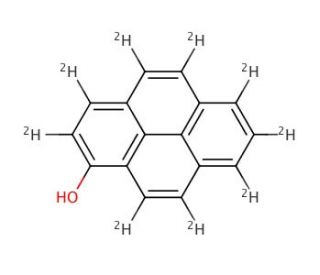

Estructura molecular de 1-Hydroxypyrene-d9, Número CAS: 132603-37-3
1-Hydroxypyrene-d9 (CAS 132603-37-3)
Nombres Alternativos:
1-Pyrenol-d9
Número de CAS:
132603-37-3
Pureza:
Isotopic purity: 98%
Peso Molecular:
227.30
Fórmula Molecular:
C16HD9O
Para Uso Exclusivo en Investigación. No está diseñado para uso en diagnosis o terapia.
* En el Certificado de Análisis específico de lote, puede encontrar información específica (como el contenido en agua).
ENLACES RÁPIDOS
Información sobre pedidos
Descripción
Información Técnica
Información de Seguridad
SDS & Certificado de Análisis
1-Hydroxypyrene-d9 es un compuesto fluorescente empleado en la investigación científica. Se encuentra en la orina humana después de la exposición al alquitrán de hulla y a un producto derivado del alquitrán de hulla. Derivado del pirén, sirve como marcador biológico para identificar moléculas que contienen pirén dentro de los sistemas biológicos. Además, los investigadores utilizan 1-hidroxipirén-d9 para investigar el metabolismo de compuestos que contienen pirén dentro de los sistemas biológicos, proporcionando información sobre sus procesos de descomposición y transformación.
1-Hydroxypyrene-d9 (CAS 132603-37-3) Referencias
- Extracción y purificación en fase sólida para la cuantificación de metabolitos de hidrocarburos aromáticos policíclicos en bilis de pescado. | Mazéas, O. and Budzinski, H. 2005. Anal Bioanal Chem. 383: 985-90. PMID: 16244859
- Metabolitos PAH biliares, actividad EROD y daño del ADN en limanda (Limanda limanda) del estuario del Sena (Francia). | Dévier, MH., et al. 2013. Environ Sci Pollut Res Int. 20: 708-22. PMID: 23208753
- Estudio comparativo de diferentes vías de exposición sobre la biotransformación y genotoxicidad de los HAP en la especie de pez plano Scophthalmus maximus. | Le Dû-Lacoste, M., et al. 2013. Environ Sci Pollut Res Int. 20: 690-707. PMID: 23247530
- Efectos de la contaminación por hidrocarburos y contaminantes orgánicos persistentes (COP) en los glicerofosfolípidos del hígado y el cerebro de machos de bacalao del Atlántico (Gadus morhua). | Bratberg, M., et al. 2013. Chemosphere. 90: 2157-71. PMID: 23266412
- Relaciones dosis-respuesta entre la exposición a hidrocarburos aromáticos policíclicos y los índices plaquetarios. | Yuan, C., et al. 2019. Environ Pollut. 245: 183-198. PMID: 30419459
- Aplicación del modelo de relación cuantitativa estructura-actividad (QSAR) en la evaluación exhaustiva del riesgo para la salud humana de los HAP y de los alquil-, nitro-, carbonil- e hidroxil- HAP cargados en el polvo de las carreteras urbanas. | Gbeddy, G., et al. 2020. J Hazard Mater. 383: 121154. PMID: 31525685
- Evaluación de intervenciones para reducir las exposiciones de los bomberos. | Burgess, JL., et al. 2020. J Occup Environ Med. 62: 279-288. PMID: 31977921
- Aplicación de técnicas de datos multivariantes en el estudio fotoquímico de hidrocarburos aromáticos policíclicos (HAP) y productos de HAP transformados en polvo de carretera. | Gbeddy, G., et al. 2020. Ecotoxicol Environ Saf. 196: 110478. PMID: 32224366
- Relaciones no lineales entre la exposición estacional a hidrocarburos aromáticos policíclicos y los niveles urinarios de 8-hidroxi-2'-desoxiguanosina entre jóvenes estudiantes chinos. | Huang, YD., et al. 2020. Chemosphere. 251: 126352. PMID: 32443248
- Influencia de la fotólisis en la caracterización de la fuente y el riesgo para la salud de los hidrocarburos aromáticos policíclicos (HAP) y los HAP carbonilados, nitrados e hidroxicados en el polvo de las carreteras urbanas. | Gbeddy, G., et al. 2021. Environ Pollut. 269: 116103. PMID: 33261958
- Evaluación de las exposiciones en el parque de bomberos mediante metabolitos urinarios de HAP. | Hoppe-Jones, C., et al. 2021. J Expo Sci Environ Epidemiol. 31: 913-922. PMID: 33654270
- Tipo de aceite de cocina doméstico y riesgo de frecuencia de micronúcleos orales en no fumadores chinos. | Jing, JJ., et al. 2022. Environ Pollut. 307: 119520. PMID: 35623571
- Efectos de los productos químicos orgánicos de las partículas de escape de gasóleo en los adipocitos diferenciados a partir de células madre mesenquimales humanas. | Brinchmann, BC., et al. 2023. Basic Clin Pharmacol Toxicol. 132: 83-97. PMID: 36214226
- Exposición a hidrocarburos aromáticos policíclicos y firma de lncRNA en plasma: Un perfil y análisis funcional. | Xu, X., et al. 2023. Sci Total Environ. 877: 162932. PMID: 36934921
Información sobre pedidos
| Nombre del producto | Número de catálogo | UNIDAD | Precio | CANTIDAD | Favoritos | |
1-Hydroxypyrene-d9, 10 mg | sc-213342 | 10 mg | $367.00 | |||
1-Hydroxypyrene-d9, 50 mg | sc-213342A | 50 mg | $1000.00 |