
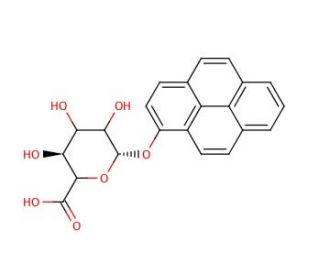

1-Hydroxypyrene β-D-Glucuronide (CAS 154717-05-2)
ENLACES RÁPIDOS
El β-D-glucurónido de 1-hidroxipireno, un metabolito derivado del pireno, destaca por su aplicación en la investigación medioambiental y bioquímica, principalmente como biomarcador de la exposición a hidrocarburos aromáticos policíclicos (HAP). La estructura del compuesto presenta una fracción de pireno, un hidrocarburo aromático policíclico, conjugada con un ácido β-D-glucurónico mediante un enlace glucosídico. Esta modificación aumenta su solubilidad en agua, facilitando su excreción y convirtiéndolo en un indicador eficaz de la exposición a HAP en estudios medioambientales. La conjugación con el ácido glucurónico es el resultado del metabolismo de fase II, un proceso de desintoxicación en el que se añaden grupos hidrófilos a las sustancias lipofílicas para facilitar su excreción. En investigación, su cuantificación en muestras biológicas, como la orina, se emplea para evaluar los niveles de exposición de los organismos a los HAP, aprovechando su especificidad y la sensibilidad de métodos de detección como la cromatografía líquida de alta resolución (HPLC) acoplada a la detección por fluorescencia. Este biomarcador es fundamental en los estudios de vigilancia e investigación del medio ambiente destinados a comprender la distribución, la acumulación y el impacto potencial de los HAP en los ecosistemas y en los organismos no humanos, contribuyendo así a la evaluación de la contaminación ambiental y sus procesos de biotransformación.
1-Hydroxypyrene β-D-Glucuronide (CAS 154717-05-2) Referencias
- Rendimiento de esferoides de hepatocitos tridimensionales de trucha arco iris (Oncorhynchus mykiss) para evaluar la biotransformación del pireno. | Hultman, MT., et al. 2019. Environ Toxicol Chem. 38: 1738-1747. PMID: 31100187
Información sobre pedidos
| Nombre del producto | Número de catálogo | UNIDAD | Precio | CANTIDAD | Favoritos | |
1-Hydroxypyrene β-D-Glucuronide, 5 mg | sc-208645 | 5 mg | $380.00 | |||
1-Hydroxypyrene β-D-Glucuronide, 10 mg | sc-208645A | 10 mg | $660.00 |