
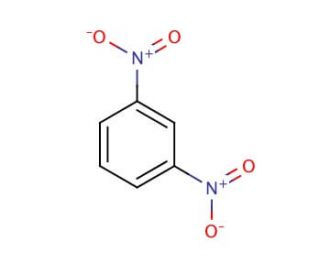

1,3-Dinitrobenzene (CAS 99-65-0)
ACCÈS RAPIDE AUX LIENS
Le 1,3-Dinitrobenzène (1,3-DNB) est un composé organique fréquemment utilisé en laboratoire comme réactif dans une multitude de réactions chimiques. Il se présente sous la forme d'un solide cristallin jaune à l'odeur caractéristique et se dissout dans l'eau. Ses utilisations couvrent un large éventail dans la synthèse organique, qui comprend la création de colorants, de pigments et d'explosifs, en plus de jouer un rôle dans la production d'additifs pour les carburants et la synthèse de polymères. Ce composé est également utilisé pour synthétiser d'autres composés nitrés et nitrosés. Malgré sa large utilisation dans diverses applications, le mécanisme exact de l'action du 1,3-Dinitrobenzène reste assez flou. On suppose que les groupes nitro de la molécule peuvent être réduits pour former un groupe nitroso, qui peut ensuite s'engager avec d'autres molécules pour former de nouveaux composés. Dans une autre voie de réaction, ces groupes nitro pourraient être oxydés pour former des ions nitrite, qui peuvent ensuite interagir avec d'autres molécules pour générer de nouveaux composés.
1,3-Dinitrobenzene (CAS 99-65-0) Références
- Métabolisme du 1,3-Dinitrobenzène et liaison aux protéines. | Reeve, IT. and Miller, MG. 2002. Chem Res Toxicol. 15: 352-60. PMID: 11896682
- Métabolisme du 1,3-Dinitrobenzène et déplétion en GSH. | Reeve, IT., et al. 2002. Chem Res Toxicol. 15: 361-6. PMID: 11896683
- Métabolisme et pharmacocinétique du 1,3-dinitrobenzène chez le rat et le hamster. | McEuen, SF. and Miller, MG. 1991. Drug Metab Dispos. 19: 661-6. PMID: 1680634
- Le 1,3-Dinitrobenzène induit l'apoptose dans les cellules sertoliennes TM4 de la souris: Implication de la voie c-Jun N-terminal kinase (JNK) MAPK. | Lee, YS., et al. 2009. Toxicol Lett. 189: 145-51. PMID: 19477251
- Identification protéomique des protéines carbonylées dans la neurotoxicité du 1,3-dinitrobenzène. | Steiner, SR. and Philbert, MA. 2011. Neurotoxicology. 32: 362-73. PMID: 21402099
- Déficience métabolique induite par le 1,3-dinitrobenzène par inactivation sélective du complexe pyruvate déshydrogénase. | Miller, JA., et al. 2011. Toxicol Sci. 122: 502-11. PMID: 21551353
- Réduction abiotique du 1,3-dinitrobenzène par des substances polymériques extracellulaires dissoutes dans l'eau et produites par des micro-organismes. | Kang, F. and Zhu, D. 2013. J Environ Qual. 42: 1441-8. PMID: 24216421
- Le 1,3-dinitrobenzène induit une oxydation spécifique à l'âge et à la région des protéines liées à la mitochondrie dans le cerveau. | Kubik, LL., et al. 2015. Toxicol Sci. 145: 48-58. PMID: 25716674
- Dégradation réductrice du 1,3-Dinitrobenzène par l'acide ascorbique alcalin - Mécanismes réactionnels, voies de dégradation et optimisation des réactifs. | Ciou, C. and Liang, C. 2017. Chemosphere. 166: 482-488. PMID: 27705834
- Génotoxicité induite par le 1,3-dinitrobène par l'altération de l'intégrité nucléaire des cellules germinales diploïdes et polyploïdes. | Peiris, LDC., et al. 2019. Dose Response. 17: 1559325819876760. PMID: 31579111
- Encéphalopathie induite par le 1,3-dinitrobenzène chez le rat. | Philbert, MA., et al. 1987. Neuropathol Appl Neurobiol. 13: 371-89. PMID: 3683748
- Évaluation de diverses mauvaises herbes naturelles et conditions de réaction pour la dégradation réductrice du 1,3-dinitrobenzène. | Luong, XTH., et al. 2023. J Hazard Mater. 454: 131467. PMID: 37104957
- Métabolisme et toxicité testiculaire du 1,3-dinitrobenzène chez le rat: effet de la voie d'administration. | McEuen, SF., et al. 1995. Fundam Appl Toxicol. 28: 94-9. PMID: 8566489
Informations pour la commande
| Nom du produit | Ref. Catalogue | COND. | Prix HT | QTÉ | Favoris | |
1,3-Dinitrobenzene, 25 g | sc-237732 | 25 g | $52.00 | |||
1,3-Dinitrobenzene, 100 g | sc-237732A | 100 g | $104.00 |