
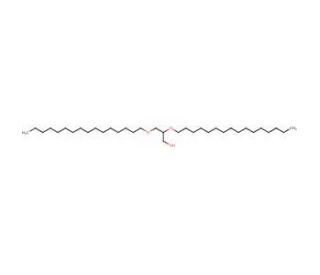

1,2-O,O-Dihexadecyl-rac-glycerol (CAS 13071-60-8)
ENLACES RÁPIDOS
El 1,2-O,O-dihexadecil-rac-glicerol (DHG) es un compuesto químico que ha suscitado una gran atención en la investigación científica debido a sus versátiles aplicaciones. El DHG consiste en una mezcla racémica de enantiómeros, con un esqueleto de glicerol con dos cadenas de hexadecil unidas. Esta estructura única ha llevado a su uso extensivo en varios campos de investigación. En el ámbito de la nanotecnología, la DHG se ha empleado en la síntesis de liposomas y nanopartículas lipídicas. Su naturaleza anfifílica permite la formación de bicapas estables, lo que la convierte en un componente valioso en sistemas de administración de fármacos y membranas modelo. Los liposomas basados en DHG permiten la liberación selectiva de cargas útiles, como agentes de imagen y material genético, al encapsularlas en el núcleo acuoso o la bicapa lipídica. La DHG también desempeña un papel crucial en la investigación biofísica y bioquímica. Sirve como bloque de construcción lipídico, imitando las membranas naturales y facilitando las investigaciones sobre las interacciones proteína-lípido, la fusión de membranas y la unión lípido-proteína. La incorporación de DHG a sistemas experimentales permite comprender mejor las propiedades estructurales y funcionales de las membranas biológicas y contribuye a profundizar en el conocimiento de los procesos celulares.
1,2-O,O-Dihexadecyl-rac-glycerol (CAS 13071-60-8) Referencias
- Extremo 3'de los conjugados de la cirugía mínimamente fosforotioato protegido oligonucleótidos con 1-O-hexadecylglycerol: síntesis y anti-ras de la actividad en la radiación de las células resistentes. | Rait, A., et al. 2000. Bioconjug Chem. 11: 153-60. PMID: 10725091
- Caracterización espectral de ocho glicerolípidos y su detección en muestras naturales mediante espectrometría de masas de iones secundarios de tiempo de vuelo. | Heim, C., et al. 2009. Rapid Commun Mass Spectrom. 23: 2741-53. PMID: 19639617
- Extracción en fluido supercrítico de biomarcadores lipídicos bacterianos y arqueos de lodos digeridos anaeróbicamente. | Hanif, M., et al. 2012. Int J Mol Sci. 13: 3022-3037. PMID: 22489140
- Arqueol: un indicador de la metanogénesis en suelos saturados de agua. | Lim, KL., et al. 2012. Archaea. 2012: 896727. PMID: 23226972
- Evaluación del arqueol como indicador molecular de la producción de metano en el ganado. | McCartney, CA., et al. 2013. J Dairy Sci. 96: 1211-7. PMID: 23261373
- Mezcla de fluidos y biosfera profunda de un sistema hidrotermal fósil tipo Ciudad Perdida en el Margen de Iberia. | Klein, F., et al. 2015. Proc Natl Acad Sci U S A. 112: 12036-41. PMID: 26324888
- Technical note: Analytical refinements of the methane indicator archaeol in bovine feces, rumen fluid, and feedtuffs. | Görs, S., et al. 2016. J Dairy Sci. 99: 9313-9318. PMID: 27592431
- Metamorfosis en Hydractinia: Estudios con activadores e inhibidores dirigidos a la proteína quinasa C y a los canales de potasio. | Leitz, T. and Klingmann, G. 1990. Rouxs Arch Dev Biol. 199: 107-113. PMID: 28305726
- Derivados lipídicos-oligodeoxiridonucleótidos ligados a 5'como inhibidores de la replicación del virus de la inmunodeficiencia humana. | Kim, SG., et al. 1996. Bioorg Med Chem. 4: 603-8. PMID: 8735848
- El glicoglicerolípido sulfatado de archaebacterium inhibe la ADN polimerasa alfa, beta y la transcriptasa inversa retroviral eucariotas y afecta a la citotoxicidad del metanosulfonato de metilo. | Ogawa, A., et al. 1998. Int J Cancer. 76: 512-8. PMID: 9590127
Información sobre pedidos
| Nombre del producto | Número de catálogo | UNIDAD | Precio | CANTIDAD | Favoritos | |
1,2-O,O-Dihexadecyl-rac-glycerol, 250 mg | sc-220529 | 250 mg | $50.00 |