
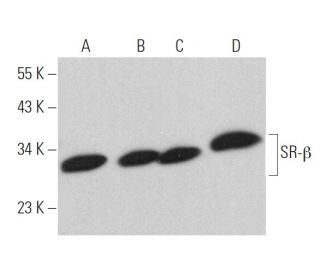
SR-β 항체 (D-4): sc-376723
- SR-beta 항체 D-4 는 마우스 monoclonal IgG2a κ SR-β 항체, 1간행물에 인용, 이며 200 µg/ml으로 제공합니다.
- human origin의 SR-β에서 C-terminus에 위치한 239-273의 아미노산사이에 위치한 항원결정부와 특정결합합니다.
- SR-beta 항체 (D-4)는 WB, IP, IF, IHC(P) and ELISA으로 mouse, rat and human유래의 SR-β 를 감지하는 데에 추천한다.
- 항-SR-beta 항체(D-4)는 IP용 agarose와 결합되어 이용 가능하며, WB, IHC(P), ELISA용 HRP와 결합되어 이용 가능하며, IF, IHC(P), FCM용 phycoerythrin 또는 FITC와 결합되어 이용 가능합니다.
- WB (RGB), IF, IHC(P) 와FCM, RGB fluorescent imaging systems, such as iBright™ FL1000, FluorChem™, Typhoon, Azure and other comparable systems에 사용가능한 Alexa Fluor® 488, Alexa Fluor® 546, Alexa Fluor® 594 or Alexa Fluor® 647결합제품도 있습니다.
- WB (NIR), IF와FCM,Near-Infrared (NIR) detection systems, such as LI-COR®Odyssey®, iBright™ FL1000, FluorChem™, Typhoon, Azure and other comparable systems에 사용가능한 Alexa Fluor® 680 or Alexa Fluor® 790 결합제품도 있습니다.
- 2a BP-HRP">m-IgG2a BP-HRP 및 m-IgGκ BP-HRP는 SR-β 항체 (D-4) WB 및 IHC(P) 애플리케이션용입니다. 이 시약은 이제 SR-β 항체 (D-4)와 함께 번들로 제공됩니다(아래 주문 정보 참조).

빠른 링크
더보기
SR-β 항체(D-4)는 IgG2a κ 마우스 단일 클론 SR-베타 항체(SRPRB 항체, SRP 수용체 서브유닛 베타 항체, SR-Beta 항체, 신호 인식 입자 수용체 서브유닛 베타 항체로도 지정됨)입니다, 신호 인식 입자 수용체 B 서브 유닛 항체, APMCF1 항체, 신호 인식 입자 수용체 베타 서브 유닛 항체 또는 SRP 수용체 베타 서브 유닛 항체)는 마우스, 쥐 및 인간 유래의 SR-beta 단백질을 WB, IP, IF, IHC(P) 및 ELISA로 검출하는 항체입니다. SR-β 항체(D-4)는 비접합 항-SR-베타 항체 형태뿐만 아니라 아가로스, HRP, PE, FITC 및 다중 Alexa Fluor® 접합체를 포함한 여러 접합 형태의 항-SR-베타 항체 형태로도 사용할 수 있습니다. 신호 인식 입자 수용체(SR-베타)의 베타 서브유닛은 Ras 저분자량 GTPase 계열의 일원으로, 초기 폴리펩타이드를 ER의 단백질 전위 기계에 표적으로 삼습니다. 신호 인식 입자 수용체(SRP)는 각각 72kDa와 30kDa인 두 개의 폴리펩타이드, SR-alpha와 SR-beta로 이루어진 헤테로다이머입니다. SRP54, SR-알파, SR-베타의 세 가지 GTPase의 상호 작용은 ER로의 공동 번역 단백질 수송을 제어합니다. SR-베타는 SR과 리보솜의 상호 작용을 조절하여 SR-알파가 막에 결합된 리보솜에서 SRP의 존재를 스캔할 수 있도록 합니다.
Alexa Fluor®는 미국 오리건주 Molecular Probes Inc.의 상표입니다.
LI-COR®와 Odyssey®는 LI-COR Biosciences의 등록 상표입니다.
SR-β 항체 (D-4) 참고문헌:
- 리보솜은 신호 인식 입자 수용체의 베타 서브 유닛의 GTPase를 조절합니다. | Bacher, G., et al. 1999. J Cell Biol. 146: 723-30. PMID: 10459008
- 신호 인식 입자 수용체 베타 서브유닛의 GTPase 도메인과 알파 서브유닛의 뉴클레오티드 의존적 결합. | Legate, KR., et al. 2000. J Biol Chem. 275: 27439-46. PMID: 10859309
- 소포체 단백질 전도 채널의 베타 서브 유닛은 신호 인식 입자 수용체의 베타 서브 유닛에 대한 구아닌 뉴클레오티드 교환 인자로서 기능합니다. | Helmers, J., et al. 2003. J Biol Chem. 278: 23686-90. PMID: 12750387
- 신호 인식 입자 수용체의 베타 서브유닛은 고유한 GTPase 활성이 없는 새로운 GTP 결합 단백질입니다. | Legate, KR. and Andrews, DW. 2003. J Biol Chem. 278: 27712-20. PMID: 12759365
- 소수성 및 친수성 서열을 포함하는 아미노 말단 도메인은 소포체 막의 베타 서브 유닛에 신호 인식 입자 수용체 알파 서브 유닛을 결합합니다. | Young, JC., et al. 1995. J Biol Chem. 270: 15650-7. PMID: 7797564
주문정보
| 제품명 | 카탈로그 번호 | 단위 | 가격 | 수량 | 관심품목 | |
SR-β 항체 (D-4) | sc-376723 | 200 µg/ml | $322.00 | |||
SR-β (D-4): m-IgGκ BP-HRP 번들 | sc-523063 | 200 µg Ab, 40 µg BP | $361.00 | |||
SR-β (D-4): m-IgG2a BP-HRP 번들 | sc-546138 | 200 µg Ab; 10 µg BP | $361.00 | |||
SR-β 항체 (D-4) AC | sc-376723 AC | 500 µg/ml, 25% agarose | $424.00 | |||
SR-β 항체 (D-4) HRP | sc-376723 HRP | 200 µg/ml | $322.00 | |||
SR-β 항체 (D-4) FITC | sc-376723 FITC | 200 µg/ml | $336.00 | |||
SR-β 항체 (D-4) PE | sc-376723 PE | 200 µg/ml | $349.00 | |||
SR-β 항체 (D-4) Alexa Fluor® 488 | sc-376723 AF488 | 200 µg/ml | $364.00 | |||
SR-β 항체 (D-4) Alexa Fluor® 546 | sc-376723 AF546 | 200 µg/ml | $364.00 | |||
SR-β 항체 (D-4) Alexa Fluor® 594 | sc-376723 AF594 | 200 µg/ml | $364.00 | |||
SR-β 항체 (D-4) Alexa Fluor® 647 | sc-376723 AF647 | 200 µg/ml | $364.00 | |||
SR-β 항체 (D-4) Alexa Fluor® 680 | sc-376723 AF680 | 200 µg/ml | $364.00 | |||
SR-β 항체 (D-4) Alexa Fluor® 790 | sc-376723 AF790 | 200 µg/ml | $364.00 | |||
SR-β (D-4) 중화펩타이드 | sc-376723 P | 100 µg/0.5 ml | $69.00 |