
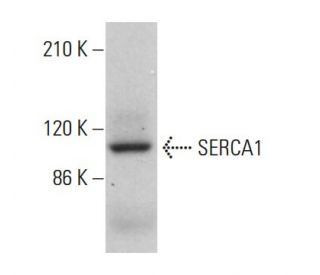


SERCA1 항체(6D139): sc-73018. 쥐 혀 조직 추출물에서 SERCA1 발현의 웨스턴 블롯 분석.
SERCA1 항체 (6D139): sc-73018
- SERCA1 항체(6D139) 는 마우스 monoclonal IgG1(kappa light chain) 이며 200 µg/ml으로 제공합니다.
- 정제된 rabbit 골격근 유세포질 망상체에 대해 양성 반응
- WB, IP와 IF으로 mouse, rat, rabbit와 canine origin의 SERCA1을 검출할것을 권장합니다.
- m-IgG Fc BP-HRP 및 m-IgG1 BP-HRP 는 SERCA1 항체 (6D139) for WB applications. 이 시약은 이제 SERCA1 항체 (6D139)와 함께 번들로 제공됩니다(아래 주문 정보 참조).

ATP 의존성 칼슘 펌프는 부분적으로 낮은 세포질 유리 칼슘 농도의 유지를 담당합니다. 세포 내 소기관에 존재하는 ATP 펌프는 소포체 또는 소포체 칼슘(SERCA) ATPase라고 하는 구조적으로 관련된 효소 계열에 의해 암호화됩니다. 줄무늬 근육의 소포체는 근육의 수축과 이완에 중요한 역할을 하는 특수한 세포 내 막 시스템입니다. SERCA는 세포 내 저장소로 Ca2+ 흡수를 매개합니다. SERCA를 매개로 한 Ca2+ 흡수는 근육 이완을 유도하고 유지합니다. SERCA1 유전자는 II형(빠른) 골격근에서만 독점적으로 발현됩니다. SERCA2 유전자는 조직 의존적 처리를 거쳐 제1형(느린) 골격근, 심장 및 평활근에서 발현되는 SERCA2a 근육 특이적 형태와 모든 세포 유형에서 발현되는 SERCA2b 이소폼의 생성을 담당합니다. SERCA3 유전자는 그다지 특징이 잘 드러나지 않으며 비근육 세포에서 발견됩니다. SERCA2는 심장 수축 기능을 조절하는 데 중요한 역할을 합니다. SERCA3는 혈소판, 림프구 세포 및 비만 세포를 포함한 여러 세포 유형에서 발현되는 동형체입니다. SERCA1, SERCA2 및 SERCA3는 모두 대체 스플라이싱을 거칩니다.
연구용으로만 사용가능합니다. 진단이나 치료용으로 사용불가합니다.
Alexa Fluor®는 미국 오리건주 Molecular Probes Inc.의 상표입니다.
LI-COR®와 Odyssey®는 LI-COR Biosciences의 등록 상표입니다.
SERCA1 항체 (6D139) 참고문헌:
- COS-1 세포와 심장 근육세포에서 발현되는 SERCA1과 SERCA2a의 비교. | Sumbilla, C., et al. 1999. Am J Physiol. 277: H2381-91. PMID: 10600859
- 골격근 소포체 Ca2+ ATPase(SERCA1) 유전자에서 체중 부하 반응 요소를 확인합니다. | Mitchell-Felton, H., et al. 2000. J Biol Chem. 275: 23005-11. PMID: 10811813
- 배양된 실패한 인간 심근세포의 수축 행동에 대한 아데노바이러스 매개 LacZ 및 SERCA1 유전자 전달의 방법 관련 효과. | Weisser-Thomas, J., et al. 2005. J Pharmacol Toxicol Methods. 51: 91-103. PMID: 15767202
- 고체 NMR 및 기능 측정에 따르면 사르콜리핀의 보존된 티로신 잔기가 SERCA1의 억제에 직접 관여하는 것으로 나타났습니다. | Hughes, E., et al. 2007. J Biol Chem. 282: 26603-13. PMID: 17616528
- 분화 중인 C2C12 근아세포에서 스트레스 호르몬에 의한 Ca2+ 신호 매개 세포 사멸 유도 및 IP3R1 및 SERCA1 발현 수준 변화. | Chai, J., et al. 2010. Gen Comp Endocrinol. 166: 241-9. PMID: 19723525
- 확장성 심근병증 심근을 가진 독일 셰퍼드 개에서 빠른 수축형 소포체 Ca2+ ATPase(SERCA1)의 발현에 대한 면역조직화학적 증거. | Summerfield, N., et al. 2010. J Vet Cardiol. 12: 17-23. PMID: 20188644
- Ca2+에 의한 촉매 활성화를 방해하여 4- 아미노퀴놀린 유도체에 의해 Ca2+-ATPase(SERCA1)가 억제되는 반면, ATPase E2 상태는 기능을 유지합니다. | Bartolommei, G., et al. 2011. J Biol Chem. 286: 38383-38389. PMID: 21914795
- 밀접하게 관련된 내열성 및 외열성 스콤브리드 어류의 상대적 사르콜리핀(SLN) 및 소포체 Ca2+ ATPase(SERCA1) 전사체 수준: 쓸모없는 칼슘 주기 비 떨림 열 발생(NST)의 분자적 기초에 대한 시사점. | Robinson, S., et al. 2024. Comp Biochem Physiol A Mol Integr Physiol. 295: 111667. PMID: 38782254
- 빠른 경련 골격근 소포체 Ca2+ ATPase인 SERCA1을 암호화하는 유전자의 돌연변이는 브로디병과 관련이 있습니다. | Odermatt, A., et al. 1996. Nat Genet. 14: 191-4. PMID: 8841193
- 만성적으로 자극받은 근육 섬유에서는 소포체 Ca-ATPase의 빠른 및 느린 경련 이소형(SERCA1 및 SERCA2a)이 동시에 발현됩니다. | Zhang, KM., et al. 1997. Pflugers Arch. 433: 766-72. PMID: 9049168
주문정보
| 제품명 | 카탈로그 번호 | 단위 | 가격 | 수량 | 관심품목 | |
SERCA1 항체 (6D139) | sc-73018 | 200 µg/ml | $322.00 | |||
SERCA1 (6D139): m-IgG Fc BP-HRP 번들 | sc-539439 | 200 µg Ab; 10 µg BP | $361.00 | |||
SERCA1 (6D139): m-IgG1 BP-HRP 번들 | sc-541488 | 200 µg Ab; 20 µg BP | $361.00 |