
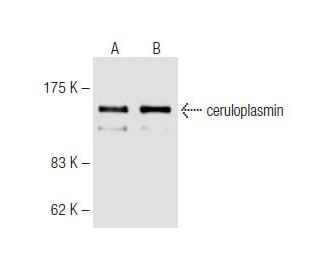

ceruloplasmin抗体(3B11): sc-69767
- ceruloplasmin抗体 3B11はマウスモノクローナルIgG1です。100 µlで提供
- 精製ceruloplasminに対するhuman起源の
- human由来のceruloplasmin WB, IP と ELISAでの検出にはお勧めします
- 現在、ceruloplasmin Antibody (3B11)に適した二次検出試薬の同定はまだ完了していません。この研究は進めています。

クイックリンク
関連項目
セルロプラスミン抗体 (3B11) はマウスモノクローナル IgG1 抗体で、ウェスタンブロッティング (WB)、免疫沈降 (IP)、酵素結合免疫吸着測定法 (ELISA) などのアプリケーションにより、ヒトサンプル中のセルロプラスミンを検出します。セルロプラスミンは肝細胞で合成される重要な青色血漿糖タンパク質で、体全体の銅輸送に重要な役割を担っています。フェルロキシダーゼとしても知られるセルロプラスミンは、遺伝子内三重 複合の結果生じた3つの相同ドメインから構成され、2つのスプライスバリアント、CP-1とCP-2 が存在し、特定の組織で発現の違いを示す。セルロプラスミンのmRNAはヒトの肝臓、マクロファージ、リンパ球で顕著であり、広範な生物学的意義を強調している。セルロプラスミンは1分子あたり6、7個の銅イオンと結合し、鉄代謝における重要なステップである、Fe(II)トランスフェリンを過酸化してFe(III)トランスフェリンを形成するのに必須である。セルロプラスミンの構造的完全性は、機能にとって極めて重要である。タンパク質分解によって分解された短型は、ある程度のフェロキシダーゼ活性を保持しているが、無傷の長型のみが、フェリチンへの鉄の担持を効果的に触媒することができる。セルロプラスミンはin vitroで低密度リポタンパク質の酸化を誘導するが、このプロセスはキレート可能な銅原子が1つ存在することに依存している。セルロプラスミンのグリコシルホスファチジルイノシトール(GPI)アンカー型変異体はセルトリ細胞に発現しており、生殖生物学における重要性の可能性を示唆している。銅と鉄の代謝における多面的な役割を持つセルロプラスミンは、人体における恒常性の維持に重要であり、抗セルロプラスミン抗体(3B11)は、これらの重要なプロセスを研究する研究者にとって非常に貴重なツールとなっている。
Alexa Fluor® はMolecular Probes Inc., OR., USAの商標です。
LI-COR® and Odyssey® はLI-COR Biosciencesの登録商標です。
ceruloplasmin抗体(3B11) 参考文献:
- 神経変性疾患におけるセルロプラスミン | Vassiliev, V., et al. 2005. Brain Res Brain Res Rev. 49: 633-40. PMID: 16269323
- セルロプラスミンとトランスフェリン間の鉄の移動。 | White, KN., et al. 2012. Biochim Biophys Acta. 1820: 411-6. PMID: 22040722
- セルロプラスミンの機能障害とパーキンソン病治療の可能性。 | Ayton, S., et al. 2013. Ann Neurol. 73: 554-9. PMID: 23424051
- セルロプラスミンはカイニン酸塩神経毒性に対する内因性保護物質である。 | Shin, EJ., et al. 2015. Free Radic Biol Med. 84: 355-372. PMID: 25843655
- 子癇前症におけるセルロプラスミンと抗酸化酵素。 | Nikolic, A., et al. 2016. J Matern Fetal Neonatal Med. 29: 2987-93. PMID: 26571141
- 機械化されたバイパラメトリックセルロプラスミンアッセイに向けて。 | Strzelak, K., et al. 2020. Talanta. 214: 120881. PMID: 32278433
- 甲状腺髄様癌におけるセルロプラスミンの状態。 | Razavi, F., et al. 2020. Iran J Public Health. 49: 209-210. PMID: 32309247
- 神経変性におけるセルロプラスミンの脱アミド化:機能の喪失から獲得へ。 | Zanardi, A. and Alessio, M. 2021. Int J Mol Sci. 22: PMID: 33440850
- 真菌病原体の銅源としてのセルロプラスミン。 | Besold, AN., et al. 2021. J Inorg Biochem. 219: 111424. PMID: 33765639
- 代謝疾患病態におけるセルロプラスミンの分子機能。 | Liu, Z., et al. 2022. Diabetes Metab Syndr Obes. 15: 695-711. PMID: 35264864
注文情報
| 製品名 | カタログ # | 単位 | 価格 | 数量 | お気に入り | |
ceruloplasmin 抗体 (3B11) | sc-69767 | 100 µl | $322.00 |