
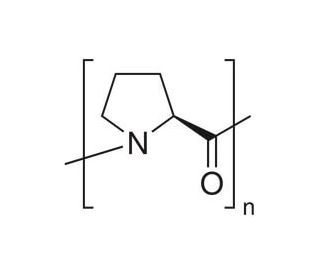

Estructura molecular de Poly-L-Proline, Número CAS: 25191-13-3
Poly-L-Proline (CAS 25191-13-3)
Número de CAS:
25191-13-3
Peso Molecular:
1,000-10,000
Fórmula Molecular:
(C5H7NO)n
Para Uso Exclusivo en Investigación. No está diseñado para uso en diagnosis o terapia.
* En el Certificado de Análisis específico de lote, puede encontrar información específica (como el contenido en agua).
ENLACES RÁPIDOS
Información sobre pedidos
Descripción
Información Técnica
Información de Seguridad
SDS & Certificado de Análisis
La poli-L-prolina es un péptido homopolimérico compuesto por el aminoácido prolina, unido mediante enlaces peptídicos en una secuencia lineal. Su capacidad para adoptar distintas conformaciones helicoidales lo convierte en un sistema modelo ideal para estudiar los principios del plegamiento de proteínas y las preferencias estructurales de los polipéptidos en diversas condiciones. Además, la hélice PPII, en particular, es de gran interés, ya que se encuentra a menudo en las regiones extendidas de proteínas que intervienen en procesos de señalización y reconocimiento.
Poly-L-Proline (CAS 25191-13-3) Referencias
- Estudios sobre la estructura de la poli-L-prolina en solución. | HARRINGTON, WF. and SELA, M. 1958. Biochim Biophys Acta. 27: 24-41. PMID: 13510248
- Interacciones entre flavan-3-oles y poli(L-prolina) estudiadas por calorimetría de valoración isotérmica: efecto de la estructura del tanino. | Poncet-Legrand, C., et al. 2007. J Agric Food Chem. 55: 9235-40. PMID: 17850090
- Propensidades de hélice de poli(L-prolina) II en generaciones de dendrigraft de poli(L-lisina) a partir de la actividad óptica Raman vibracional. | Johannessen, C., et al. 2009. Biomacromolecules. 10: 1662-4. PMID: 19499952
- Mutarotación impulsada por complejación en copolipéptidos en bloque de poli(L-prolina). | Gkikas, M., et al. 2015. Biomacromolecules. 16: 3686-93. PMID: 26461162
- Propiedades termorresponsivas y mecánicas de los geles de poli(L-prolina). | Gkikas, M., et al. 2016. Biomacromolecules. 17: 399-406. PMID: 26736072
- Medición de la elasticidad de las hélices de poli-l-prolina mediante espectroscopia de terahercios. | Ruggiero, MT., et al. 2016. Angew Chem Int Ed Engl. 55: 6877-81. PMID: 27121300
- La exposición al oxígeno durante la fermentación del vino tinto modifica la reactividad de los taninos con la poli-l-prolina. | Watrelot, AA., et al. 2019. Food Chem. 297: 124923. PMID: 31253258
- Las proteínas de unión a poli(L-prolina) de embriones de pollo son una profilina y una profilactina. | Tanaka, M. and Shibata, H. 1985. Eur J Biochem. 151: 291-7. PMID: 3928377
- Espectroscopia Raman de oligómeros de prolina y poli-L-prolina. | Rippon, WB., et al. 1970. J Am Chem Soc. 92: 7455-9. PMID: 5487551
- Una nueva prolil hidroxilasa que actúa sobre la poli-L-prolina, procedente de células cultivadas en suspensión de Vinca rosea. | Tanaka, M., et al. 1980. Biochim Biophys Acta. 616: 188-98. PMID: 6260150
- La prolil hidroxilasa vegetal reconoce la hélice poli(L-prolina) II. | Tanaka, M., et al. 1981. J Biol Chem. 256: 11397-400. PMID: 6271746
- Interacción de la profilina con la G-actina y la poli(L-prolina). | Perelroizen, I., et al. 1994. Biochemistry. 33: 8472-8. PMID: 8031780
- Aislamiento y caracterización de dos mutantes de la profilina I humana que no se unen a la poli(L-prolina). | Björkegren-Sjögren, C., et al. 1997. FEBS Lett. 418: 258-64. PMID: 9428724
Activador de:
Profilin-1.Información sobre pedidos
| Nombre del producto | Número de catálogo | UNIDAD | Precio | CANTIDAD | Favoritos | |
Poly-L-Proline, 50 mg | sc-296120 | 50 mg | $161.00 | |||
Poly-L-Proline, 100 mg | sc-296120A | 100 mg | $265.00 | |||
Poly-L-Proline, 500 mg | sc-296120B | 500 mg | $983.00 |