
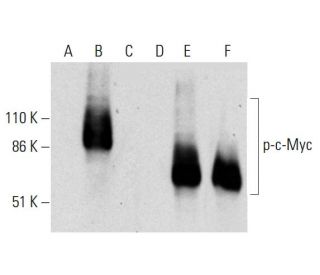


Anticorpo p-Myc (E-3): sc-377552
- p-Myc Antibody E-3 è un monoclonale di topo IgG2b κ, citato in 2 pubblicazioni, fornito in 200 µg/ml
- sollevato contro una breve sequenza aminoacidica contenente Thr 58 e Ser 62 fosforilati dualmente in c-Myc di origine human
- p-Myc Antibody (E-3) é raccomandato per il rilevamento di Thr 58 and Ser 62 dually phosphorylated c-Myc di origine broad species in WB, IP, IF, IHC(P) e ELISA
- p-Myc Antibody (E-3) é disponibile coniugato con agarose per IP; HRP per WB, IHC(P) ed ELISA; sia con phycoerythrin o FITC per IF, IHC(P) e FCM
- disponibile anche coniugato con Alexa Fluor® 488, Alexa Fluor® 546; Alexa Fluor® 594 o Alexa Fluor® 647 per IF, IHC (P) e FCM
- disponibile anche coniugato con Alexa Fluor® 680 o Alexa Fluor® 790 per WB (NIR), IF e FCM
- reagente TransCruz per utilizzo in ChIP (sc-377552 X, 200 µg/0.1 ml)
- Al momento non abbiamo ancora completato l'identificazione dei reagenti secondari di rilevazione preferiti per p-Myc l'anticorpo (E-3). Questo lavoro è in corso.

L'anticorpo p-Myc/c-Myc (E-3) è un anticorpo monoclonale di topo IgG2b κ p-c-Myc che rileva la c-Myc doppiamente fosforilata Thr 58 e Ser 62 di ampia origine mediante WB, IP, IF, IHC(P) ed ELISA. L'anticorpo p-Myc/c-Myc (E-3) è disponibile nella forma anticorpo anti-p-c-Myc non coniugato e in più forme coniugate di anticorpo anti-p-c-Myc, tra cui agarosio, HRP, PE, FITC e coniugati Alexa Fluor® multipli. Le proteine codificate c-Myc-, N-Myc- e L-Myc funzionano nella proliferazione cellulare, nella differenziazione e nelle malattie neoplastiche. L'amplificazione del gene c-Myc è stata riscontrata in diversi tipi di tumori umani, tra cui i carcinomi del polmone, della mammella e del colon. La presenza di tre motivi di sequenza nella terminazione COOH di c-Myc, tra cui lo zipper di leucina, l'elica-loop-elica e una regione basica, ha fornito le prime prove di una funzione di legame sequenza-specifica. Una proteina con regione basica a elica-loop-elica con motivo zip di leucina (bHLH-Zip), designata Max, si associa specificamente alle proteine c-Myc, N-Myc e L-Myc. Il complesso Myc-Max si lega al DNA in maniera sequenza-specifica in condizioni in cui né Max né Myc presentano un legame apprezzabile. Max può anche formare eterodimeri con almeno altre due proteine bHLH-Zip, Mad 1 e Mxi1, ed è stato dimostrato che i dimeri Mad 1-Max reprimono la trascrizione attraverso l'interazione con mSin3.
Alexa Fluor® è un marchio registrato di Molecular Probes Inc., OR., USA
LI-COR® e Odyssey® sono marchi registrati di LI-COR Biosciences
Anticorpo p-Myc (E-3) Riferimenti:
- Espressione di c-MYC fosforilata nella malattia di Alzheimer, nella malattia di Pick, nella paralisi sopranucleare progressiva e nella degenerazione corticobasale. | Ferrer, I., et al. 2001. Neuropathol Appl Neurobiol. 27: 343-51. PMID: 11679086
- L'attivazione trascrizionale dell'oncoproteina umana c-Myc nel lievito richiede l'interazione con Max. | Amati, B., et al. 1992. Nature. 359: 423-6. PMID: 1406955
- Le oncoproteine della famiglia Myc funzionano attraverso una via comune per trasformare le cellule normali in coltura: interferenza incrociata da parte di mutanti dominanti Max e trans. | Mukherjee, B., et al. 1992. Genes Dev. 6: 1480-92. PMID: 1644290
- Disassemblaggio del nucleo nella mitosi e nell'apoptosi: ridistribuzione dinamica di c-Myc fosforilata, fibrillarina e Ki-67. | Soldani, C., et al. 2006. Eur J Histochem. 50: 273-80. PMID: 17213035
- Effetto del paclitaxel sulla localizzazione intracellulare di c-Myc e P-c-Myc in linee cellulari di carcinoma prostatico. | Supino, R., et al. 2007. Ann N Y Acad Sci. 1095: 175-81. PMID: 17404030
- Max: proteina zipper a elica-loop-elica che forma un complesso di legame al DNA specifico per la sequenza con Myc. | Blackwood, EM. and Eisenman, RN. 1991. Science. 251: 1211-7. PMID: 2006410
- Aumento dell'espressione del gene N-myc nei tumori di Wilms. | Nisen, PD., et al. 1986. Cancer Res. 46: 6217-22. PMID: 2430692
- L-myc, un nuovo gene correlato a myc amplificato ed espresso nel carcinoma polmonare umano a piccole cellule. | Nau, MM., et al. Nature. 318: 69-73. PMID: 2997622
- Regioni cromosomiche a colorazione omogenea contengono copie amplificate di un oncogene cellulare abbondantemente espresso (c-myc) in cellule neuroendocrine maligne di un carcinoma del colon umano. | Alitalo, K., et al. 1983. Proc Natl Acad Sci U S A. 80: 1707-11. PMID: 6300869
- La repressione trascrizionale di Mad-Max è mediata dalla formazione di un complesso ternario con gli omologhi di mammifero del repressore Sin3 del lievito. | Ayer, DE., et al. 1995. Cell. 80: 767-76. PMID: 7889570
Informazioni ordini
| Nome del prodotto | Codice del prodotto | UNITÀ | Prezzo | Quantità | Preferiti | |
p-Myc Anticorpo (E-3) | sc-377552 | 200 µg/ml | $322.00 | |||
p-Myc Anticorpo (E-3) X | sc-377552 X | 200 µg/0.1 ml | $322.00 | |||
p-Myc Anticorpo (E-3) AC | sc-377552 AC | 500 µg/ml, 25% agarose | $424.00 | |||
p-Myc Anticorpo (E-3) HRP | sc-377552 HRP | 200 µg/ml | $322.00 | |||
p-Myc Anticorpo (E-3) FITC | sc-377552 FITC | 200 µg/ml | $336.00 | |||
p-Myc Anticorpo (E-3) PE | sc-377552 PE | 200 µg/ml | $349.00 | |||
p-Myc Anticorpo (E-3) Alexa Fluor® 488 | sc-377552 AF488 | 200 µg/ml | $364.00 | |||
p-Myc Anticorpo (E-3) Alexa Fluor® 546 | sc-377552 AF546 | 200 µg/ml | $364.00 | |||
p-Myc Anticorpo (E-3) Alexa Fluor® 594 | sc-377552 AF594 | 200 µg/ml | $364.00 | |||
p-Myc Anticorpo (E-3) Alexa Fluor® 647 | sc-377552 AF647 | 200 µg/ml | $364.00 | |||
p-Myc Anticorpo (E-3) Alexa Fluor® 680 | sc-377552 AF680 | 200 µg/ml | $364.00 | |||
p-Myc Anticorpo (E-3) Alexa Fluor® 790 | sc-377552 AF790 | 200 µg/ml | $364.00 | |||
p-Myc (E-3) peptide neutralizzante | sc-377552 P | 100 µg/0.5 ml | $69.00 |