
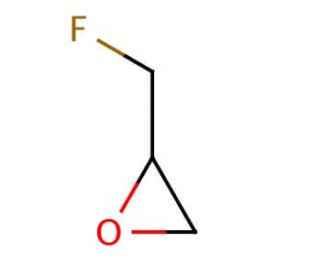

Epifluorohydrin (CAS 503-09-3)
ENLACES RÁPIDOS
Epifluorohydrin (EFH) es un compuesto orgánico versátil y reactivo (VOC) ampliamente empleado en diversas aplicaciones, especialmente en la producción de polímeros y plásticos. Es un intermediario químico esencial que desempeña un papel crucial en la síntesis de una variedad de compuestos fluorados, incluyendo polímeros y plásticos. Este líquido incoloro posee un olor penetrante y muestra una ligera solubilidad en agua. Sin embargo, se requiere precaución, ya que la alta reactividad de EFH puede causar irritación en los ojos y la piel. La investigación científica ha adoptado EFH para una diversa gama de aplicaciones. Ha contribuido a la síntesis de polímeros y plásticos fluorados utilizados en celdas de combustible, implantes médicos y otros sectores. Además, EFH ha sido fundamental en la producción de agroquímicos, apoyando avances en el control de plagas. La reactividad de EFH se extiende a una amplia gama de compuestos, incluyendo el agua. Al entrar en contacto con el agua, EFH forma el ion hidrofluoruro, que sirve como precursor para la generación de nuevos compuestos. Además, al interactuar con varios compuestos orgánicos como alcoholes y aminas, EFH participa fácilmente en la formación de nuevos compuestos. Es importante destacar que la reactividad de EFH no se limita a compuestos orgánicos, también puede interactuar con sustancias inorgánicas, como metales, lo que lleva a la creación de compuestos adicionales.
Epifluorohydrin (CAS 503-09-3) Referencias
- Caracterización de una nueva vía de degradación de la epiclorhidrina por células enteras de la cepa py2 de xanthobacter. | Small, FJ., et al. 1995. Appl Environ Microbiol. 61: 1507-13. PMID: 16535000
- Aminólisis en fase acuosa: enfoque para el análisis de epóxidos en agua. | Khan, SJ., et al. 2006. Anal Chem. 78: 2608-16. PMID: 16615770
- Una epóxido hidrolasa adaptada al frío de una bacteria marina estricta, Sphingophyxis alaskensis. | Kang, JH., et al. 2008. J Microbiol Biotechnol. 18: 1445-52. PMID: 18756107
- Unión enantioselectiva de isómeros estructurales de epóxido por un complejo quiral de vanadil-saleno: una investigación EPR pulsada, cw-ENDOR y DFT. | Murphy, DM., et al. 2009. Phys Chem Chem Phys. 11: 6757-69. PMID: 19639150
- Espectros infrarrojos e isomería rotacional de la epifluorohidrina y otros derivados del óxido de propeno | S.W. Charles, G.I.L. Jones, N.L. Owen. 1974. Journal of Molecular Structure. 20: 83-93.
- Espectros Raman, estabilidad conformacional, parámetros estructurales, asignación vibracional y cálculos ab initio para epifluorohidrina | H.M Badawi 1, Goran Baranovic 1, P Groner, Mengzhang Zhen, J.R Durig. 1994. Spectrochimica Acta Part A: Molecular Spectroscopy. 50: 383-397.
- Estabilidad conformacional de la epifluorohidrina a partir de espectros FT-IR dependientes de la temperatura de soluciones de xenón y cálculos ab initio | T.K. Gounev, Seung Won Hur, J.R. Durig. 1998. Journal of Molecular Structure. 449: 241-253.
- Espectro rotacional de la epifluorohidrina medido mediante espectroscopia de microondas por transformada de Fourier de pulso chirpeado | Gordon G. Brown, Brian C. Dian, Kevin O. Douglass, Scott M. Geyer, Brooks H. Pate. 2006. Journal of Molecular Spectroscopy. 238: 200-212.
- Transformaciones de la epifluorohidrina catalizadas por la halohidrina deshalogenasa | Maja Majerić Elenkov a, Mirjana Čičak a, Ana Smolko b, Anamarija Knežević a. 2018. Maja Majerić Elenkov a, Mirjana Čičak a, Ana Smolko b, Anamarija Knežević a. 59: 406-408.
Información sobre pedidos
| Nombre del producto | Número de catálogo | UNIDAD | Precio | CANTIDAD | Favoritos | |
Epifluorohydrin, 1 g | sc-257415 | 1 g | $198.00 |