
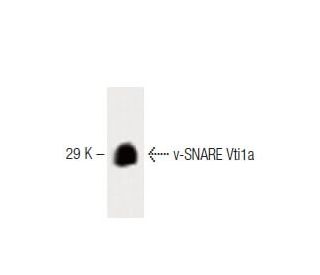
v-SNARE Vti1a Antibody (45): sc-136117
- v-SNARE Vti1a Antibody (45) is a mouse monoclonal IgG1 κ v-SNARE Vti1a antibody, cited in 1 publications, provided at 200 µg/ml
- raised against amino acids 114-217 of v-SNARE Vti1a of mouse origin
- recommended for detection of v-SNARE Vti1a of mouse, rat, human and canine origin by WB, IP and IF
- m-IgGκ BP-HRP is the preferred secondary detection reagent for v-SNARE Vti1a Antibody (45) for WB applications. This reagent is now offered in a bundle with v-SNARE Vti1a Antibody (45) (see ordering information below). For additional m-IgGκ BP conjugates see our complete list of Mouse IgG Binding Proteins.

QUICK LINKS
v-SNARE Vti1a Antibody (45) is a mouse monoclonal IgG1 kappa light chain antibody that detects v-SNARE Vti1a of mouse, rat, human, and canine origin by western blotting (WB), immunoprecipitation (IP), and immunofluorescence (IF). anti-v-SNARE Vti1a antibody (45) is available as a non-conjugated format. v-SNARE Vti1a, also known as vesicle transport v-SNARE protein Vti1-like 2, plays a crucial role in vesicular transport, essential for eukaryotic cell survival. v-SNARE Vti1a participates in SNARE complex formation, interacting with various t-SNARE proteins, including syntaxin 7, syntaxin 8, and syntaxin 10, to facilitate vesicle fusion with target membranes. Proper functioning of v-SNARE Vti1a is vital for trafficking important proteins such as Glut4, which enables glucose uptake in adipocytes. v-SNARE Vti1a and Glut4 levels decrease following insulin treatment, and v-SNARE Vti1a mRNA knockdown inhibits adiponectin secretion and insulin-stimulated deoxyglucose uptake, indicating a significant regulatory role in metabolic processes.
Alexa Fluor® is a trademark of Molecular Probes Inc., OR., USA
LI-COR® and Odyssey® are registered trademarks of LI-COR Biosciences
v-SNARE Vti1a Antibody (45) References:
- The SNAREs vti1a and vti1b have distinct localization and SNARE complex partners. | Kreykenbohm, V., et al. 2002. Eur J Cell Biol. 81: 273-80. PMID: 12067063
- Syntaxin 7, syntaxin 8, Vti1 and VAMP7 (vesicle-associated membrane protein 7) form an active SNARE complex for early macropinocytic compartment fusion in Dictyostelium discoideum. | Bogdanovic, A., et al. 2002. Biochem J. 368: 29-39. PMID: 12175335
- The v-SNARE Vti1a regulates insulin-stimulated glucose transport and Acrp30 secretion in 3T3-L1 adipocytes. | Bose, A., et al. 2005. J Biol Chem. 280: 36946-51. PMID: 16131485
- SNAREs in neurons--beyond synaptic vesicle exocytosis (Review). | Wang, Y. and Tang, BL. 2006. Mol Membr Biol. 23: 377-84. PMID: 17060155
- A syntaxin 10-SNARE complex distinguishes two distinct transport routes from endosomes to the trans-Golgi in human cells. | Ganley, IG., et al. 2008. J Cell Biol. 180: 159-72. PMID: 18195106
- A VAMP7/Vti1a SNARE complex distinguishes a non-conventional traffic route to the cell surface used by KChIP1 and Kv4 potassium channels. | Flowerdew, SE. and Burgoyne, RD. 2009. Biochem J. 418: 529-40. PMID: 19138172
- Endosomal fusion upon SNARE knockdown is maintained by residual SNARE activity and enhanced docking. | Bethani, I., et al. 2009. Traffic. 10: 1543-59. PMID: 19624487
- A human homolog can functionally replace the yeast vesicle-associated SNARE Vti1p in two vesicle transport pathways. | Fischer von Mollard, G. and Stevens, TH. 1998. J Biol Chem. 273: 2624-30. PMID: 9446565
Ordering Information
| Product Name | Catalog # | UNIT | Price | Qty | FAVORITES | |
v-SNARE Vti1a Antibody (45) | sc-136117 | 200 µg/ml | $322.00 | |||
v-SNARE Vti1a Antibody (45): m-IgGκ BP-HRP Bundle | sc-521329 | 200 µg Ab, 40 µg BP | $361.00 |