
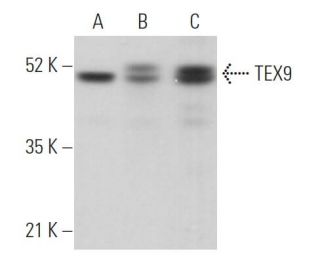


TEX9 Antikörper (D-2): sc-398987
- TEX9 Antikörper D-2 ist ein monoklonales IgG1 (kappa light chain) TEX9 Antikörper in einer Menge von 200 µg/ml
- spezifisch für ein Epitop, welches zwischen den Aminosäuren 287-309 innerhalb einer internen Region von TEX9 aus der Spezies human liegt
- TEX9 Antikörper (D-2) ist empfohlen für die Detektion von TEX9 aus der Spezies mouse, rat und human per WB, IP, IF und ELISA
- Anti-TEX9 Antikörper (D-2) ist erhältlich als Konjugat mit Agarose für IP; HRP für WB, IHC(P) und ELISA; und entweder mit Phycoerythrin oder FITC für IF, IHC(P) und FCM
- auch erhältlich als Konjugat mit Alexa Fluor® 488, Alexa Fluor® 546, Alexa Fluor® 594 oder Alexa Fluor® 647 für IF, IHC(P) und FCM
- auch erhältlich als Konjugat mit Alexa Fluor® 680 oder Alexa Fluor® 790 für WB (NIR), IF und FCM
- m-IgG Fc BP-HRP, 1 BP-HRP">m-IgG1 BP-HRP und m-IgGκ BP-HRP sind die bevorzugten sekundären Nachweisreagenzien für TEX9 Antikörper (D-2) für WB-Anwendungen. Diese Reagenzien werden jetzt in Bündeln mit TEX9 Antikörper (D-2) angeboten(siehe Bestellinformationen unten).

Der TEX9-Antikörper (D-2) ist ein monoklonaler Maus IgG1 κ TEX9-Antikörper (auch als TEX9-Antikörper bezeichnet), der das TEX9-Protein von Maus-, Ratte- und menschlicher Herkunft mittels WB, IP, IF und ELISA detektiert. Der TEX9-Antikörper (D-2) ist sowohl in nicht konjugierter Form als auch in mehreren konjugierten Formen des TEX9-Antikörpers, einschließlich Agarose, HRP, PE, FITC und mehreren Alexa Fluor®-Konjugaten, erhältlich. TEX9 (Testis-expressed Sequence 9 Protein) ist ein Protein mit 391 Aminosäuren. Das Gen, das TEX9 codiert, enthält ungefähr 80.448 Basen und ist auf dem menschlichen Chromosom 15q21.3 kartiert. Mit etwa 106 Millionen Basenpaaren und der Kodierung von mehr als 700 Genen macht Chromosom 15 etwa 3% des menschlichen Genoms aus. Angelman- und Prader-Willi-Syndrome sind mit einem Funktionsverlust oder einer Deletion von Genen im Bereich 15q11-q13 verbunden. Im Fall des Angelman-Syndroms ist dieser Verlust auf die Inaktivität des mütterlich codierten UBE3A-Gens im Gehirn durch entweder chromosomale Deletion oder Mutation zurückzuführen. Bei Fällen des Prader-Willi-Syndroms besteht eine partielle oder vollständige Deletion dieses Bereichs von der paternen Kopie des Chromosoms 15. Das Tay-Sachs-Syndrom ist eine tödliche Störung, die mit Mutationen des HEXA-Gens in Verbindung gebracht wird, das vom Chromosom 15 codiert wird. Das Marfan-Syndrom ist mit dem Chromosom 15 durch das FBN1-Gen verbunden.
Alexa Fluor® ist ein Markenzeichen von Molecular Probes Inc., OR., USA
LI-COR® und Odyssey® sind Markenzeichen von LI-COR Biosciences
TEX9 Antikörper (D-2) Literaturhinweise:
- Psychotische Erkrankungen bei Menschen mit Prader-Willi-Syndrom aufgrund einer mütterlichen uniparentalen Disomie des Chromosoms 15. | Boer, H., et al. 2002. Lancet. 359: 135-6. PMID: 11809260
- Diagnose und Behandlung von Patienten mit Marfan-Syndrom. | Midla, GS. 2008. JAAPA. 21: 21-5. PMID: 18323350
- Angelman-Syndrom: Derzeitige Erkenntnisse und Forschungsperspektiven. | Dan, B. 2009. Epilepsia. 50: 2331-9. PMID: 19874386
- Das C15orf2-Gen in der Region des Prader-Willi-Syndroms unterliegt der genomischen Prägung und der positiven Selektion. | Wawrzik, M., et al. 2010. Neurogenetics. 11: 153-61. PMID: 20020165
- Tyrosinämie Typ 1 und Angelman-Syndrom aufgrund einer väterlichen uniparentalen Isodisomie 15. | Ferrer-Bolufer, I., et al. 2009. J Inherit Metab Dis. 32 Suppl 1: S349-53. PMID: 20033293
- Das Angelman-Syndrom und das Prader-Willi-Syndrom haben eine gemeinsame Deletion auf Chromosom 15, unterscheiden sich aber im elterlichen Ursprung der Deletion. | Knoll, JH., et al. 1989. Am J Med Genet. 32: 285-90. PMID: 2564739
- Neuropsychiatrische Aspekte der Tay-Sachs-Krankheit im Erwachsenenalter: zwei Fallberichte mit mehreren neuen Erkenntnissen. | Hurowitz, GI., et al. 1993. J Neuropsychiatry Clin Neurosci. 5: 30-6. PMID: 8428133
Bestellinformation
| Produkt | Katalog # | EINHEIT | Preis | ANZAHL | Favoriten | |
TEX9 Antikörper (D-2) | sc-398987 | 200 µg/ml | $322.00 | |||
TEX9 (D-2): m-IgG Fc BP-HRP Bundle | sc-530999 | 200 µg Ab; 10 µg BP | $361.00 | |||
TEX9 (D-2): m-IgGκ BP-HRP Bundle | sc-524567 | 200 µg Ab, 40 µg BP | $361.00 | |||
TEX9 (D-2): m-IgG1 BP-HRP Bundle | sc-544355 | 200 µg Ab; 20 µg BP | $361.00 | |||
TEX9 Antikörper (D-2) AC | sc-398987 AC | 500 µg/ml, 25% agarose | $424.00 | |||
TEX9 Antikörper (D-2) HRP | sc-398987 HRP | 200 µg/ml | $322.00 | |||
TEX9 Antikörper (D-2) FITC | sc-398987 FITC | 200 µg/ml | $336.00 | |||
TEX9 Antikörper (D-2) PE | sc-398987 PE | 200 µg/ml | $349.00 | |||
TEX9 Antikörper (D-2) Alexa Fluor® 488 | sc-398987 AF488 | 200 µg/ml | $364.00 | |||
TEX9 Antikörper (D-2) Alexa Fluor® 546 | sc-398987 AF546 | 200 µg/ml | $364.00 | |||
TEX9 Antikörper (D-2) Alexa Fluor® 594 | sc-398987 AF594 | 200 µg/ml | $364.00 | |||
TEX9 Antikörper (D-2) Alexa Fluor® 647 | sc-398987 AF647 | 200 µg/ml | $364.00 | |||
TEX9 Antikörper (D-2) Alexa Fluor® 680 | sc-398987 AF680 | 200 µg/ml | $364.00 | |||
TEX9 Antikörper (D-2) Alexa Fluor® 790 | sc-398987 AF790 | 200 µg/ml | $364.00 | |||
TEX9 (D-2) Neutralizing Peptid | sc-398987 P | 100 µg/0.5 ml | $69.00 |