
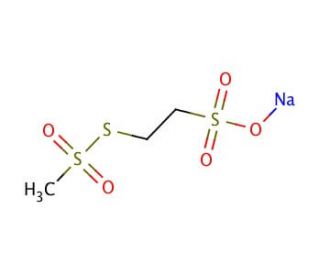

Sodium (2-Sulfonatoethyl)methanethiosulfonate 的分子结构, CAS编号: 184644-83-5
Sodium (2-Sulfonatoethyl)methanethiosulfonate (CAS 184644-83-5)
查看产品引用文献(1)
备用名:
Sodium (2-Sulfonatoethyl)methanethiosulfonate is also known as MTSES.
应用:
Sodium (2-Sulfonatoethyl)methanethiosulfonate is a methanethiosulfonate, a sulfhydryl-reactive probe for GABAA receptor channels.
CAS号码:
184644-83-5
分子量:
242.26
分子式:
C3H7O5S3•Na
仅供科研使用。不可用于诊断或治疗。
* 参考分析证明 大量特定数据 (包括水 含量).
快捷链接
订购信息
产品相关文献索引
描述
技术信息
安全信息
安全技术说明书和分析证明书
(2-磺酸基乙基)甲硫代磺酸钠是 GABAA 受体通道的探针。作为一种甲硫磺酸盐,(2-磺酸基乙基)甲硫磺酸钠具有巯基反应性,可用于研究蛋白质上的半胱氨酸残基。(2-磺酸基乙基)甲硫代磺酸钠能与硫醇发生特异而快速的反应,形成混合二硫化物。(2-磺酸基乙基)甲硫代磺酸钠可探测 GABAA 受体通道的 ACh 受体通道和乳糖渗透酶的结构。(2-磺酸基乙基)甲硫代磺酸钠在探测与膜相关的原生蛋白质(如通道和转运体)时尤其有效。
Sodium (2-Sulfonatoethyl)methanethiosulfonate (CAS 184644-83-5) 参考文献
1. Dunten, R.L., et al.: Biochem., 32, 3139 (1993),2. Yang, N. et al.: Neuron, 16, 113 (1996),
3. Holmgren, M., et al: Neuropharmacology, 35, 797 (1996),
4. Chahine, M., et al.: Biochem. Bio. Res. Commun., 233, 606 (1997),
5. Ehrlich, B.E., et al.: J. Gen. Physiol., 109, 255 (1997),
6. Lang, R.J., Harvey, J.R., and Mulholland, E.L.Sodium (2-sulfonatoethyl) methanethiosulfonate prevents S-nitroso-L-cysteine activation of Ca2+-activated K+ (BKCa) channels in myocytes of the guinea-pig taenia caeca. Br. J. Pharmacol. 139(6), 1153-1163 (2003).
7. Li, R.A., Tsushima, R.G., Kallen, R.G., et al.Pore residues critical for μ-CTX binding to rat skeletal muscle Na+ channels revealed by cysteine mutagenesis. Biophys. J. 73(4), 1874-1884 (1997).
8. Guan, L., and Kaback, H.R.Site-directed alkylation of cysteine to test solvent accessibility of membrane proteins. Nature Protocols 2(8), 2012-2017 (2007).
9. Engh, A.M., and Maduke, M.Cysteine accessibility in ClC-0 supports conservation of the ClC intracellular vestibule. Journal of General Physiology 125(6), 601-617 (2014).
10. Liu, X., Alexander, C., Serrano, J., et al.Variable reactivity of an engineered cysteine at position 338 in cystic fibrosis transmembrane conductance regulator reflects different chemical states of the thiol. The Journal of Biological Chemisty 281(12), 8275-8285 (2006).
订购信息
| 产品名称 | 产品编号 | 规格 | 价格 | 数量 | 收藏夹 | |
Sodium (2-Sulfonatoethyl)methanethiosulfonate, 250 mg | sc-212933 | 250 mg | $370.00 |