
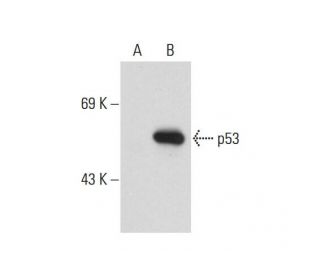


p53 Anticuerpo (2Q375): sc-71820
- p53 Anticuerpo 2Q375 es un monoclonal de ratón IgG1, ver las 11 publicaciones, proporcionado como 200 µg/ml
- criado contra p53-proteína de fusión beta galactosidasa
- recomendado para detectarp53 de mouse, rat y human origen, mediante WB, IP, IF y IHC(P)
- Ver p53 (DO-1): sc-126 para p53 anticuerpos conjugados, incluyendo AC, HRP, FITC, PE, Alexa Fluor® 488, 594, 647, 680 y 790.
- Actualmente, aún no hemos completado la identificación de los reactivos de detección secundaria preferidos para p53 Anticuerpo (2Q375). Este trabajo está en progreso.

ENLACES RÁPIDOS
VER TAMBIÉN ....
El anticuerpo p53 (2Q375), criado contra la proteína de fusión p53-beta galactosidasa, es un anticuerpo monoclonal de ratón altamente específico para la detección de p53 en todas las especies, incluidos el ratón, la rata y el ser humano. Recomendado para su uso en western blot, inmunoprecipitación, inmunofluorescencia e inmunohistoquímica en secciones incluidas en parafina, este anticuerpo permite a los investigadores estudiar la expresión y la función de p53 en diversos ensayos experimentales. Dado que el p53 es un supresor tumoral crítico, el anticuerpo anti-p53 (2Q375) es útil para la investigación del cáncer y los estudios celulares. Codificado por el gen TP53, el p53 desempeña un papel esencial en el mantenimiento de la estabilidad genómica regulando procesos celulares como la reparación del ADN, la detención del ciclo celular, la apoptosis y la senescencia. En respuesta al estrés celular o a daños en el ADN, el p53 detiene el ciclo celular en puntos de control clave (G1/S o G2/M), dando tiempo a la reparación. Si el daño es irreparable, el p53 desencadena la apoptosis, eliminando las células genéticamente comprometidas y previniendo la formación de tumores. Las modificaciones postraduccionales, como la fosforilación en residuos de serina (Ser6, Ser15, Ser46) por quinasas como ATM, ATR y Chk2, aumentan la estabilidad de p53 y su capacidad de unión al ADN. La acetilación por proteínas como p300 y CBP estabiliza aún más el p53, mientras que la desacetilación por SIRT1 afina su actividad en respuesta al envejecimiento celular y al daño del ADN. Los anticuerpos dirigidos contra p53, como el anticuerpo monoclonal p53 (2Q375), son esenciales para estudiar la expresión, las modificaciones postraduccionales y la localización de p53 en células y tejidos. Los anticuerpos monoclonales p53 de Santa Cruz Biotechnology permiten a los investigadores estudiar cómo las mutaciones de p53, frecuentes en más de la mitad de los cánceres, alteran su función supresora de tumores. Comprender el papel de p53 en los mecanismos de la enfermedad es fundamental para desarrollar terapias dirigidas que restauren la actividad de p53 o compensen su pérdida en las células tumorales. La utilización del anticuerpo anti-p53 (2Q375) ofrece una comprensión más profunda de las vías moleculares reguladas por p53 y de cómo su disfunción contribuye al cáncer. Este conocimiento es fundamental para avanzar en las estrategias de diagnóstico dirigidas a modular la vía p53 en el tratamiento del cáncer.
Alexa Fluor® es una marca registrada de Molecular Probes Inc., OR., USA
REIVEW LI-COR® y Odyssey® son marcas registradas de LI-COR Biosciences.
p53 Anticuerpo (2Q375) Referencias:
- El óxido nítrico nitra residuos de tirosina de la proteína p53 supresora de tumores en células MCF-7. | Chazotte-Aubert, L., et al. 2000. Biochem Biophys Res Commun. 267: 609-13. PMID: 10631110
- Supresor tumoral p53: regulación y función. | Somasundaram, K. 2000. Front Biosci. 5: D424-37. PMID: 10762600
- Expresión de p53 en el ojo murino normal. | Pokroy, R., et al. 2002. Invest Ophthalmol Vis Sci. 43: 1736-41. PMID: 12036973
- La acumulación de proteína p53 en pterigión no se acompaña de mutación del gen TP53. | Schneider, BG., et al. 2006. Exp Eye Res. 82: 91-8. PMID: 16005868
- Pérdida de heterocigosidad del gen p53 y expresión desregulada de su ARNm y proteína en tumores cerebrales humanos. | Rohini, K., et al. 2007. Mol Cell Biochem. 300: 101-11. PMID: 17180249
- Inversión del cambio conformacional del bucle L1 inducido por la unión al ADN en una proteína p53 humana modificada por ingeniería. | Emamzadah, S., et al. 2014. J Mol Biol. 426: 936-44. PMID: 24374182
- Efecto de una mutación de inserción de dos bases del gen TP53 sobre la expresión de la proteína p53 en células de sarcoma histiocítico canino. | Asada, H., et al. 2019. Am J Vet Res. 80: 680-688. PMID: 31246118
- Los cribajes paralelos CRISPR-Cas9 aclaran el impacto de p53 en el rendimiento de los cribajes. | Bowden, AR., et al. 2020. Elife. 9: PMID: 32441252
- El análisis de los mutantes p53 más representativos derivados de tumores revela que los cambios en la conformación de la proteína no se correlacionan con la pérdida de transactivación o la inhibición de la proliferación celular. | Ory, K., et al. 1994. EMBO J. 13: 3496-504. PMID: 8062826
- Una proteína celular activa la unión al ADN específica de la secuencia de p53 mediante la interacción con la región central conservada. | Srinivasan, R. and Maxwell, SA. 1996. Oncogene. 12: 193-200. PMID: 8552392
Información sobre pedidos
| Nombre del producto | Número de catálogo | UNIDAD | Precio | CANTIDAD | Favoritos | |
p53 Anticuerpo (2Q375) | sc-71820 | 200 µg/ml | $322.00 |