
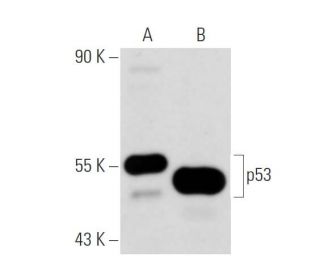
Anticorps p53 (2B2.71): sc-71819
- L'anticorps p53 2B2.71 est un monoclonal IgG2b de souris, cité dans 11 publications, fourni en 200 µg/ml
- dirigé contre les acides aminés 370-378 de p53 d'origine mouse
- recommandé pour la détection de a conserved, denaturation-resistant determinant of the p53 protein d'origine mouse, rat et human par WB, IP, IF et FCM
- disponible conjugué soit à la phycoérythrine soit à la FITC pour IF, IHC(P) et FCM
- Voir p53 (DO-1): sc-126 pour d'autres anticorps conjugués p53, dont AC, HRP, FITC, PE, Alexa Fluor® 488, 594, 647, 680 et 790.
- 2b BP-HRP">m-IgG2b BP-HRP est le réactif de détection secondaire préféré pour l'anticorps p53 (2B2.71) pour les applications WB. Ce réactif est désormais proposé en association avec l'anticorps p53 (2B2.71)(voir les informations relatives à la commande ci-dessous).

ACCÈS RAPIDE AUX LIENS
VOIR ÉGALEMENT...
L'anticorps p53 (2B2.71) est un anticorps monoclonal de souris développé en tant qu'isotype IgG2b et dirigé contre les acides aminés 370-378 de la protéine p53 d'origine murine. Il s'agit d'un anticorps très efficace pour détecter un épitope conservé et résistant à la dénaturation dans la protéine p53 de la souris, du rat et de l'homme. L'anticorps monoclonal anti-p53 (2B2.71) est polyvalent et fonctionne dans de multiples applications, y compris le western blotting, l'immunoprécipitation, l'immunofluorescence et la cytométrie de flux. L'anticorps anti-p53 (2B2.71) est disponible conjugué avec de la phycoérythrine ou de l'isothiocyanate de fluorescéine, ce qui le rend idéal pour l'immunofluorescence, l'immunohistochimie sur des tissus inclus en paraffine et la cytométrie de flux. La protéine p53 joue un rôle essentiel dans la prévention du cancer et le maintien de la stabilité du génome. Codée par le gène TP53 sur le chromosome 17p13.1, p53 joue le rôle de suppresseur de tumeur en régulant l'arrêt du cycle cellulaire, la réparation de l'ADN, l'apoptose et la sénescence. Les domaines structurels de p53, notamment le domaine de transactivation (TAD), le domaine de liaison à l'ADN (DBD), le domaine d'oligomérisation (OD) et le domaine de régulation, sont essentiels à ces processus, les modifications post-traductionnelles contrôlant en outre son activité en cas de stress cellulaire. Les mutations du gène TP53 sont parmi les plus fréquentes dans les cancers humains, puisqu'elles sont présentes dans plus de la moitié des tumeurs. Ces mutations compromettent la capacité de p53 à réguler la croissance cellulaire, ce qui entraîne une prolifération incontrôlée et la formation de tumeurs. Le statut de mutation de TP53 est un marqueur diagnostique et pronostique clé pour de nombreux cancers, y compris le cancer du sein, du poumon et le cancer colorectal. Les thérapies émergentes se concentrent sur la réactivation de la fonction p53 par le biais de la thérapie génique, de petites molécules et d'immunothérapies, ce qui constitue une avancée prometteuse dans le traitement du cancer. Le ciblage de la protéine p53 pour la thérapie du cancer offre un potentiel énorme, et la compréhension de ses mutations et de ses réseaux de régulation reste essentielle pour développer de nouveaux traitements contre le cancer.
Alexa Fluor® est une marque déposée de Molecular Probes Inc., OR., USA
LI-COR® et Odyssey® sont marques déposées de LI-COR Biosciences
Anticorps p53 (2B2.71) Références:
- Implications cliniques de la protéine p53 : effet sur le pronostic, la progression tumorale et la réponse à la chimiothérapie. | Peller, S. 1998. Semin Cancer Biol. 8: 379-87. PMID: 10101803
- Statut de p53 dans les cellules cytotrophoblastiques du premier trimestre. | Cohen, M., et al. 2007. Mol Hum Reprod. 13: 111-6. PMID: 17158854
- Liaison à l'ADN et accumulation de p53 dans les lignées cellulaires du cancer du sein et lien avec la phosphorylation de la sérine 15. | Ray, D., et al. 2012. Cancer Biol Ther. 13: 848-57. PMID: 22785213
- Les substitutions G245C et G245D dans la poche de liaison au Zn(2+) de la protéine p53 entraînent des différences de flexibilité conformationnelle du domaine de liaison à l'ADN. | Pintus, SS., et al. 2013. J Biomol Struct Dyn. 31: 78-86. PMID: 22803791
- Les agrégats de p53 pénètrent dans les cellules et induisent la coagrégation de p53 intracellulaire. | Forget, KJ., et al. 2013. PLoS One. 8: e69242. PMID: 23844254
- Commentaire sur la « Participation de la protéine p53 à la réponse cellulaire aux dommages causés par l'ADN ». | Kastan, MB. 2016. Cancer Res. 76: 3663-5. PMID: 27371738
- Surexpression de la protéine p53 dans les carcinomes épidermoïdes de la tête et du cou sans mutations génétiques apparentes. | Xu, L., et al. 1994. Diagn Mol Pathol. 3: 83-92. PMID: 8061893
- Expression de la protéine p53 dans la maladie de Hodgkin. | Lauritzen, AF., et al. 1993. APMIS. 101: 689-94. PMID: 8240788
- Accumulation de la protéine p53 dans les lésions précancéreuses de l'œsophage humain : un biomarqueur précoce possible pour la carcinogenèse. | Wang, LD., et al. 1993. Cancer Res. 53: 1783-7. PMID: 8467496
- Signification de l'expression de la protéine p53 dans le modèle de croissance du carcinome épidermoïde de l'œsophage. | Nozoe, T., et al. 1998. Oncol Rep. 5: 1119-23. PMID: 9683820
Informations pour la commande
| Nom du produit | Ref. Catalogue | COND. | Prix HT | QTÉ | Favoris | |
Anticorps p53 (2B2.71) | sc-71819 | 200 µg/ml | $322.00 | |||
p53 (2B2.71): m-IgG2b BP-HRP Kit | sc-548453 | 200 µg Ab; 10 µg BP | $361.00 | |||
Anticorps p53 (2B2.71) FITC | sc-71819 FITC | 200 µg/ml | $336.00 | |||
Anticorps p53 (2B2.71) PE | sc-71819 PE | 200 µg/ml | $349.00 |