
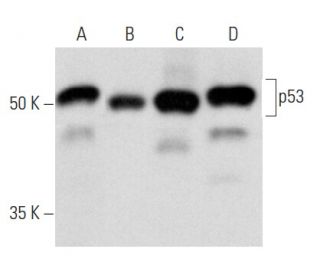
Anticorps p53 (2B2.68): sc-71817
- L'Anticorps p53 (2B2.68) est un monoclonal de souris IgG2a κ, cité dans 23 publications, fourni en 200 µg/ml
- N-terminal cartographie des épitopes entre les résidus d'acides aminés 11-25 de p53 d'origine human.
- recommandé pour la détection de wild type and mutant p53 under denaturing and non-denaturing conditions d'origine human par WB, IP, IF, IHC(P) et FCM
- disponible conjugué à l'agarose pour de l'IP; à l'HRP pour du WB, IHC(P) et ELISA; et soit à la phycoérythrine soit à la fluorescéine pour de l'IF, IHC(P) et FCM.
- aussi disponible conjugué au TRITC pour IF, IHC(P) et FCM
- Réactif TransCruz pour une utilisation en Gel Supershift et ChIP (sc-71817 X, 200 µg/0.1 ml)
- Voir p53 (DO-1): sc-126 pour d'autres anticorps conjugués p53, dont AC, HRP, FITC, PE, Alexa Fluor® 488, 594, 647, 680 et 790.
- m-IgG Fc BP-HRP et 2a BP-HRP">m-IgG2a BP-HRP sont les réactifs de détection secondaire préférés pour p53 Antibody (2B2.68) pour les applications WB et IHC(P). Ces réactifs sont désormais proposés en lots avec p53 Antibody (2B2.68)(voir les informations de commande ci-dessous).

ACCÈS RAPIDE AUX LIENS
VOIR ÉGALEMENT...
L'anticorps p53 (2B2.68) est un anticorps monoclonal de souris IgG2a à chaîne légère kappa qui se lie à un épitope N-terminal entre les résidus d'acides aminés 11-25 de la protéine p53 humaine, détectant à la fois les formes sauvages et mutantes. L'anticorps monoclonal p53 (2B2.68) est disponible pour de multiples applications telles que l'immunoprécipitation, le western blotting, l'immunohistochimie, l'ELISA, la cytométrie de flux, et l'immunofluorescence. La protéine p53 est un suppresseur de tumeur crucial qui joue un rôle clé dans le maintien de l'intégrité de l'ADN. Codée par le gène TP53, p53 agit comme un facteur de transcription, régulant des processus cellulaires essentiels tels que la réparation de l'ADN, l'arrêt du cycle cellulaire, l'apoptose et la sénescence cellulaire. Lorsque les cellules subissent un stress ou des dommages à l'ADN, p53 s'active et arrête le cycle cellulaire à des points de contrôle critiques (G1/S ou G2/M) pour permettre la réparation de l'ADN. Si les dommages sont irréparables, p53 déclenche l'apoptose, empêchant ainsi la propagation de cellules génétiquement anormales et réduisant le risque de développement de tumeurs. La régulation de p53 s'effectue par des modifications post-traductionnelles telles que la phosphorylation et l'acétylation. La phosphorylation des résidus sérine tels que Ser6, Ser15 et Ser46, par des kinases telles que ATM, ATR et Chk2, renforce la stabilité de p53 et sa capacité à se lier à l'ADN. L'acétylation par p300 et CBP stabilise davantage p53, tandis que la désacétylation par des protéines comme SIRT1 ajuste sa fonction au cours du vieillissement cellulaire ou en réponse aux dommages causés à l'ADN. Dans la recherche sur le cancer, les anticorps ciblant p53 permettent d'étudier son rôle dans la maladie. En utilisant l'anticorps monoclonal p53 (2B2.68), les chercheurs peuvent évaluer l'expression de p53, les modifications post-traductionnelles et sa localisation dans les tissus. Étant donné que les mutations de p53 sont fréquentes dans divers cancers, ces études sont essentielles pour comprendre les mécanismes de suppression des tumeurs et développer des stratégies thérapeutiques ciblées dans la voie de p53.
Alexa Fluor® est une marque déposée de Molecular Probes Inc., OR., USA
LI-COR® et Odyssey® sont marques déposées de LI-COR Biosciences
Anticorps p53 (2B2.68) Références:
- La phosphorylation stoechiométrique de p53 humain à Ser315 stimule la transcription dépendante de p53. | Blaydes, JP., et al. 2001. J Biol Chem. 276: 4699-708. PMID: 11078726
- Stimulation de l'autophagie par le gène cible de p53, la Sestrine2. | Maiuri, MC., et al. 2009. Cell Cycle. 8: 1571-6. PMID: 19377293
- Fonctions de p53 dans le métabolisme et l'invasion. | Vousden, KH. 2009. Biochem Soc Trans. 37: 511-7. PMID: 19442244
- Transactivation par des mutants de p53 dépendant de la température dans des cellules de levure et des cellules humaines. | Slovackova, J., et al. 2010. Cell Cycle. 9: 2141-8. PMID: 20505364
- Le glissement de p53 le long de l'ADN peut être modulé par son état oligomérique et par les liaisons croisées entre ses domaines constitutifs. | Khazanov, N. and Levy, Y. 2011. J Mol Biol. 408: 335-55. PMID: 21338609
- Différences morphofonctionnelles des micronoyaux dans les cultures de cellules tumorales humaines p53-positives et p53-négatives. | Sutyagina, OI. and Kisurina-Evgenieva, OP. 2019. Bull Exp Biol Med. 167: 813-817. PMID: 31656006
- Nanoamplificateur d'effecteur d'espèces réactives d'oxygène déclenché par ultrasons pour une thérapie combinée améliorée des tumeurs p53 mutantes. | Wang, X., et al. 2022. Colloids Surf B Biointerfaces. 215: 112489. PMID: 35395477
- Des domaines superposés sur la protéine p53 régulent ses fonctions d'activation et de répression transcriptionnelles. | Subler, MA., et al. 1994. Oncogene. 9: 1351-9. PMID: 8152795
- Le gène suppresseur de tumeur TP53 et la cancérogenèse humaine. | Basset-Séguin, N., et al. 1993. Exp Dermatol. 2: 99-105. PMID: 8162331
- La localisation intracellulaire de la protéine suppresseur de tumeur p53 dans les cellules irradiées aux rayons gamma est régulée par le cycle cellulaire et déterminée par le noyau. | Komarova, EA., et al. 1997. Cancer Res. 57: 5217-20. PMID: 9393737
Informations pour la commande
| Nom du produit | Ref. Catalogue | COND. | Prix HT | QTÉ | Favoris | |
Anticorps p53 (2B2.68) | sc-71817 | 200 µg/ml | $322.00 | |||
p53 (2B2.68): m-IgG Fc BP-HRP Kit | sc-539414 | 200 µg Ab; 10 µg BP | $361.00 | |||
p53 (2B2.68): m-IgG2a BP-HRP Kit | sc-546699 | 200 µg Ab; 10 µg BP | $361.00 | |||
Anticorps p53 (2B2.68) AC | sc-71817 AC | 500 µg/ml, 25% agarose | $424.00 | |||
Anticorps p53 (2B2.68) FITC | sc-71817 FITC | 200 µg/ml | $336.00 | |||
Anticorps p53 (2B2.68) HRP | sc-71817 HRP | 200 µg/ml | $322.00 | |||
Anticorps p53 (2B2.68) PE | sc-71817 PE | 200 µg/ml | $349.00 | |||
Anticorps p53 (2B2.68) TRITC | sc-71817 TRITC | 200 µg/ml | $326.00 | |||
Anticorps p53 (2B2.68) X | sc-71817 X | 200 µg/0.1 ml | $322.00 |